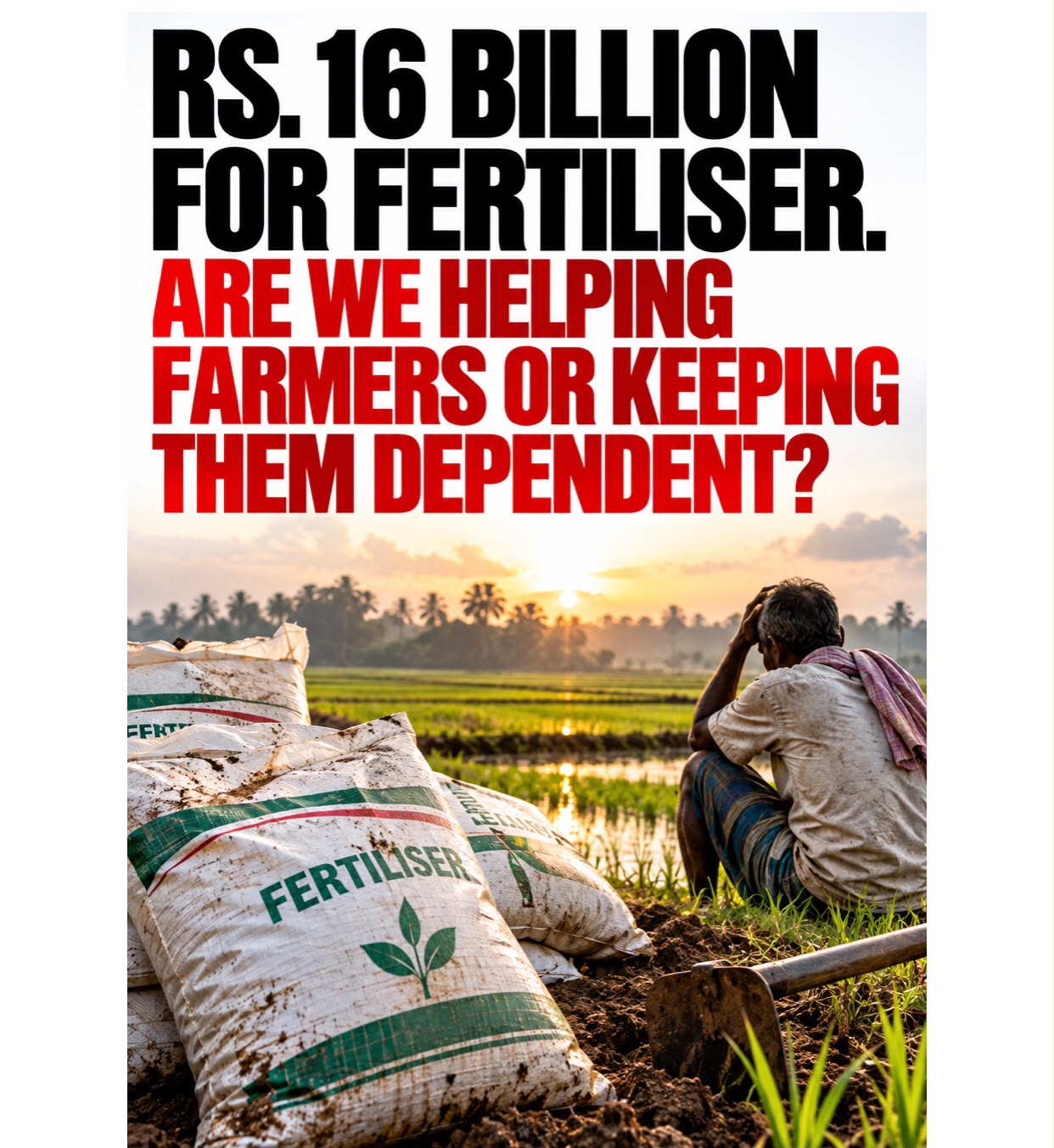
The Government has approved Rs. 16 billion for fertiliser assistance during the 2026/27 Maha season, providing Rs. 30,000 per hectare up to a maximum of two hectares per farmer. The support will reduce cultivation costs, but it does not answer the larger question of whether Sri Lanka’s agricultural economy allows farmers to earn a sustainable living.
Sri Lanka has once again committed substantial public funds to supporting agricultural production, with the Cabinet approving an estimated Rs. 16 billion for fertiliser subsidies during the forthcoming Maha season. Eligible farmers cultivating paddy and other approved field crops in paddy lands will receive Rs. 30,000 per hectare, subject to a maximum of two hectares. The decision recognises the importance of protecting domestic food production while reducing the immediate financial burden on cultivators.
There is little difficulty understanding why such assistance is necessary. Agricultural input costs remain significant, cultivation involves considerable uncertainty and many farming households operate with limited financial reserves. A subsidy can make the difference between proceeding with cultivation and abandoning a season because the initial expenditure is unaffordable.
Submit Your Press Release
Get your company news, announcements, launches, appointments and events in front of a wider audience.


But the announcement also exposes a weakness in Sri Lanka’s agricultural debate. Governments routinely explain how much money is being allocated to farmers, while providing considerably less information about whether the economic structure within which those farmers operate is sustainable. The amount distributed becomes the headline, although the farmer’s actual income should be the central concern.
The question is straightforward. What does it cost to produce a kilogram of paddy in Sri Lanka, and how much profit does the farmer retain after paying for seed, fertiliser, machinery, labour, irrigation, transport and financing?
There is no single answer applicable to every cultivator. Production costs vary according to land conditions, yields, access to irrigation, mechanisation and the extent to which family labour can substitute for paid workers. Yet these differences are frequently obscured when agricultural policy is presented through uniform subsidy rates and national production targets.
A farmer may receive fertiliser assistance and still suffer a financial loss if rainfall is inadequate, yields decline or the selling price fails to cover total expenditure. The subsidy reduces one component of production costs without eliminating the commercial risks associated with cultivation. Those risks become particularly serious when farmers borrow money before planting and must repay it regardless of the eventual harvest.
The distinction between the price of paddy and the retail price of rice is another area requiring greater transparency. Processing, storage, transport, finance and distribution all involve legitimate expenditure, but the public rarely receives a sufficiently clear explanation of how the final consumer price is divided across the supply chain. Farmers complain about inadequate returns while consumers complain about expensive rice, leaving both groups dissatisfied with an arrangement whose underlying economics remain poorly understood.
Sri Lanka has repeatedly experienced disputes involving paddy purchasing prices, milling capacity, stock availability and rice imports. These controversies are often reduced to political arguments about whether the Government has intervened sufficiently or whether private market participants are exercising excessive influence. The more useful question concerns whether competition, information and market infrastructure are adequate to protect both producers and consumers.
Farmers require access to credible production-cost information and reliable market signals before committing themselves to a cultivation season. Consumers require confidence that retail prices reflect genuine costs rather than avoidable inefficiencies or distortions. The Government, meanwhile, needs dependable information about national stocks, expected harvests and consumption requirements if it is to make sensible decisions about procurement and imports.
The subsidy programme should also be assessed against the Government’s broader agricultural objectives. If public expenditure is intended to improve food security, the authorities should be able to demonstrate how that expenditure affects cultivation, productivity, farmer income and domestic supply. Simply announcing that Rs. 16 billion has been allocated does not establish whether the money is producing the best possible result.
There is a further complication this season. Water shortages and uncertain rainfall are affecting agricultural communities, raising questions about the relationship between fertiliser assistance and actual cultivation prospects. Where irrigation supplies are inadequate, farmers may be unable to realise the intended benefit of subsidised inputs.
Agricultural policy must therefore be coordinated across fertiliser distribution, irrigation management, crop planning, research and financial protection. Supporting one input while leaving other essential conditions uncertain risks producing disappointing results despite considerable public expenditure.
None of this means fertiliser subsidies should be abolished. Agricultural support is a legitimate policy instrument, and many countries recognise the public interest in maintaining domestic food production. But assistance should strengthen the productive capacity and financial resilience of farmers rather than become a permanent substitute for improvements in the agricultural economy.
There is a difference between helping a farmer become more prosperous and helping him remain sufficiently solvent to begin another season of uncertainty. Sri Lanka should be aiming for the former, even while acknowledging that immediate assistance remains necessary for many households.
The Government deserves recognition for allocating resources to cultivation, but public expenditure must be judged by outcomes rather than announcements. Farmers should be earning sustainable returns, consumers should have access to reasonably priced food and the country should be improving its ability to withstand disruptions to agricultural production.
Be that as it may, a nation cannot claim to have solved the problems of its farmers merely because it helps pay for their fertiliser. The real achievement will come when growing the country’s staple food provides a dependable livelihood rather than another season of financial anxiety.