The President Is Not an Appeal Court
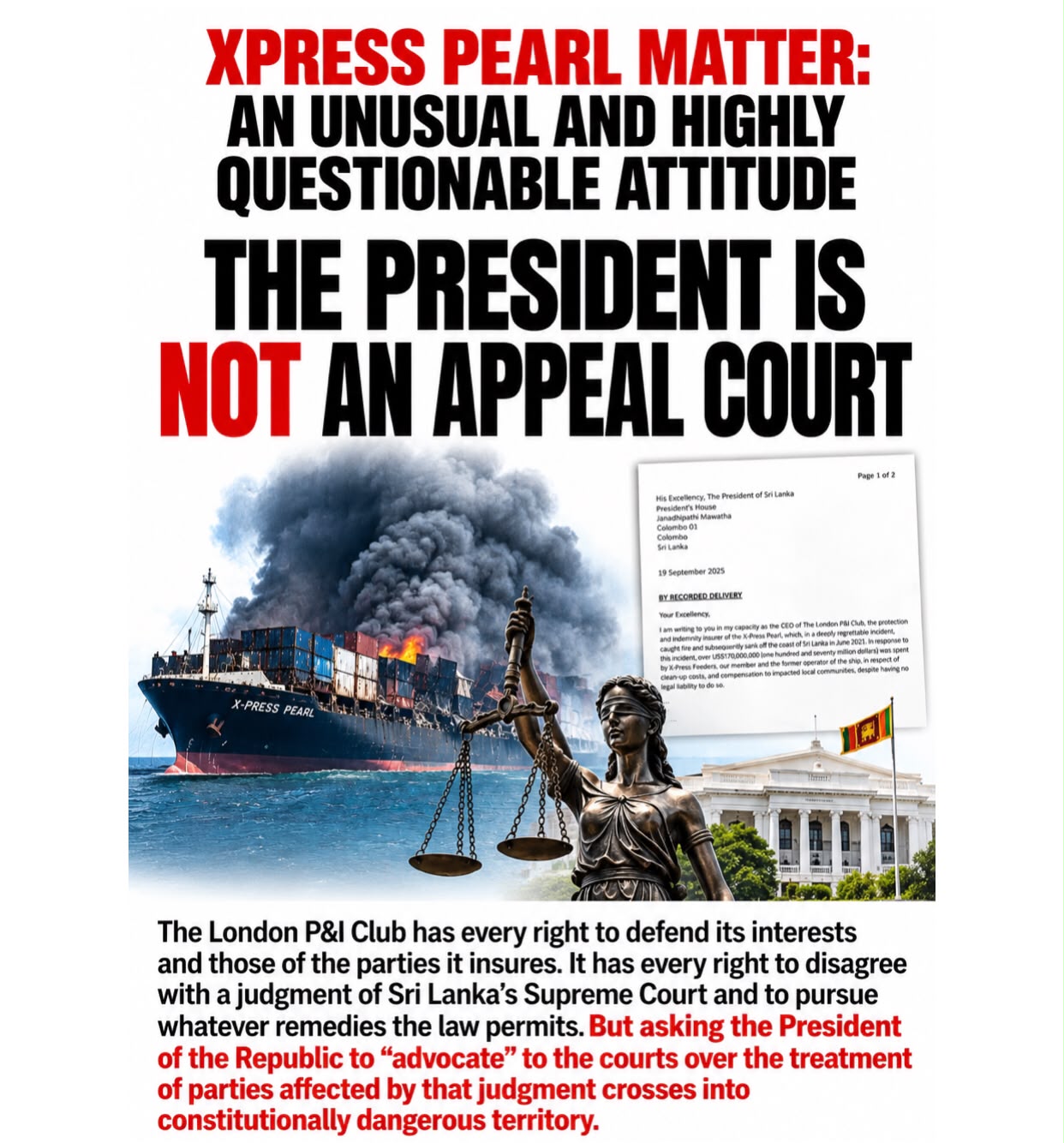
The London P&I Club has every right to defend its interests and those of the parties it insures. It has every right to disagree with a judgment of Sri Lanka’s Supreme Court and to pursue whatever remedies the law permits. But asking the President of the Republic to “advocate” to the courts over the treatment of parties affected by that judgment crosses into constitutionally dangerous territory.
NEWSLINE has obtained a letter dated September 19, 2025, addressed to the President of Sri Lanka by James Bean, Chief Executive Officer of The London P&I Club, the protection and indemnity insurer connected to the X-Press Pearl.
Submit Your Press Release
Get your company news, announcements, launches, appointments and events in front of a wider audience.


The letter deserves very careful reading, not because writing to the President is itself improper, but because of what the President is being asked to do.
The Club tells the President that it is concerned that the vessel’s agents and master could face detention under contempt proceedings and then makes this request:
“we would humbly ask that you seek to advocate that the courts make alternative arrangements”
Those words matter.
Sri Lanka is a constitutional democracy. The President heads the executive. He is not the head of the judiciary, he does not sit above the Supreme Court and he possesses no general constitutional authority to tell a court how it should deal with a party appearing before it.
Indeed, the constitutional architecture points firmly in the opposite direction.
Article 3 places sovereignty in the People. Article 4 then distributes the exercise of that sovereignty among the institutions of the State. Executive power is exercised by the President. Judicial power is exercised through the courts, tribunals and institutions established or recognised by the Constitution or law. The separation is fundamental to Sri Lanka’s constitutional structure.
There is an even more direct provision.
Article 111C provides that persons entrusted with judicial powers or functions shall exercise those functions without being subject to direction or other interference from anyone except where lawful supervision exists within the judicial structure. The constitutional purpose could hardly be clearer: judicial decision-making is to remain independent of outside influence.
That makes the request to the President extraordinary.
The London P&I Club actually acknowledges in its letter the President’s “responsibility for ensuring the constitutional separation of powers” and, almost in the same breath, asks him to “advocate” that the courts adopt particular arrangements for the agents and master.
Those two propositions sit very uneasily together.
What precisely would presidential “advocacy” to a court mean?
Would the President write to the judiciary? Would an official from the Presidential Secretariat convey the Club’s concerns? Would the executive publicly express a preference as to whether particular persons should be detained? Would someone communicate with a court concerning proceedings before it?
NEWSLINE is not suggesting that any of those things happened. We have no basis for saying that they did.
The point is that they should not happen.
The President’s constitutional duty is not to secure a particular judicial outcome for a shipowner, insurer, agent, captain, environmental organisation, fisherman, government department or anyone else. His obligation is to respect the institutional independence that permits a court to reach its own decision according to law.
The Club makes a second request that raises a different but related issue. It asks the President to appoint a high-level representative to facilitate discussions between the Government, The London P&I Club, X-Press Feeders and others concerning how the situation might be resolved.
Dialogue with the executive is not inherently objectionable. Governments negotiate. Governments discuss settlements. State agencies communicate with litigants. The Attorney-General represents the State. There may be entirely legitimate space for discussions about matters falling within executive authority.
But there must be a bright line.
A government may discuss what the Government can lawfully do. It cannot negotiate away a judgment of the Supreme Court. Nor should an executive dialogue become an indirect mechanism for achieving what must properly be sought from a court through legal process.
The distinction is crucial because this is not simply an insurance dispute.
In its X-Press Pearl judgment, the Supreme Court ordered an initial US$1 billion payment after considering the environmental damage and losses suffered by fishing communities and others. The Court held the relevant X-Press Pearl parties jointly and severally accountable under the Polluter Pays Principle.
The Club and the parties concerned are perfectly entitled to challenge conclusions available for challenge, seek clarification, make applications, advance arguments concerning proportionality, liberty and flight risk, and invoke every procedural protection available under Sri Lankan law.
That is what courts are for.
If detention is unnecessary or disproportionate, make that argument before the court. If a travel restriction is sufficient, ask the court for one. If circumstances have changed, place the evidence before the judges. If there is a lawful route to vary an order, use it.
The answer cannot be to ask the President to advocate the preferred outcome.
There is another sentence in the letter worth examining. The Club asks the President to “reaffirm the commitment to a presumption of innocence and fair trials” for individuals facing legal jeopardy.
As a statement of principle, there can be little argument with it. Presumption of innocence and fair process are essential components of justice.
But those protections ultimately belong in the courtroom. They are secured by law and by independent judges, not by presidential intervention in individual cases.
This distinction protects everybody, including the London P&I Club.
Today an insurer may want a President to advocate restraint by a court. Tomorrow a government might want a President to advocate severity. Once executive intervention in individual judicial proceedings is accepted when the desired result appears reasonable, the constitutional barrier protecting the judiciary has already been weakened.
That is precisely why separation of powers matters most when the stakes are high.
NEWSLINE therefore makes no allegation that the London P&I Club has committed an offence by sending this letter. Nor do we question its right to represent its members vigorously. International insurers facing exposure of this magnitude would be expected to explore every lawful avenue available to them.
But diplomatic access and constitutional authority are not the same thing.
The doors of the Presidential Secretariat may properly be open to international businesses wishing to discuss government policy. The doors of Sri Lanka’s courts are open to litigants seeking judicial relief.
The two doors must not become interchangeable.
President Anura Kumara Dissanayake can listen. His Government can engage on matters lawfully within executive competence. Officials can meet representatives of the international maritime and insurance industries. The State can consider lawful proposals placed before it.
What the President cannot properly become is an intermediary between a litigant and the judges deciding that litigant’s fate.
The Supreme Court is not a department of the Presidential Secretariat. And the President of Sri Lanka is not a court of appeal.
Be that as it may, NewsLine has these questions for the President and which we are writing to him directly. In essence the questions are as follows:
1. Has our President written (by way of disclosure) to the parliament and the judiciary about him being written to by London P and I club, where the President is party to the ongoing fundamental rights application on the issue of X-Press pearl?
2. Did the President meet UK Chancellor Reeves or did she contact the government on any of these matters? if so Why did the President not brief the parliament and the Supreme Court about it ? or if he did confirmation thereof.
3. Did the Cabinet headed by the President take any decisions through the cabinet regarding the X-Press Pearl after 30 April 2026? If so please table those decisions before Parliament.