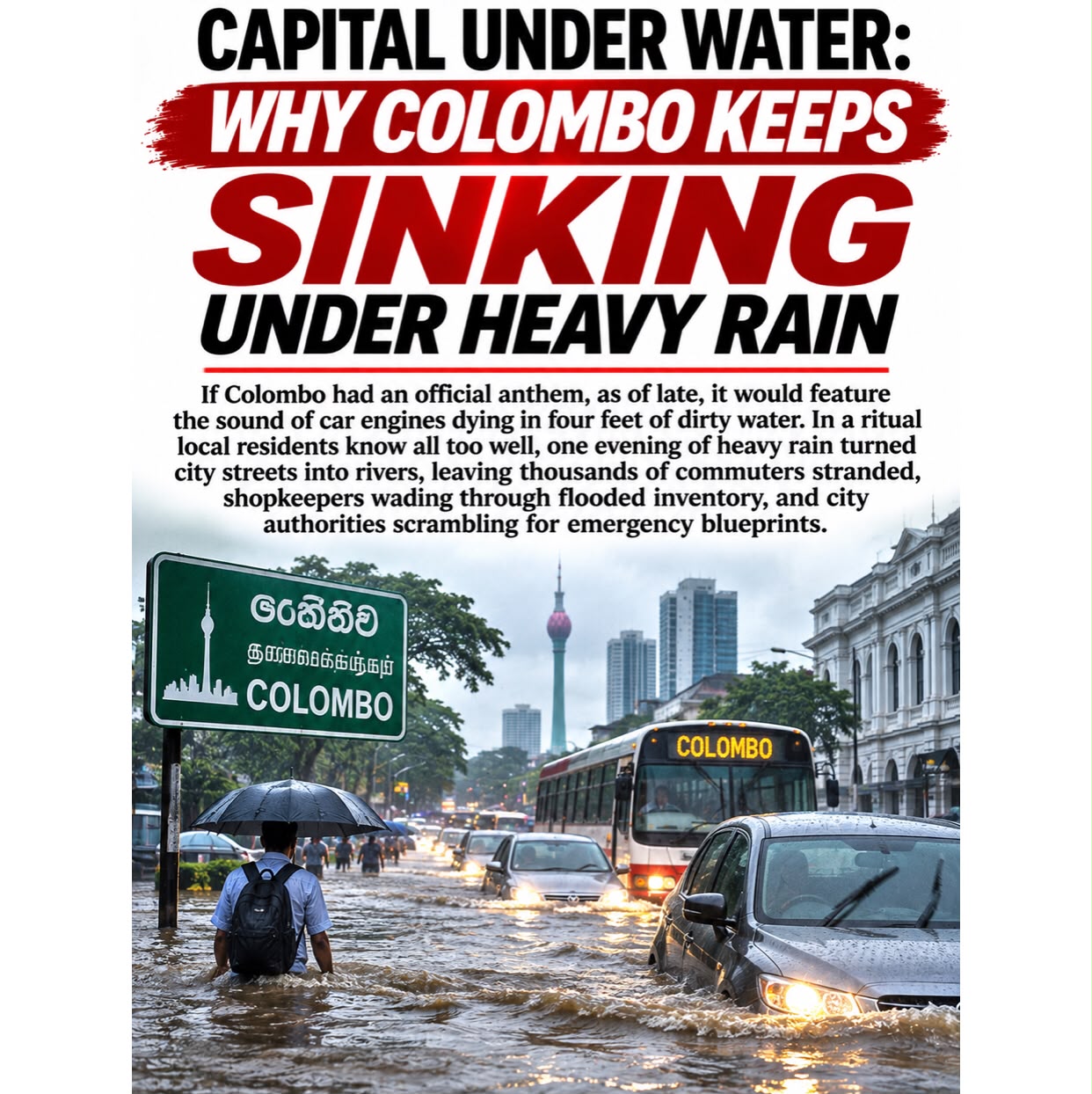
If Colombo had an official anthem, as of late, it would feature the sound of car engines dying in four feet of dirty water. In a ritual local residents know all too well, one evening of heavy rain turned city streets into rivers, leaving thousands of commuters stranded, shopkeepers wading through flooded inventory, and city authorities scrambling for emergency blueprints.
The immediate trigger for the chaos was a cloudburst that delivered 129 millimetres of rainfall over the span of a few hours on Friday evening. To grasp the sheer volume of water involved, that equates to roughly 129 litres dumping onto every single square metre of the city in one burst. Multiply that across Colombo’s urban footprint, and the skies effectively dropped billions of litres of water onto a concrete jungle with nowhere left for it to soak in.
The physical reality on the ground was immediate and unforgiving. Major thoroughfares across the city transformed into slow-moving canals. Luxury SUVs and modest three-wheelers found themselves equally neutralized, lining flooded roadsides with hazards flashing in unison. Office workers in the central business district found their evening commutes extended into midnight endurance tests, while low-lying residential areas saw water creeping over doorsteps, destroying electrical appliances, and submerging ground-floor living quarters.
Submit Your Press Release
Get your company news, announcements, launches, appointments and events in front of a wider audience.


As has become custom, the online public reaction moved far faster than the city’s drainage capacity. Social media platforms erupted into a frenzy of commentary, satirical memes, and outrage. Citizens posted videos of submerged intersections alongside sharp critiques of decades of urban planning. Commentators pointed out the absurd predictability of the crisis, noting that every monsoon cycle brings the exact same headlines, the exact same political promises, and the exact same floating plastic containers bobbing down main avenues. The digital debate quickly turned political, with critics demanding accountability while defenders argued that no municipal system could absorb a sudden, tropical deluge of such density.
The government and municipal authorities responded by convening emergency high-level discussions featuring Colombo Mayor Vraie Cally Balthazaar, senior officials from the Urban Development Authority, the Road Development Authority, the Sri Lanka Land Development Corporation, and the Tri-Forces. The official diagnostic, however, produced a stark mathematical paradox: Colombo’s existing drainage infrastructure was historically designed to handle roughly 30 millimetres of rainfall per hour. When hit with more than four times that capacity in a single window, the system simply suffered total structural indigestion.
Beyond the raw volume of rain, officials highlighted a familiar triad of systemic failures: decades of unauthorized constructions built directly over natural drainage corridors, indiscriminate plastic waste disposal clogging vital canal networks, and the relentless conversion of natural wetland buffers into concrete real estate. In response, the government announced a special task force to push forward short-, medium-, and long-term remedies. Proposed measures include launching immediate dredging operations, enforcing legal penalties for illegal dumping, and drawing up plans to demolish unauthorized structures blocking major waterways.
Yet for the average Colombo resident who has watched successive administrations announce identical task forces after every major downpour, official assurances are greeted with skepticism. The fundamental way forward requires more than post-disaster committees and temporary water pumps. It demands a serious, long-term overhaul of urban engineering: restoring depleted wetland basins, modernizing subterranean storm-water channels, and enforcing strict zoning laws without political interference. Until those structural changes take precedence over short-term band-aids, the citizens of Colombo can rest assured of one predictable certainty: the next time the clouds burst, they will once again be reaching for their rubber boots.