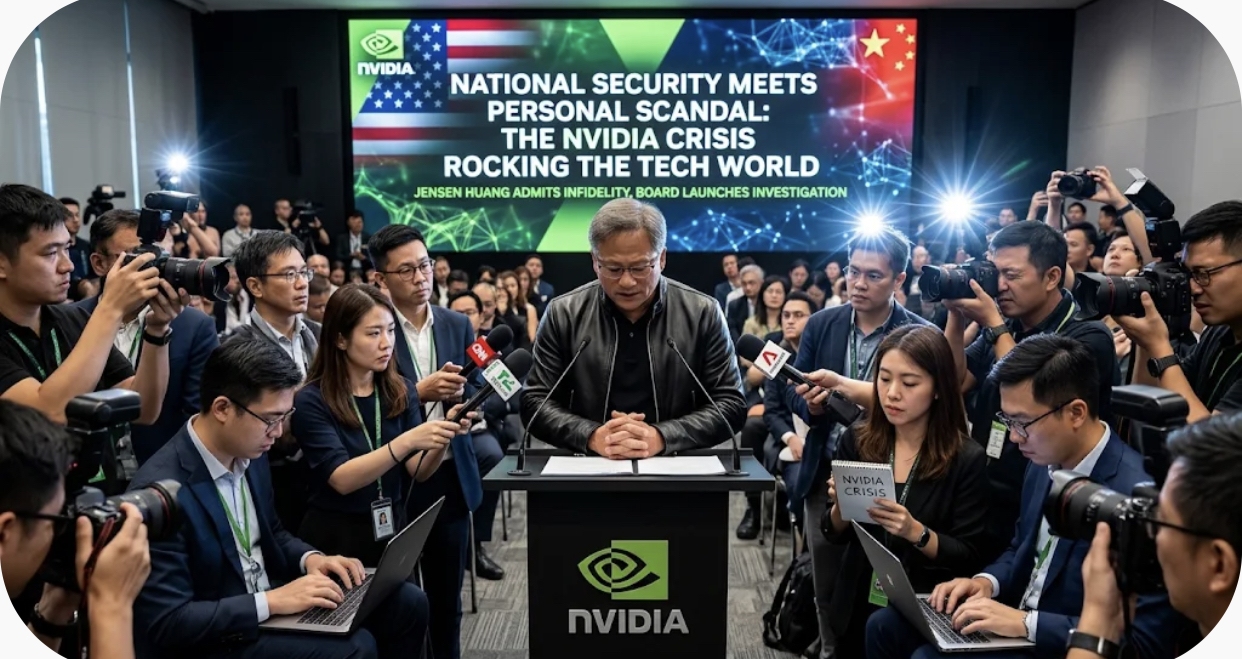
What began as whispers of an executive scandal has rapidly escalated into a full-blown corporate and geopolitical crisis for Nvidia, the world’s most powerful semiconductor giant. Over the weekend, Nvidia co-founder and Chief Executive Officer Jensen Huang sent shockwaves through Silicon Valley and Wall Street by issuing a public admission of infidelity, alongside an announcement that Nvidia’s board of directors has launched an independent investigation into his conduct.
The controversy erupted after revelations surfaced linking Huang to a close relationship with Alice Huang, also known as Huang Le, a Singapore-based businesswoman and executive connected to data center firm Megaspeed. According to reports, United States intelligence agencies had been tracking her over suspicions of acting on behalf of China’s Ministry of State Security. Intelligence surveillance allegedly uncovered communications between Alice Huang and Jensen Huang, raising immediate alarms inside Washington regarding foreign espionage targeting critical American artificial intelligence technology.
In an internal email sent to Nvidia staff on November 8, Huang addressed the situation directly. “I was unfaithful to my wife. My actions hurt her and our children,” Huang wrote, offering an unreserved apology to his family, staff, and shareholders while acknowledging that he had broken their trust. Addressing the espionage allegations, Huang added, “Regarding the national security concerns raised in news reports, the Nvidia Board of Directors has initiated an independent investigation. I support the investigation and will cooperate fully. I love our country and our company. I am committed to protecting Nvidia and supporting America’s national security.”
Submit Your Press Release
Get your company news, announcements, launches, appointments and events in front of a wider audience.


Nvidia’s board of directors promptly formed a special committee of independent directors, backed by outside legal counsel, to review the matter. In an official statement, the board emphasized that national security remains paramount, though it noted that there is currently no evidence to suggest that company trade secrets or US national security were compromised. Despite the ongoing inquiry, the board expressed continued operational confidence in Huang, who remains in his role as chief executive.
Wall Street’s reaction was swift and punishing. Nvidia stock fell by over four percent in overnight and pre-market trading, wiping out nearly 190 billion dollars in market value. The plunge reflects deep investor anxiety over potential executive disruption at a company that serves as the backbone for the global artificial intelligence boom, supplying critical chips to tech giants such as OpenAI and Meta. The broader tech sector also experienced tremors, amplified by growing market sensitivity around data center capital expenditures and legislative shifts in Washington.
Political fallout in Washington has intensified the pressure. Leaders of the House of Representatives written to Huang, requesting his appearance before congressional committees to explain Nvidia’s security protocols and address potential foreign intelligence risks. Lawmakers have emphasized that the intersection of advanced microchip architecture and foreign espionage poses a direct threat to American technological dominance.
Public and industry reaction has ranged from disbelief to intense skepticism. While some analysts view the board’s swift investigation as a necessary governance step to protect shareholder interests, market observers warn that an extended probe, combined with congressional hearings, could severely dent investor confidence. For a company that has driven the global tech rally, Nvidia now finds itself navigating a high-stakes crossroad where personal accountability, corporate governance, and international geopolitics collide.