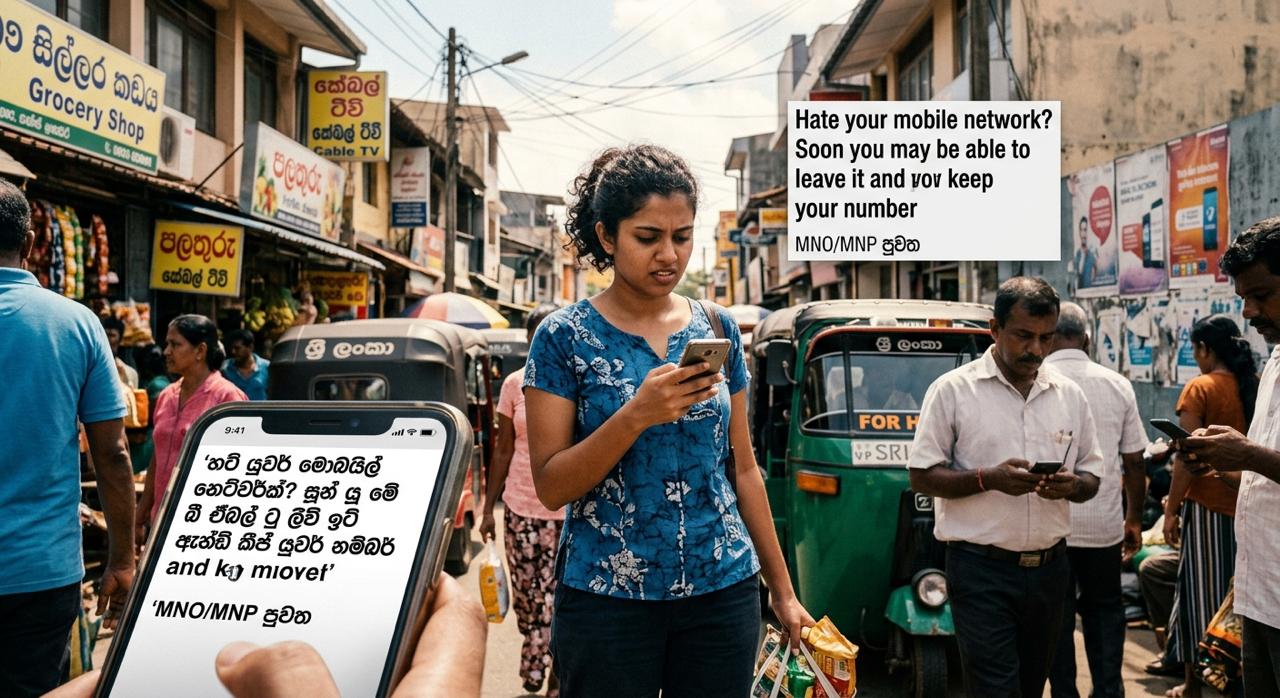
Sri Lanka has talked about Mobile Number Portability for years. The process has now reached another important stage, with regulatory approval awaiting legal clearance. If it finally happens, something quite fundamental changes: your telephone number stops being one of the reasons you remain with a network you might otherwise leave.
Changing a mobile telephone network should be an uncomplicated consumer decision. Find a better price, stronger signal or superior service and move.
Except that for many Sri Lankans it isn’t quite that simple.
Submit Your Press Release
Get your company news, announcements, launches, appointments and events in front of a wider audience.


A mobile number that has been used for ten or fifteen years has acquired a life of its own. It is held by family, friends, employers and customers. It may be attached to WhatsApp, banking services, two-factor authentication, delivery applications and countless databases the owner has probably forgotten exist.
Changing the network can therefore mean changing the number. And changing the number can be sufficiently inconvenient to persuade an unhappy customer to stay exactly where he is.
Mobile Number Portability, usually called MNP, is intended to remove that obstacle.
The principle is wonderfully simple. The telephone number belongs, in practical terms, to the customer rather than becoming a permanent reason for remaining attached to the operator that originally issued it. Change the network, keep the number.
Sri Lanka has been moving towards that system for years. The latest development brings the process another step closer, with the regulatory arrangements now awaiting legal clearance before the necessary licences can be issued.
If implemented properly, its importance goes considerably beyond convenience.
It changes competition.
At present, mobile operators compete vigorously for new customers, but an established customer carries a switching cost that has nothing to do with the advertised price of a package. Leaving can involve informing dozens or hundreds of contacts, changing details with institutions and risking the loss of calls or messages from people who continue using the old number.
That inconvenience has value.
Remove it and the network has to work harder to keep the customer.
A subscriber dissatisfied with coverage could move. Someone offered substantially cheaper data elsewhere could move. A business customer unhappy with service standards could move without printing a new telephone number on everything from business cards to advertising material.
That should force operators to compete more aggressively on the things consumers actually care about: coverage, speed, reliability, customer service and price.
There will, of course, be complications.
A functioning portability system requires networks to cooperate technically even while competing commercially. Calls and messages must be routed correctly regardless of which operator originally issued the number. Customer identity has to be verified. Fraud controls have to be strong. Porting requests need to happen quickly enough that changing networks does not become another bureaucratic adventure.
There is also the question of cost.
If moving a number is cumbersome, expensive or takes days, the theoretical freedom to switch becomes considerably less useful. Successful portability systems elsewhere generally work because changing operators has become an ordinary transaction rather than an exceptional event.
Sri Lanka should aim for the same.
There is another reason the reform matters now. The mobile telephone is no longer merely a telephone. It has become an identity device.
Banking codes arrive on it. Government and commercial services increasingly rely upon it. WhatsApp may contain years of personal and professional communication. For many small businesses, the mobile number effectively is the business number.
The idea that changing the company providing the signal should require changing that identity increasingly belongs to another era.
Sri Lanka’s telecommunications market has changed substantially over the years, through consolidation, competition and enormous growth in mobile data. Consumers now compare packages in gigabytes rather than counting individual calls.
Number portability is one of those reforms that is barely noticed once it works.
Until then, its absence quietly favours the incumbent provider.
After years of discussion, Sri Lankan consumers may finally be approaching the point where they can tell their mobile operator something rather useful.
Improve the service, improve the price or I leave.
And yes, I am taking my number with me.