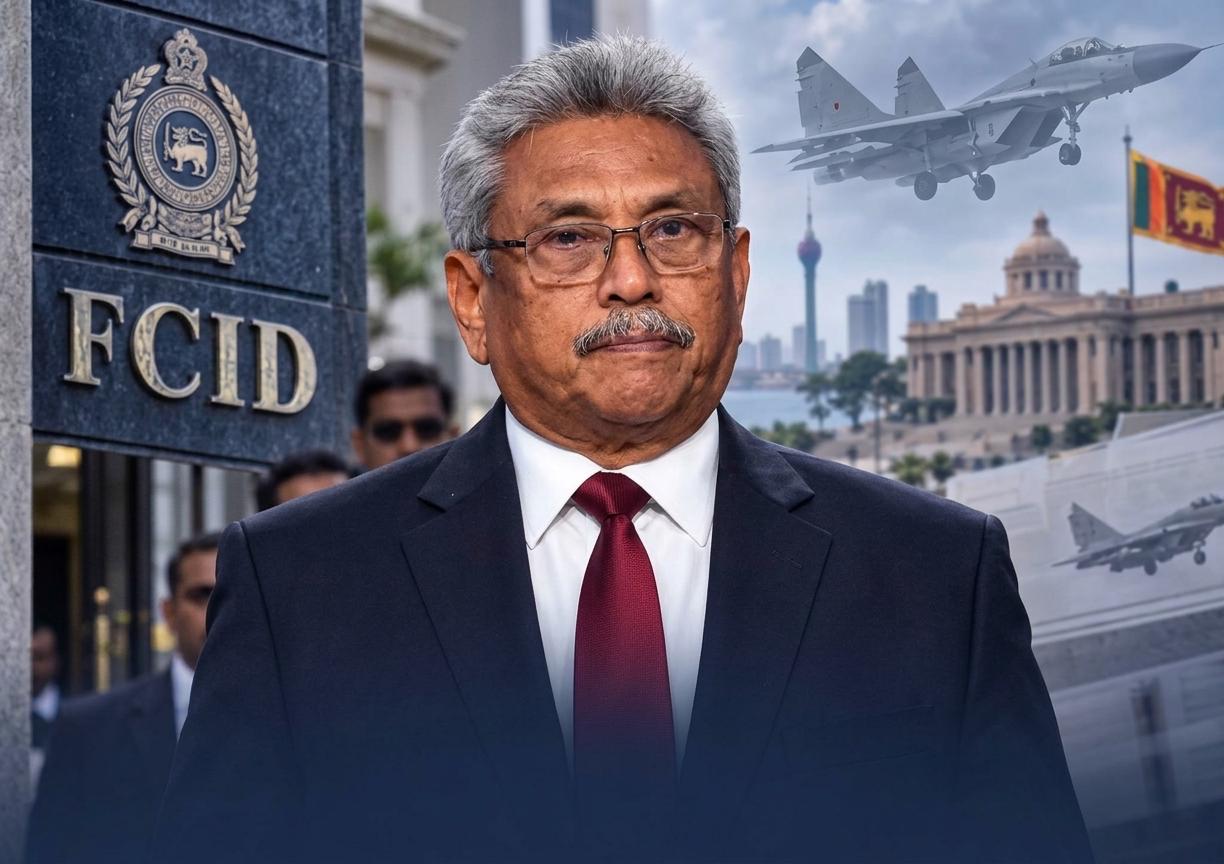
Sri Lanka is investigating money leaving the country, reopening questions about the MiG deal, prosecuting alleged money laundering and examining the proceeds of organised crime. The Supreme Court has meanwhile demonstrated that even a President’s power of mercy is reviewable. All of this is encouraging – provided accountability is a principle rather than a political preference.
There is a curious thread running through several of the stories in today’s NEWSLINE.
Police are investigating allegations that US$80 million left Sri Lanka disguised as payments for imports. The FCID has returned to the controversial MiG procurement of 2006. A prosecution witness in the money-laundering case against Yoshitha Rajapaksa is himself facing possible legal consequences after the Attorney General’s Department accused him of giving contradictory and false evidence.
Submit Your Press Release
Get your company news, announcements, launches, appointments and events in front of a wider audience.


Police are also pursuing more than Rs 1.1 billion in property, vehicles and cash alleged to represent proceeds of crime. Meanwhile, the Supreme Court has declared that the presidential pardon granted by Maithripala Sirisena to Ven. Galagoda Aththe Gnanasara Thero was arbitrary and unlawful.
Different cases. Different people. Different allegations.
But one principle.
Power must answer to evidence.
That principle becomes particularly important in Sri Lanka because investigations here so quickly become political property. When the person under investigation belongs to the other side, an inquiry is celebrated as accountability. When the person belongs to one’s own side, exactly the same process is condemned as persecution.
That cannot be the rule of law.
Gotabaya Rajapaksa is entitled to precisely the same presumption of innocence as any other citizen questioned by the FCID. The fact that investigators have summoned him over the MiG transaction does not establish that he committed an offence. It establishes that investigators have questions which they believe require answers.
But the reverse is equally true. The fact that he was Defence Secretary during a war does not make financial questions surrounding a defence procurement illegitimate. Whether Sri Lanka required MiG aircraft and whether every dollar connected with their purchase was properly accounted for are entirely separate questions.
The same principle applies to Yoshitha Rajapaksa.
If a prosecution witness has given false or contradictory evidence, the prosecution should confront it rather than conceal it. If that witness has damaged the State’s case, the defence is entitled to expose that damage. If independent documentary and financial evidence remains capable of proving the prosecution’s allegations, the court will assess it.
Justice does not require prosecutors to win.
It requires the process to be honest.
That is why the Supreme Court’s decision concerning the Gnanasara pardon is particularly important. The Court did not abolish the President’s constitutional power to grant mercy. It ruled that even this exceptionally broad presidential discretion must be exercised lawfully, rationally and within the public trust.
The President therefore has power, but not ownership of power.
That is an enormously important distinction in a country which has spent much of its post-independence history treating elected office as though electoral victory temporarily transfers possession of the State to the winner.
It does not.
Governments administer the State. Presidents exercise powers entrusted by the Constitution. Police exercise powers given by law. Prosecutors act on behalf of the public. Judges exercise judicial authority.
None owns the institution in which he or she temporarily serves.
That principle must extend into the most difficult territory of all: Sri Lanka’s unresolved past.
Seventeen years after the war ended, allegations concerning disappearances, detention, civilian deaths and other violations remain unresolved. The LTTE committed grave crimes, including suicide bombings, political assassinations, child recruitment, attacks upon civilians and the forcible expulsion of Muslims from the North. Those crimes should neither be forgotten nor sanitised because the organisation was eventually defeated.
But LTTE crimes cannot operate as an immunity certificate for anybody else.
If credible evidence exists that members of the security forces committed offences, those allegations must be capable of investigation without the investigation itself being branded an attack upon the military or the country.
That is not hostility towards soldiers.
It is the opposite.
Thousands of members of Sri Lanka’s armed forces served without being accused of war crimes. If particular individuals committed offences, collective silence does not protect the reputation of those who served honourably; it attaches unresolved allegations to an entire institution.
A credible investigation can separate the two.
The same standard must apply to allegations involving politicians, police officers, public servants, businessmen, monks, military officers and ordinary citizens. Evidence should determine whether a case proceeds, not surname, uniform, political party, ethnicity, religion or popularity.
Sri Lanka has heard a great deal about accountability over the years. Every incoming administration promises investigations. Files are reopened, committees appointed, suspects questioned and cameras gather outside investigative agencies.
Then governments change.
The people being investigated change.
Sometimes even the enthusiasm for investigating changes.
That is the problem.
A functioning justice system should be almost boring in its consistency. It should investigate an allegation against a Rajapaksa with the same seriousness with which it investigates an allegation against an NPP politician. It should examine accusations against a military officer with the same evidential discipline applied to an LTTE member. It should investigate a powerful businessman with the same determination applied to the drug dealer standing on a street corner.
And when the evidence is insufficient, it should have the courage to say so.
Accountability is not measured by the number of famous people summoned to the FCID, the number of television cameras outside a courthouse or the size of the figures announced at Police briefings.
It is measured by conclusions.
Who was charged? What evidence was produced? Who was convicted? Who was acquitted? What money was recovered? Which allegation proved false? Which public official was responsible? Which innocent person had his name cleared?
Those answers are what distinguish justice from political theatre.
The US$80 million investigation provides a useful immediate test. If investigators are correct that thousands of outward transfers moved through Sri Lanka’s financial system under the guise of imports, following the money should eventually identify where it went, who received it, what documentation supported it and whether anybody within the control system knowingly facilitated wrongdoing.
The public should not be asked simply to admire the arrest.
It should eventually be shown the evidence.
Sri Lanka told the Human Rights Council in Geneva this week that it remains committed to nationally owned reconciliation and accountability mechanisms and pointed to reopened investigations into important cases. That is welcome.
But national ownership comes with national responsibility.
If Sri Lanka argues that its own institutions are capable of delivering accountability, the strongest response to international criticism is not another speech in Geneva. It is a justice system at home which demonstrates that no person is too powerful to investigate and no allegation too politically inconvenient to examine.
That requires something more difficult than prosecuting one’s opponents.
It requires investigating one’s friends.
It requires admitting when investigators get things wrong. It requires prosecutors to disclose weaknesses in their own cases. It requires governments to allow institutions to follow evidence even when that evidence leads somewhere politically uncomfortable.
Most of all, it requires Sri Lanka to abandon the idea that justice must belong to somebody.
Justice does not belong to the Government.
It does not belong to the Opposition.
It does not belong to Geneva, Washington or any political dynasty.
It belongs to the public.
Be that as it may, a country cannot credibly demand accountability from the people it dislikes while demanding immunity for the people it likes.