
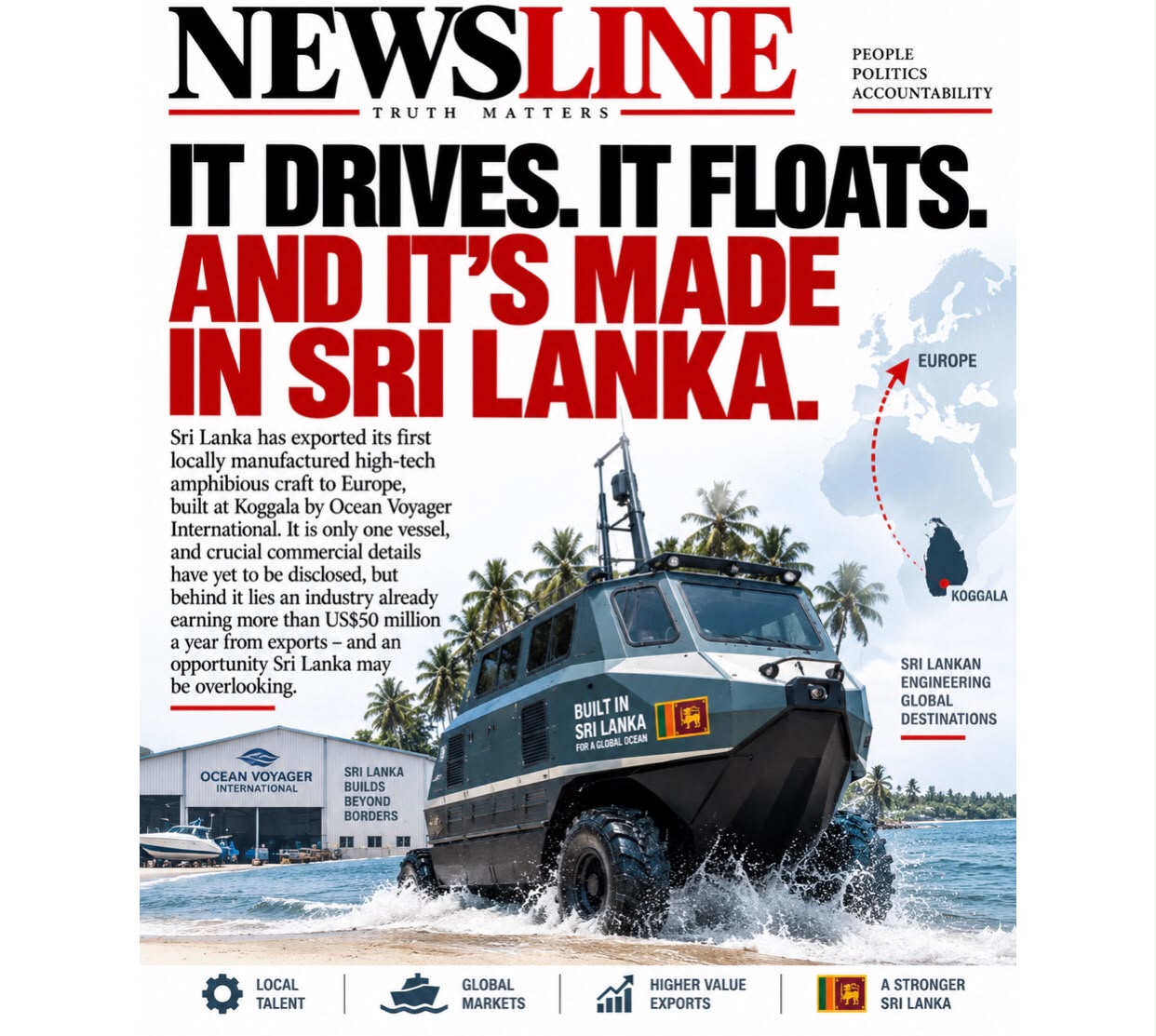
Sri Lanka has exported its first locally manufactured high-tech amphibious craft to Europe, built at Koggala by Ocean Voyager International. It is only one vessel, and crucial commercial details have yet to be disclosed, but behind it lies an industry already earning more than US$50 million a year from exports – and an opportunity Sri Lanka may be overlooking.
Amid the investigations, court cases, drugs and crime which dominate Sri Lanka’s news, something rather different rolled – and presumably could have floated – out of Koggala this week.
Sri Lanka has produced its first locally manufactured high-tech amphibious craft for export to the European market, a vessel designed to operate both on land and water. Built by Ocean Voyager International at the Koggala Free Trade Zone, the craft was formally marked for export on Thursday at a ceremony attended by Industry and Entrepreneurship Development Minister Sunil Handunnetti, Board of Investment officials and representatives of the company.
Submit Your Press Release
Get your company news, announcements, launches, appointments and events in front of a wider audience.


It is a modest event when measured against Sri Lanka’s enormous foreign-exchange requirements. One amphibious craft will not transform the balance of payments, create thousands of jobs overnight or suddenly turn Koggala into Rotterdam.
But it is worth paying attention to what has actually happened. Sri Lanka has manufactured a specialised engineering product, found a customer in one of the world’s demanding export markets and produced it here for sale abroad.
That is exactly the direction in which a small economy with limited natural resources needs to move.
Ocean Voyager International is not simply an experimental workshop which appeared yesterday. The Export Development Board identifies it as part of the Sail Lanka Yachting Group and says the company already operates two boatyards in Sri Lanka, manufacturing Ceycat catamarans in the 47-to-55-foot range as well as the Ocean Diamond superyacht. Its vessels incorporate designs associated with French naval architects and the company has worked through international joint ventures.
Sri Lanka’s wider boat and shipbuilding sector is also more substantial than many outside the industry may realise. According to the Export Development Board, the sector generated US$53.71 million in export revenue in 2025, directly employed approximately 2,000 people, supported another 10,000 indirect jobs, and included 22 boatyards devoted to exports.
Sri Lankan yards already produce fishing boats, passenger craft, patrol and surveillance vessels, workboats, yachts and larger commercial ships. Colombo Dockyard, for example, has previously delivered sophisticated vessels to European customers, including hybrid bulk carriers to Norway and a cable-laying and repair vessel to France.
The significance of the Koggala craft therefore lies not in pretending Sri Lanka has suddenly discovered boatbuilding. It lies in demonstrating another niche within an industry in which the country already possesses engineering capability, an experienced workforce and a record of selling internationally.
There are, however, important gaps in what has been announced.
Neither the European buyer nor the destination country has been publicly identified in the principal reports of the export. The sale price has not been disclosed, nor have detailed technical specifications, the percentage of locally manufactured content, the size of any follow-on order or the number of jobs directly supported by production of the craft.
Those numbers matter.
There is a large difference between assembling a largely imported product in Sri Lanka and designing, engineering and manufacturing a high-value craft with substantial local content. Both can generate employment and exports, but the second creates considerably greater value for the economy and develops expertise which can be transferred into other industries.
The Government says it wants Sri Lanka to become a regional centre for marine manufacturing, pointing to the country’s position alongside major international shipping routes. Geography certainly helps, but geography alone does not build boats.
Engineers do. Technicians do. Composite specialists, electricians, welders, designers and skilled tradespeople do. So do reliable ports, efficient Customs procedures, internationally recognised certification, access to finance and an industrial policy which remains stable long enough for exporters to plan beyond the next order.
Sri Lanka has spent decades talking about becoming a maritime hub because of where it sits on the map. The more interesting proposition may be to become a maritime manufacturing centre because of what Sri Lankans can actually build.
There is also an economic advantage in pursuing specialised products rather than attempting to compete purely on volume. Sri Lanka is unlikely to challenge the giant shipyards of China, South Korea or Japan in mass commercial shipbuilding. It does not need to.
High-value specialist craft, leisure vessels, catamarans, patrol boats, workboats, marine composites, repair services and niche engineering offer a different route – one where expertise and quality can matter more than sheer industrial scale.
That makes Thursday’s export something worth celebrating, but also something worth measuring. NEWSLINE would like to know the value of the craft, the identity of the European market receiving it, how much of it was genuinely produced here and, perhaps most importantly, whether another one is already on the production line.
One amphibious craft makes a good photograph.
A continuing order book makes an industry.



