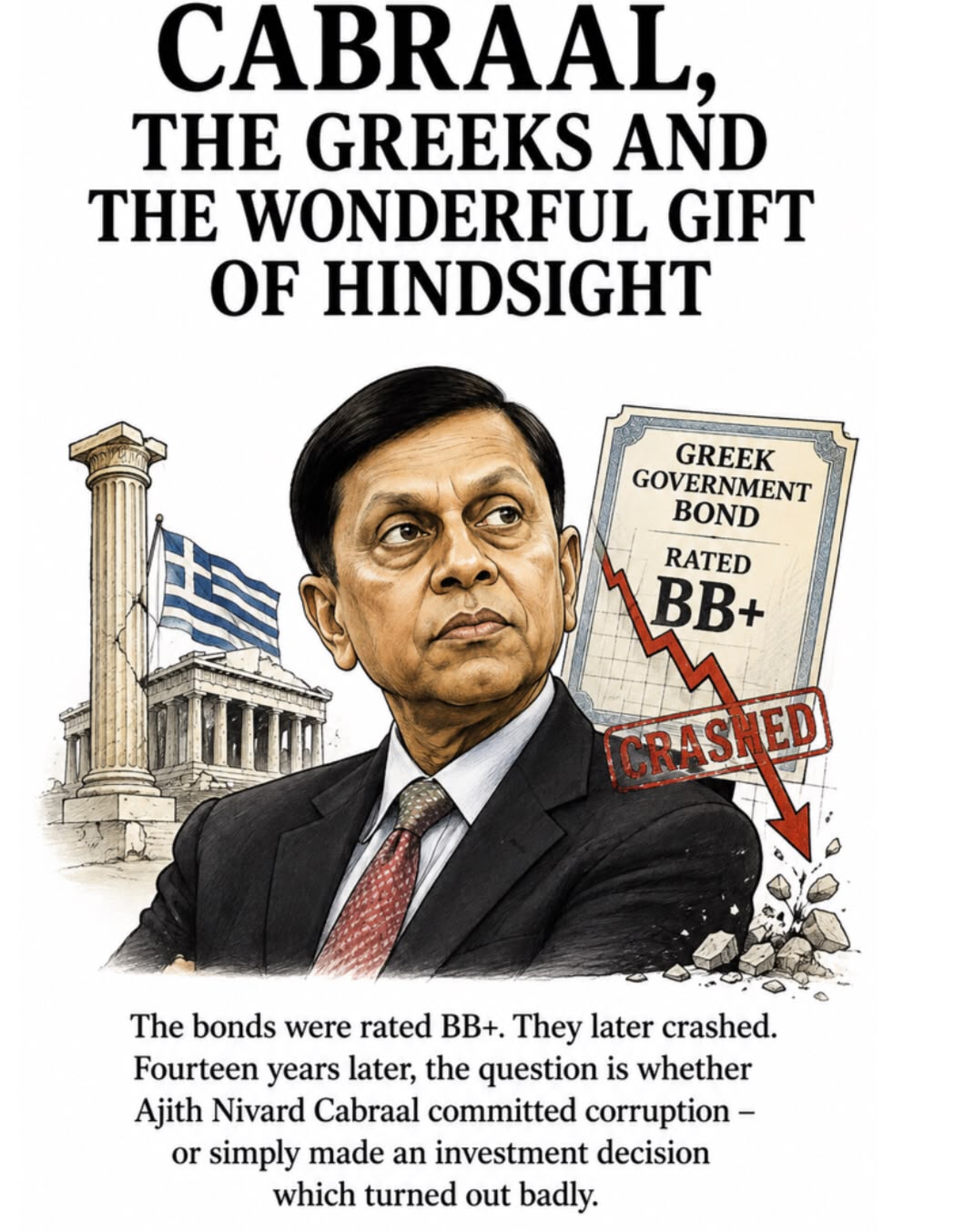
The bonds were rated BB+. They later crashed. Fourteen years later, the question is whether Ajith Nivard Cabraal committed corruption – or simply made an investment decision which turned out badly.
Poor Ajith Nivard Cabraal. Not necessarily because he deserves our sympathy, but because the former Central Bank Governor appears to have suffered from a condition common to most human beings: he could not see the future.
At the time of the purchase, Fitch still rated Greek sovereign debt BB+. Was it a prediction of the catastrophe that followed.

The crisis subsequently deteriorated dramatically, Greece’s ratings plunged and Sri Lanka lost a great deal of money. The State now alleges a loss exceeding Rs.1.84 billion and Cabraal stands before a three-judge Trial-at-Bar accused of corruption arising from the investment. He denies wrongdoing and remains innocent unless the prosecution proves otherwise.
Which brings us to the simple question at the heart of this extraordinary saga: what did Cabraal know then?
Knowing Greece was in financial difficulty is one thing. Knowing precisely what Greek bonds would be worth several months later is quite another. If Cabraal possessed information showing disaster was coming and nevertheless improperly caused public money to be invested, that is plainly serious. Produce the evidence and prove it.
But if the proposition is that Greece was risky, the bonds subsequently collapsed and therefore Cabraal should have known they would collapse, we appear to have discovered an exciting new qualification for Governor of the Central Bank: clairvoyance.
“Economics desirable. Financial experience essential. Crystal ball compulsory.”
Hindsight, after all, is the world’s most successful fund manager. It has never made a losing investment.
Curioser and Curioser:
There are other curiosities. Cabraal was not originally alone. Earlier proceedings over the Greek bonds involved other former Central Bank officials as well. Those proceedings encountered legal difficulties and at one stage ended after a preliminary objection concerning the authority of the CIABOC Director General who had signed the indictment was upheld. That was a procedural ruling, not an acquittal on the merits. Further proceedings followed, other former officials were subsequently discharged, and today Cabraal stands alone.
One investment, several officials, several rounds of litigation – and now one Cabraal. Greek tragedy is beginning to resemble Agatha Christie.
There is also the inconvenient matter of an earlier Supreme Court judgment. The Greek bond investment was considered years ago in a fundamental-rights case. That was not the criminal trial Cabraal faces today and cannot be treated as an acquittal of the present charges. But the Supreme Court declined to hold that the Monetary Board had acted arbitrarily, unreasonably or fraudulently in deciding to invest in the bonds.
That judgment cannot determine the present prosecution. Equally, it cannot simply disappear.
Perhaps the prosecution now possesses evidence that changes the picture completely. If so, let it be produced and tested. If Cabraal was corrupt, prove corruption. If he abused his office, prove it. If there is evidence demonstrating that this was something more sinister than a risky investment which subsequently went horribly wrong, put it before the judges.
Because governments make bad decisions. Central Banks make bad decisions. Ministers make bad decisions. Journalists occasionally make bad decisions too, although naturally considerably fewer. Sometimes those decisions cost enormous amounts of money.
But a bad decision is not automatically a crime, just as describing something as an investment decision cannot provide shelter for corruption. The difference is evidence.
The dangerous shortcut is altogether simpler: the investment lost money, therefore it was wrong; because it was wrong, somebody should have known; because somebody should have known, somebody must be a criminal.
That may make excellent politics. It is a rather more troublesome principle of criminal justice.
The Greeks gave the world democracy, philosophy, mathematics and tragedy. Sri Lanka may yet contribute something new: prosecution by hindsight.
Perhaps Cabraal should indeed have known in April what international rating agencies themselves would only conclude later. Perhaps every Central Bank Governor should.
In which case, next time the job becomes vacant, forget the economists and hire an astrologer. Be that as it may, Cabraal requires neither sympathy nor political protection. He requires what every citizen standing before a criminal court is entitled to: a prosecution required to prove what he knew then, not what everybody knows now.