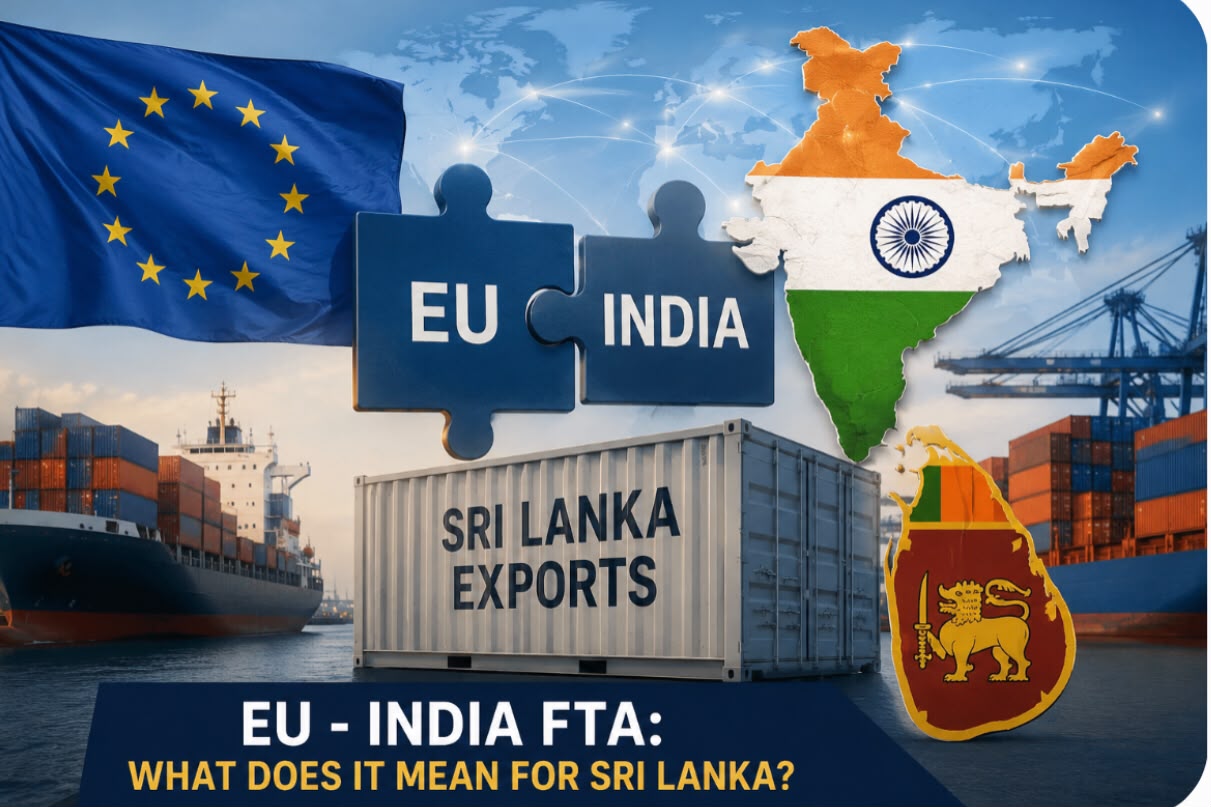
India is preparing for substantially improved access to the European market under its new free trade agreement with the EU. For Sri Lanka, whose exporters compete with India in several important sectors, the question is no longer simply what India gains – but what Sri Lanka could lose.
Sri Lanka has begun examining the potential consequences of the European Union–India Free Trade Agreement amid concern that preferential access granted to Indian exporters could weaken the competitive position of Sri Lankan products in one of the country’s most important overseas markets.
The Export Development Board recently held discussions with European Commission-appointed consultants Paul Baker and Talal Rafi, who are assessing the implications of the agreement for Sri Lanka.

The Joint Apparel Association Forum was also represented at the discussions, reflecting particular concern within an industry that remains one of Sri Lanka’s most important sources of export earnings.
Negotiations on the EU–India FTA were concluded on January 27 and the agreement is expected to enter into force following completion of legal review, signature and ratification procedures.
Once operational, it is expected to substantially improve the competitiveness of Indian goods entering Europe.
That matters to Sri Lanka.
The European Union is Sri Lanka’s second-largest merchandise export destination after the United States and accounts for approximately 24 per cent of the country’s merchandise exports.
India and Sri Lanka also compete in several labour-intensive industries.
Apparel, leather and footwear, marine products, chemicals, plastics and rubber products, sporting goods, toys and gems and jewellery are among the sectors in which Indian exporters are expected to benefit from substantial tariff liberalisation. Many Indian products are expected eventually to receive duty-free access to the European market.
For Sri Lankan exporters, therefore, the problem is relatively straightforward.
An Indian product which currently competes with a Sri Lankan product may soon enter Europe carrying a substantially smaller tariff burden.
Price matters.
And in highly competitive international supply chains, even relatively small differences in landed cost can influence purchasing decisions.
The apparel industry faces an additional complication involving rules of origin.
Sri Lankan manufacturers use fabrics and other inputs sourced from India. Industry representatives are concerned that restrictions affecting regional cumulation could make it more difficult for garments manufactured here using Indian materials to obtain the full benefit of Sri Lanka’s preferential access under the EU’s GSP+ scheme.
The Government is expected to engage the European Union on appropriate cumulation arrangements involving India.
There are opportunities as well.
European markets are placing increasing importance on sustainability, environmental performance, traceability and regulatory compliance. Sri Lankan manufacturers which can demonstrate higher standards, specialised production and greater value addition may therefore be able to compete on something more substantial than price alone.
But that requires strategy.
Sri Lanka cannot prevent India from negotiating better access to the world’s major markets. Nor should it expect European buyers to purchase Sri Lankan goods merely because they have traditionally done so.
The response must be to protect GSP+ access, secure workable rules of origin, improve productivity, move further into higher-value products and aggressively negotiate new market access of our own.
India has made its move. Sri Lanka now needs to make one too.