The June quarter consequently presents an unusually strong opening to Hayleys’ new financial year: rapid revenue expansion, substantially faster operating-profit growth, sharply higher shareholder earnings and considerable momentum across several of its largest businesses.
It also presents an interesting corporate combination.
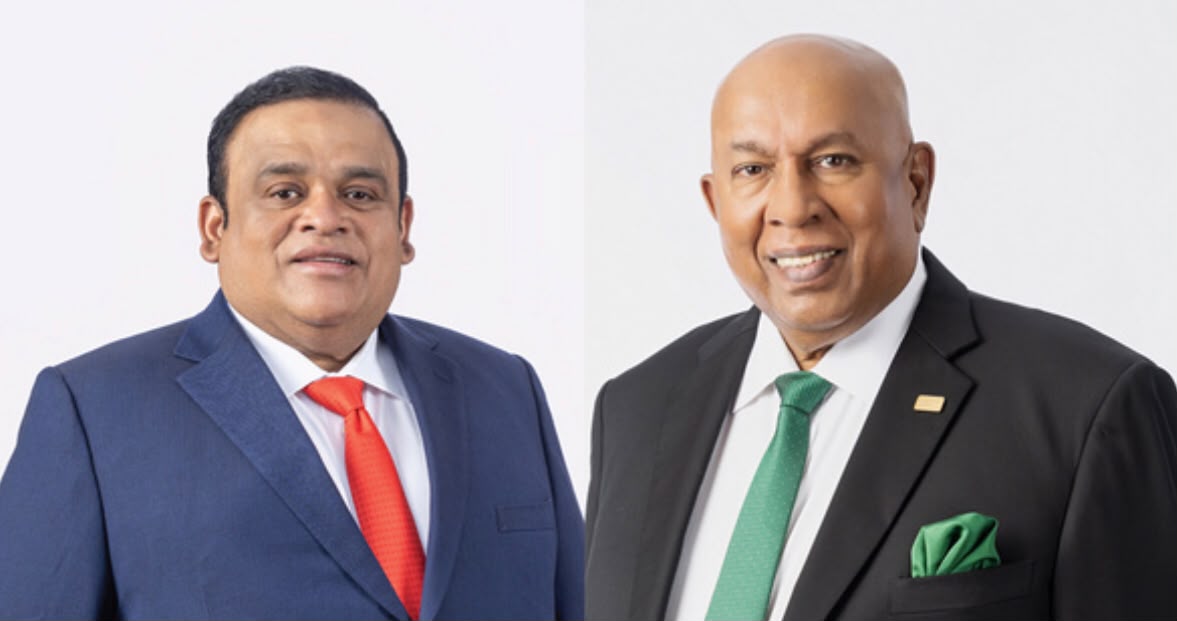
Hayleys has the financial backing and strategic influence of a majority shareholder in Dhammika Perera, alongside the institutional continuity of Mohan Pandithage, who has spent more than half a century inside the organisation and has led it as Chairman and Chief Executive since 2009.
For international investors looking at Sri Lanka, that combination – entrepreneurial capital on one side and deeply embedded professional management on the other – may be as noteworthy as the headline earnings themselves.
But there is now a third component to that investment proposition.
Hayleys is not merely positioned to benefit from Sri Lanka’s recovery. With US$800 million in annual foreign-currency inflows, around 5% of national export income and substantial exposure to international markets, the Group is itself a significant participant in the process through which Sri Lanka earns the foreign currency required to strengthen that recovery.
The tests ahead remain identifiable: converting rapidly expanding profits into stronger operating cash flows, managing finance costs and demonstrating adequate returns from the Group’s heavy investment programme.
But the starting position is formidable.
Revenue is expanding.
Operating profits are growing faster than sales.
Several major businesses are accelerating simultaneously.
Loss-making assets are being removed.
Capital is being deployed at a substantially increased rate.
And the Group continues to generate foreign currency on a scale unusual among Sri Lankan listed companies.
Be that as it may, Hayleys has begun FY2026/27 with considerably more earnings momentum than it had a year ago – and with Rs 17.9 billion invested in a single quarter alongside US$800 million in annual foreign-currency inflows, the Group appears to be positioning itself not merely to participate in Sri Lanka’s next growth cycle, but to capture a substantial share of it.