
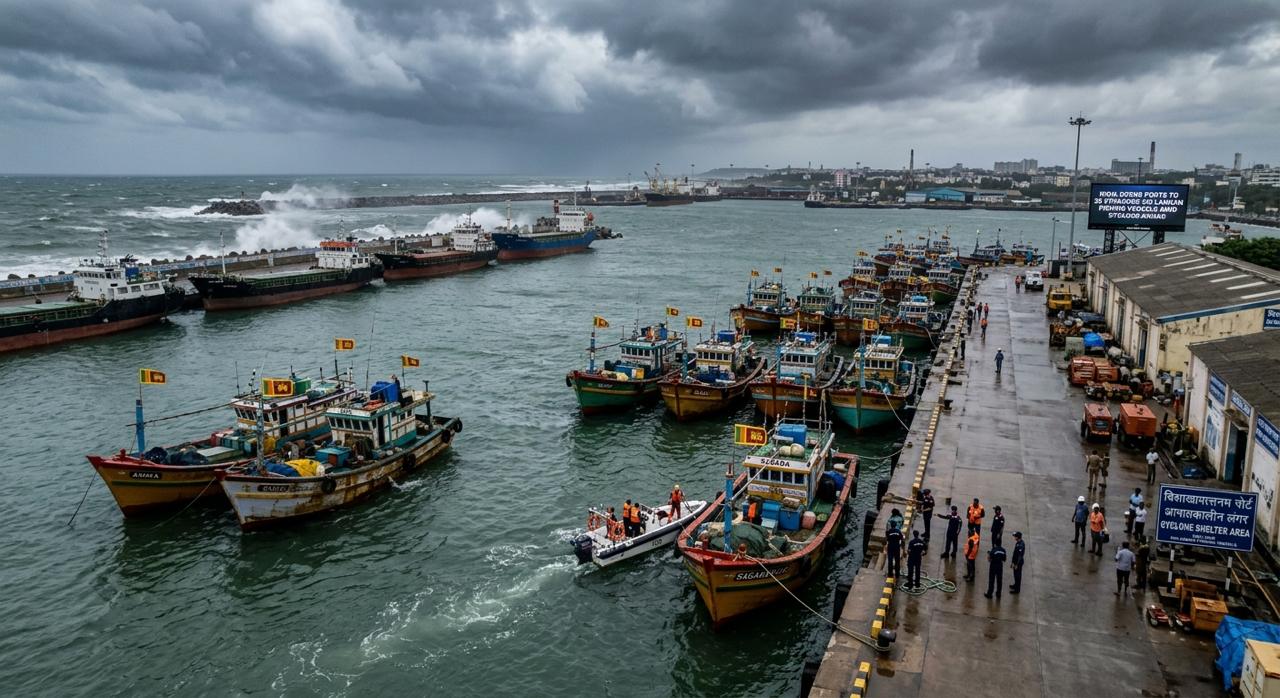
When Cyclonic Storm Arnab began rapidly gathering strength over the Bay of Bengal, it left nearly two dozen Sri Lankan multi-day fishing trawlers exposed to violent ocean conditions near India’s maritime boundary. Trapped in deep waters where gale-force winds and rising swell threatened to capsize vessels, the crews faced a perilous situation. However, swift diplomatic action between Colombo and New Delhi led to a critical decision: India opened its territorial waters to provide emergency sanctuary for 25 stranded Sri Lankan fishing boats.
The crisis unfolded as the Department of Meteorology issued an urgent warning for sea areas between latitudes 10°N and 20°N and longitudes 80°E and 95°E. With Cyclonic Storm Arnab churning toward the Andhra Pradesh coast, meteorologists forecast sustained winds between 80 and 140 km/h and wave heights reaching up to four meters. Recognizing that the vessels could not outrun the storm or return to Sri Lankan ports in time, the Ministry of Fisheries, Aquatic and Ocean Resources made an emergency diplomatic request to the Indian Government through the High Commission of India in Sri Lanka.
India responded promptly, granting permission for the 25 multi-day vessels to cross into its territorial waters and drop anchor at designated safe locations along its coast. Officials from the Department of Fisheries immediately radioed the stranded crews, ordering them to abandon high-risk fishing grounds and proceed to Indian safe harbors under guided safety protocols. Meanwhile, vessel owners on the island were briefed on distress procedures as naval and maritime authorities in both countries coordinated to track the fleet’s real-time movement.
Submit Your Press Release
Get your company news, announcements, launches, appointments and events in front of a wider audience.


This emergency response offers a notable contrast to the usual news surrounding the Palk Strait and Bay of Bengal, where bilateral maritime headlines are often dominated by illegal trawling disputes, net confiscations, and naval arrests. When severe weather strikes, legal boundaries give way to humanitarian obligation. The prompt clearance granted to the Sri Lankan trawlers illustrates the practical value of established bilateral disaster response frameworks, proving that humanitarian protocols can operate smoothly even amid complex maritime geopolitics.
But the incident does underscore a persistent structural vulnerability in Sri Lanka’s deep-sea fishing sector. As climate change increases the frequency and intensity of unseasonal Bay of Bengal cyclones, multi-day crews spending weeks at sea remain highly exposed to rapid storm development. While diplomatic intervention secured a safe outcome this time, how much longer can traditional fishing fleets rely on ad-hoc emergency clearances before regional maritime safety standards and early-warning communications are permanently upgraded?



