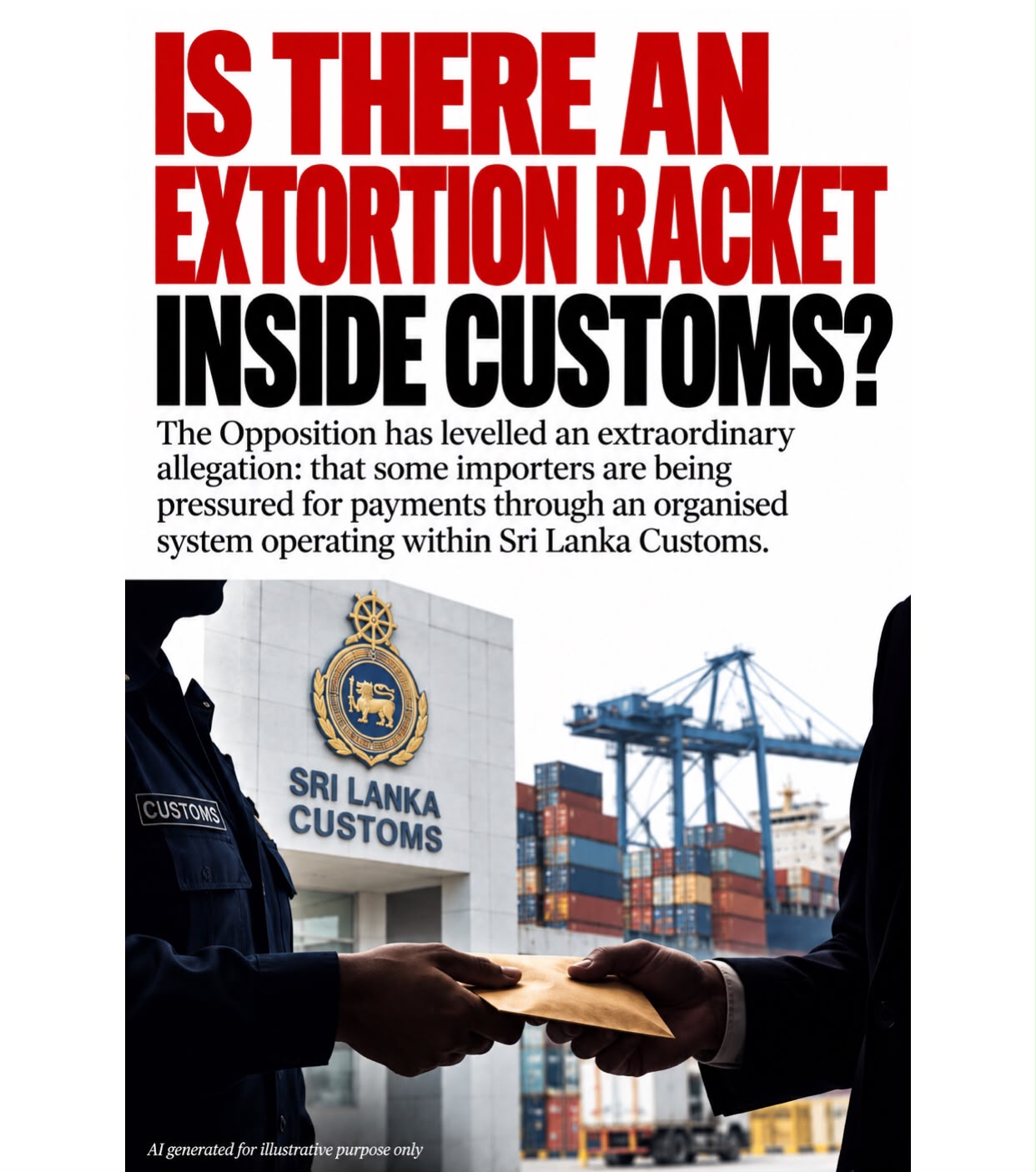
The Opposition has levelled an extraordinary allegation: that some importers are being pressured for payments through an organised system operating within Sri Lanka Customs. It is an allegation, not an established fact. But if businesses importing legally into Sri Lanka believe unofficial payments determine how quickly their goods move, somebody needs to establish the truth quickly.
The Samagi Jana Balawegaya has raised serious allegations concerning the treatment of importers by Sri Lanka Customs, claiming that an organised system of extortion is operating within the institution.
The allegations were raised in Parliament by SJB MP Mujibur Rahman, who claimed that some importers were being pressured into making payments to secure the release of consignments and avoid delays.
Submit Your Press Release
Get your company news, announcements, launches, appointments and events in front of a wider audience.


These are allegations made by the Opposition.
NEWSLINE has seen no finding by a court or independent investigation establishing that Sri Lanka Customs, as an institution, operates an extortion racket. Nor should individual Customs officers be condemned on the basis of a political allegation.
But the accusation is sufficiently serious that it cannot simply disappear into another day’s Hansard.
Customs occupies one of the most commercially sensitive points in the Sri Lankan economy.
Every unnecessary delay at the border costs somebody money. Containers accumulate demurrage and storage charges. Raw materials fail to reach factories. Retailers wait for goods. Exporters dependent on imported inputs can lose production time.
That creates an obvious vulnerability.
Where an official possesses substantial discretion over whether a shipment moves today, tomorrow or next week, delay itself can become leverage.
That is precisely why Customs procedures need to be transparent, predictable and increasingly automated.
An importer complying with the law should know what documents are required, what duties are payable, why a consignment has been stopped and what mechanism exists to challenge an unreasonable decision.
There should be as little room as possible for the outcome to depend upon whom somebody knows.
Sri Lanka has spent years speaking about becoming a regional logistics hub, improving ease of doing business and attracting foreign investment.
Those ambitions become meaningless if businesses believe goods cannot cross the country’s principal commercial gateway without unofficial negotiation.
The allegation also arrives at an interesting moment.
The Government has made anti-corruption one of the defining themes of its administration. President Anura Kumara Dissanayake has repeatedly insisted that political status and influence will no longer shield people from investigation.
That principle cannot stop at politicians.
If the allegations concerning Customs are false, the institution and its officers deserve to have their names cleared.
If there is evidence supporting them, those responsible deserve something rather different.
The simplest answer is an independent investigation capable of establishing which it is.
Sri Lanka does not need another rumour about corruption. It needs either proof or exoneration.