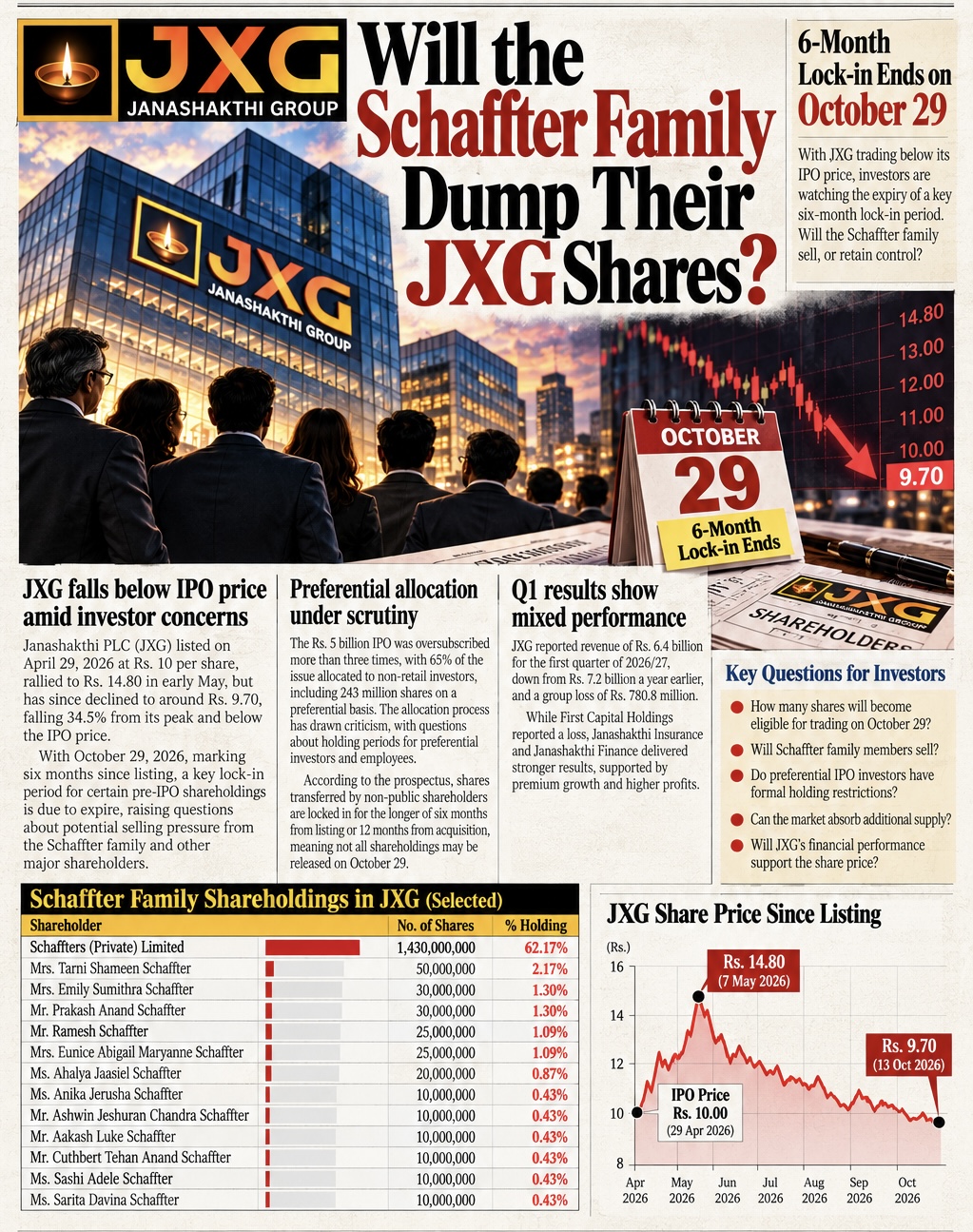
JXG trades below its Rs. 10 IPO price as investors assess potential selling pressure, but no verified evidence confirms a planned disposal by the Schaffter family.
COLOMBO, October 14, 2026 — Investors in Janashakthi PLC (JXG.N0000) are closely watching October 29, 2026, when a six-month lock-in period applicable to certain pre-IPO shares is due to expire, raising questions about whether additional shares could enter the Colombo Stock Exchange (CSE).
The approaching date has attracted attention because JXG shares have fallen below their initial public offering (IPO) price of Rs. 10. The stock, which reached a reported high of Rs. 14.80 on May 7, was trading at approximately Rs. 9.70 on October 13, representing a decline of around 34.5% from its post-listing peak.
Submit Your Press Release
Get your company news, announcements, launches, appointments and events in front of a wider audience.


However, the expiry of a lock-in period does not necessarily mean that shareholders will sell. No verified evidence reviewed for this article establishes that the Schaffter family has decided to dispose of its holdings.
Schaffters Hold a Controlling 62.17% Stake
According to the shareholder schedule in JXG’s IPO prospectus, Schaffters (Private) Limited is the company’s largest shareholder, holding 1.43 billion shares, equivalent to 62.17% of the 2.3 billion shares in issue.
The prospectus also identifies several individual shareholders bearing the Schaffter name. Their reported holdings include Mrs. Tarni Shameen Schaffter with 50 million shares, Mrs. Emily Sumithra Schaffter with 30 million shares, Mr. Prakash Anand Schaffter with 30 million shares and Mr. Ramesh Schaffter with 25 million shares.
The concentration of ownership makes the lock-in expiry particularly relevant to investors. Nevertheless, the holdings of individual family members should not automatically be treated as a single block available for sale, as different shareholders may be subject to different restrictions.
What Happens on October 29?
JXG made its stock market debut on April 29, 2026, following a Rs. 5 billion IPO that offered 500 million new ordinary voting shares at Rs. 10 each.
Under the IPO prospectus, the 1.43 billion shares held by Schaffters (Private) Limited were subject to a six-month lock-in from the listing date, bringing the relevant expiry date to October 29.
Certain individual non-public shareholders, however, are subject to a different condition. Their shares become available for trading after the longer of 12 months from the date of transfer or six months from the listing date.
Consequently, October 29 does not automatically mean that every individual family holding becomes freely tradable. The applicable restriction and the date of transfer must be examined for each relevant shareholder.
Preferential IPO Allocations Add to Market Concerns

The potential supply of shares is not limited to the pre-IPO shareholder lock-in.
JXG’s Rs. 5 billion IPO attracted applications for approximately 1.516 billion shares, representing demand of around Rs. 15.16 billion, more than three times the issue size.
According to the published basis of allotment, approximately 325 million shares, or 65% of the issue, were allocated to the non-retail category. Of this amount, 243 million shares were allotted to strategic investors on a preferential basis.
The allocation attracted criticism from some market participants, particularly over the reductions in retail investors’ allotments despite strong overall demand.
In an announcement dated April 24, 2026, JXG explained that it had approached local and foreign investors to secure firm commitments in a changing market environment. The company said preferential allocations reflected investors’ requests for reasonable assurances that their applications would receive allocations consistent with their pre-commitments.
Separately, Daily FT reported, citing company sources, that there were no formal agreements with non-retail investors requiring them to hold their shares for a specified period, although most were understood to expect to retain their investments for approximately 12 months. Employee allocations were also reported to have no holding period, subject to applicable restrictions concerning undisclosed information.
An expected holding period, however, is not equivalent to a binding contractual lock-in. Investors therefore need to distinguish between formal restrictions, contractual commitments and informal expectations.
How Much Selling Pressure Could Emerge?
The market impact will depend on the number of shares actually offered for sale and the market’s ability to absorb them, rather than simply the number of shares becoming eligible for trading.
At an illustrative share price of Rs. 9.70, the potential transaction values would be:
- 10 million shares: Rs. 97 million
- 25 million shares: Rs. 242.5 million
- 50 million shares: Rs. 485 million
- 100 million shares: Rs. 970 million
- 200 million shares: Rs. 1.94 billion
These are illustrative scenarios, not estimates of actual disposals. A large block offered into a market with limited buying interest could place downward pressure on the share price. Conversely, strong institutional or retail demand could absorb additional supply.
Trading turnover, the availability of buy orders and the timing of any transactions will therefore be important indicators in the days surrounding October 29.
First-Quarter Results Provide Additional Context
JXG’s underlying financial performance is another factor investors must consider when assessing its valuation.
In its September 3, 2026 results announcement, the group reported consolidated revenue of Rs. 6.4 billion for the first quarter of financial year 2026/27, compared with Rs. 7.2 billion in the corresponding period of the previous year. The company attributed the decline to global economic uncertainty and geopolitical tensions associated with the conflict in the Middle East.
The group recorded a consolidated loss of Rs. 780.8 million for the quarter. First Capital Holdings reported a loss after tax of Rs. 726 million, which the group attributed largely to mark-to-market pressure on fixed-income positions amid short-term interest-rate volatility.
Other businesses delivered more resilient results. Janashakthi Insurance reported net profit after tax of Rs. 129 million for the first half of its 2026 financial year, alongside 36% year-on-year growth in gross written premiums to Rs. 5.1 billion. Janashakthi Finance reported quarterly net profit after tax of Rs. 90.4 million, an increase of 51%.
The group has also announced a proposed acquisition of Continental Insurance Lanka Limited, subject to regulatory approval, as part of its strategy to expand its insurance operations.
These developments highlight the importance of assessing the group’s individual businesses, earnings volatility and future prospects rather than relying solely on movements in its share price.
Will the Schaffter Family Sell?
Three possible outcomes warrant attention.
First, some shareholders whose restrictions have expired could decide to realise their investments, increasing the supply of shares in the market.
Second, Schaffters (Private) Limited could retain its controlling stake, even if individual shareholders choose to sell smaller holdings.
Third, investors could adjust their positions in anticipation of additional supply, creating volatility before any major shareholder disposal is confirmed.
These are possible scenarios, not predictions. No verified announcement reviewed for this article establishes that the Schaffter family intends to sell its JXG shares or that a coordinated disposal is planned.
What Investors Should Watch
Investors should monitor CSE announcements concerning substantial shareholdings, the precise lock-in conditions applicable to different shareholders, trading volumes and price movements. They should also follow JXG’s financial results and developments concerning the proposed Continental Insurance acquisition.
An increase in turnover or a falling share price alone does not establish that a particular shareholder is selling. Any conclusion about a major disposal requires reliable evidence linking the trading activity to the relevant shareholder.
Conclusion: A Date to Watch, Not Proof of a Sell-Off
The October 29 lock-in expiry could become an important event for JXG investors, particularly while the stock trades below its IPO price. However, the prospectus establishes different conditions for the controlling shareholder and certain individual shareholders, while the status of preferential IPO allocations must be assessed separately.
The central question is not simply how many shares may become eligible for trading, but how many will actually be offered for sale, by whom, and whether market demand can absorb the additional supply.
Until a disposal is confirmed through reliable evidence or formal disclosures, it would be premature to conclude that the Schaffter family is preparing to sell its JXG holdings.
Disclaimer: This article is based on the information contained in the reviewed IPO prospectus, company disclosures and publicly reported information. It does not allege that any named shareholder intends to sell and should not be treated as investment advice.