
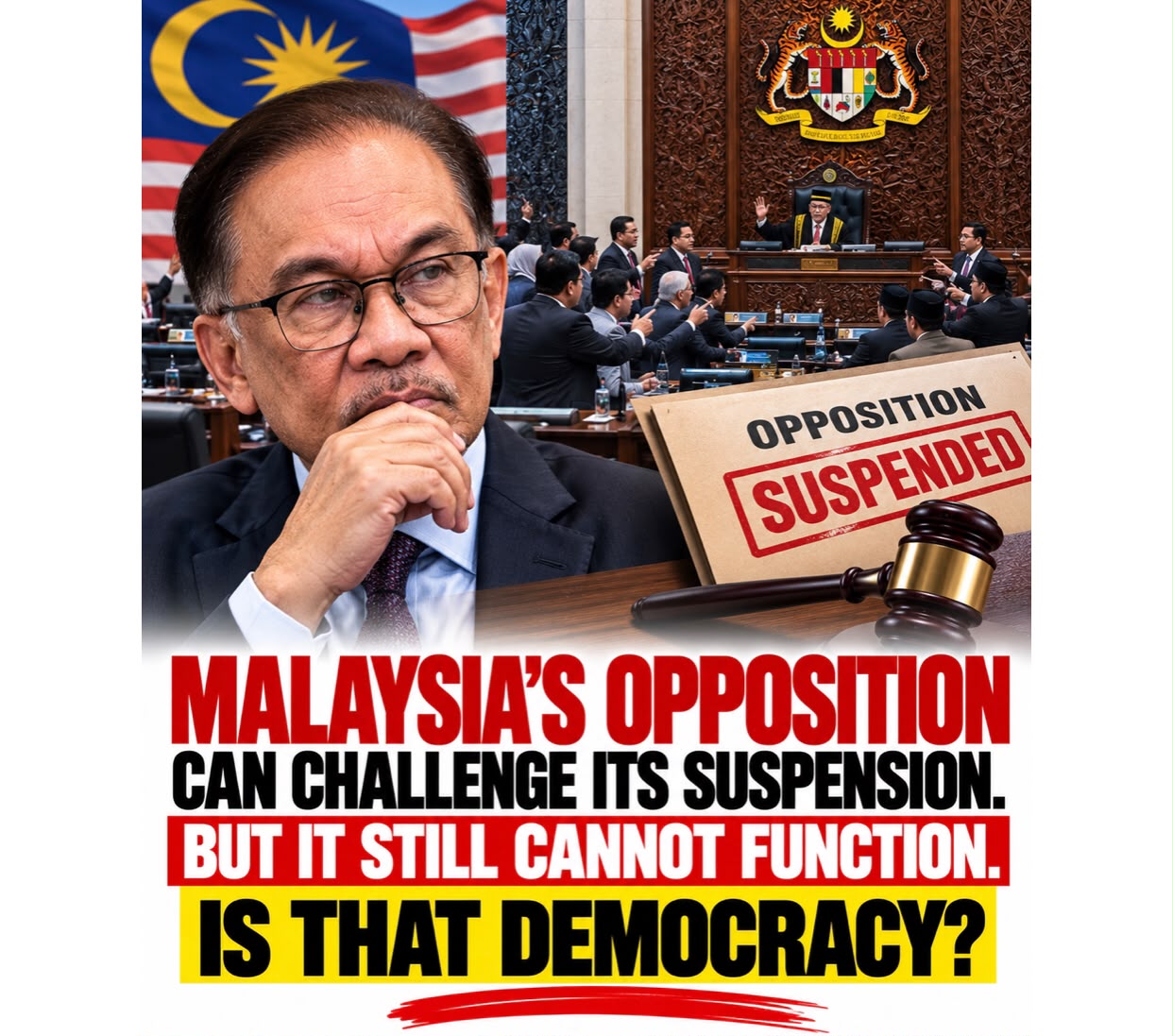
Malaysia’s High Court has granted opposition coalition Perikatan Nasional permission to challenge a government regulator’s suspension of its activities, but refused to lift the restriction while the legal challenge proceeds. The ruling on Tuesday, 13 October, leaves one of Malaysia’s principal opposition alliances unable to conduct normal political activities as preparations intensify for the Melaka state election on 14 November. The dispute raises a fundamental democratic question: can administrative powers intended to regulate organisations be exercised in a manner that effectively prevents a political opposition from competing?
Malaysia’s opposition coalition Perikatan Nasional has secured an important procedural victory in the High Court, but the immediate practical consequences are considerably less encouraging for the alliance.
The Kuala Lumpur High Court ruled on Tuesday that the coalition may proceed with judicial review proceedings challenging the Registrar of Societies’ decision to suspend its activities.
Submit Your Press Release
Get your company news, announcements, launches, appointments and events in front of a wider audience.


However, the court declined to grant an interim stay of the suspension.
The result is an unusual legal position. Perikatan Nasional has been permitted to challenge the government’s administrative action, but the restriction it seeks to overturn remains in force.
For an opposition coalition preparing for an election, the distinction is rather more significant than the average legal technicality.
The Registrar of Societies issued a notice on 22 September requiring the coalition to explain why it should not be deregistered. A further notice suspended its activities with effect from 23 September.
The action was taken under the Societies Act 1966, which provides the regulatory framework governing registered organisations in Malaysia.
The coalition and representatives of its component parties subsequently approached the courts, arguing that the restrictions were interfering with their ability to undertake legitimate political activities.
Their concerns have become particularly urgent because Melaka is scheduled to hold its state election on 14 November.
According to submissions made on behalf of the coalition, the suspension has prevented Perikatan Nasional from conducting meetings, finalising candidates, organising grassroots activities and preparing to contest the election under its established political identity.
These are not incidental administrative functions.
They are among the essential activities through which political organisations participate in democratic elections.
The government, represented by the Attorney General’s Chambers, has argued that the legal challenge is premature because the regulatory process has not yet been completed.
That argument deserves proper judicial consideration. Governments must retain the ability to enforce laws governing registered organisations, and political parties cannot reasonably claim immunity from legitimate regulatory requirements.
But the exercise of those powers becomes especially sensitive when the organisation affected is a major political opponent of the government.
An administrative decision that prevents a commercial association from holding meetings may create inconvenience. A similar restriction imposed upon an opposition coalition immediately before an election can have consequences for the democratic process itself.
The difference is not merely one of degree.
Elections depend upon the ability of political parties to organise, communicate with voters, select candidates and present competing programmes.
When those activities are restricted, the question is no longer confined to whether an organisation has complied with registration requirements.
It becomes a question about the conditions under which democratic competition is permitted to take place.
The High Court’s decision must nevertheless be understood accurately.
Justice Azizan Md Arshad granted the coalition permission to proceed with judicial review because it had met the legal threshold for bringing the challenge.
That does not mean the court has determined that the Registrar of Societies acted unlawfully.
Nor does the refusal to grant an immediate stay establish that the suspension was justified.
Both matters remain subject to further proceedings.
The court has fixed 22 October for an inter partes hearing concerning the application to suspend the effect of the regulatory order. At that hearing, the competing arguments can be examined with both sides represented.
Until then, the restrictions remain in place.
The timing is important.
By 22 October, the Melaka election will be little more than three weeks away. Every day during which a political organisation remains unable to undertake normal preparations may affect its ability to compete effectively.
Even if the coalition eventually succeeds in obtaining relief, some consequences of the intervening restrictions may prove difficult to reverse.
A political campaign cannot always recover lost preparation time simply because a court subsequently authorises the organisation to resume its activities.
That reality places considerable responsibility upon both regulators and the judiciary.
The authorities must demonstrate that restrictions are legally justified, proportionate and not being used to secure political advantage.
The courts, meanwhile, must ensure that legal challenges involving electoral participation are considered with appropriate urgency.
There is no reason to assume that every regulatory action against an opposition party is politically motivated. Political organisations, like other registered bodies, must comply with the law.
But there is equally no reason to assume that administrative powers are immune from misuse merely because they are exercised through formally established procedures.
Malaysia’s democratic institutions are being tested on precisely that distinction.
Prime Minister Anwar Ibrahim’s administration has repeatedly emphasised reform, accountability and the strengthening of democratic governance.
Those commitments will be judged not only by the government’s treatment of its supporters but also by the protections available to its political opponents.
The same principle applies to every government, regardless of ideology.
Democracy is not simply the process through which a governing coalition wins an election. It is also the system that allows competing parties to organise freely, challenge those in power and seek the public’s mandate under fair conditions.
A government confident in its democratic legitimacy should have little reason to fear lawful political competition.
Indeed, the credibility of an electoral victory depends substantially upon the freedom of opponents to contest it.
Be that as it may, Perikatan Nasional has not yet won its substantive legal challenge. It has secured the opportunity to present that challenge while remaining subject to the very restrictions it contests.
The court’s next decision will therefore carry consequences beyond the immediate interests of one political coalition.
It will help determine whether Malaysia’s regulatory framework provides adequate safeguards against administrative interference with electoral competition.
And it raises a question that governments throughout the region, including Sri Lanka, would do well to consider.
If an opposition party must first obtain judicial permission to challenge a suspension while the suspension itself prevents it from preparing for an election, how effectively is the democratic process being protected?
The answer will matter long after the Melaka votes have been counted.



