
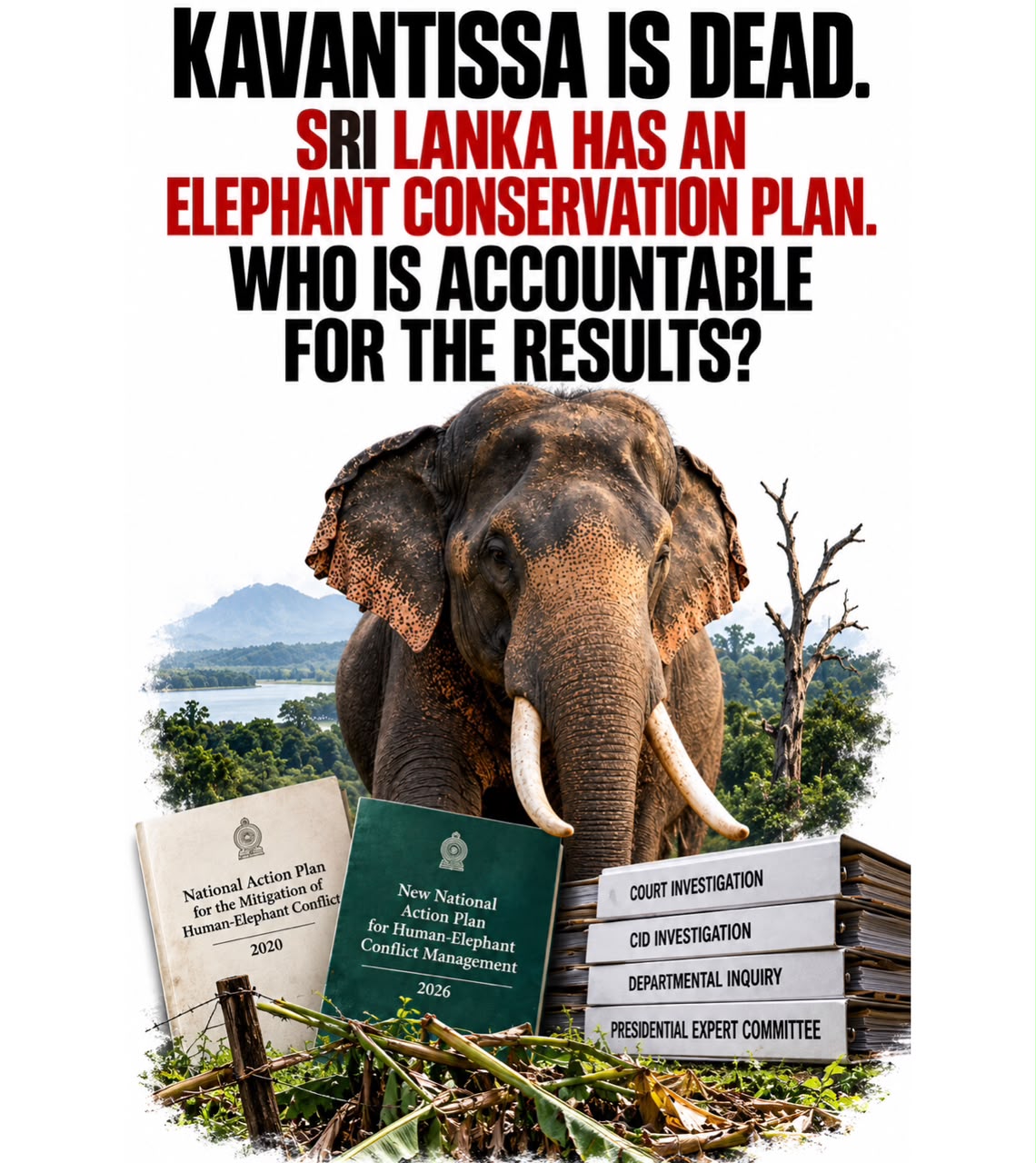
The death of one of Sri Lanka’s best-known wild tuskers has exposed troubling questions about conservation policy, institutional responsibility and the unequal burden imposed on rural communities. With three investigations underway and the Government preparing another national action plan, the country must confront a fundamental question: why have years of scientific advice, public expenditure and political promises failed to prevent the continuing loss of human and elephant lives?
The death of Tusker Kavantissa on 16 October 2026 should provoke more than the familiar national expression of sadness that follows the loss of a celebrated wild elephant. It should compel Sri Lanka to examine the effectiveness of a conservation system in which scientific knowledge, government authority, public expenditure and repeated policy announcements have not produced sufficient protection for either elephants or the people who live alongside them. The question is not simply whether Sri Lanka values its wildlife, but whether its institutions have translated that commitment into measurable results.
Kavantissa reportedly suffered a gunshot injury to his right front leg on 23 September and received veterinary treatment before his health deteriorated. The precise cause of death must be established through the proper investigative and veterinary processes rather than presumed in advance. The Galgamuwa Magistrate’s Court has ordered a post-mortem examination and a formal investigation, while two suspects have been arrested and remanded until 28 October. Their arrest represents an important development, but criminal responsibility must be established through evidence and due process.
Submit Your Press Release
Get your company news, announcements, launches, appointments and events in front of a wider audience.


The Government has now initiated three separate investigations, including an inquiry by the Criminal Investigation Department, an internal investigation involving external specialists and a six-member presidential expert committee. The presidential committee has been directed to examine the circumstances surrounding Kavantissa’s death, including possible shortcomings in veterinary treatment, and recommend improvements to wild elephant welfare and conservation. At its first meeting on 21 October, the committee also considered establishing a rapid-response veterinary unit to provide timely treatment to injured elephants. These initiatives deserve recognition, but their ultimate value will depend upon the independence of their findings, the transparency of their recommendations and the Government’s willingness to implement them.
The distinction between investigation and accountability is important. The death of an elephant, however distressing, does not automatically establish negligence by wildlife authorities. Equally, the absence of a confirmed finding of negligence cannot absolve the State of its wider responsibility to demonstrate that its conservation policies are effective. Public accountability requires evidence in both directions, together with an honest willingness to examine uncomfortable findings.
Sri Lanka’s broader record offers ample reason for concern. Reported figures indicate that since 2019, an average of approximately 402 elephants and 138 people have died annually in connection with human-elephant conflict. In 2023 alone, 488 elephant deaths were recorded. These are not merely statistics about wildlife. They represent the destruction of a national ecological resource alongside the deaths, injuries, lost livelihoods and persistent insecurity experienced by rural communities.
The scale of the problem also exposes the limitations of treating elephant conservation as an activity confined to national parks. Research and official assessments demonstrate that elephants occupy extensive areas outside protected reserves, sharing landscapes with settlements, farms, irrigation systems and infrastructure. Conservation policy must therefore address the realities of coexistence rather than assume that elephants can simply be confined to designated forests while human development proceeds elsewhere.
Perhaps the most serious governance question concerns Sri Lanka’s National Action Plan for the Mitigation of Human-Elephant Conflict, prepared in 2020. That plan recognised the importance of scientific management, community participation and protecting villages and cultivated land. It offered an alternative to approaches that depend excessively on reactive interventions, elephant relocation and administrative responses after conflict has already occurred.
Yet in June 2026, the Cabinet approved the preparation of a new National Action Plan for Human-Elephant Conflict Management, acknowledging that changing circumstances demanded a revised approach. The Government reported that the conflict had spread across 19 districts and 134 Divisional Secretariat divisions, affecting a substantial proportion of the country. The decision to prepare another plan may be justified, but it raises an unavoidable question: what happened to the recommendations of the 2020 plan, and what evidence establishes that a replacement is preferable to implementing measures previously recommended?
Before another national strategy is adopted, the public deserves an account of the previous one. Which measures were implemented, which were abandoned, which encountered administrative resistance, and which produced demonstrable improvements? How much public money was allocated, what outcomes were achieved, and which institutions were responsible for failures or delays? Without such an assessment, successive action plans risk becoming substitutes for action rather than instruments of effective governance.
Conservation responsibilities extend beyond the Department of Wildlife Conservation to agencies dealing with forestry, agriculture, land, irrigation, infrastructure and regional administration. A programme requiring cooperation across those institutions cannot succeed unless responsibilities are clearly assigned and its progress independently assessed. Where conflicting decisions undermine conservation, the public must know which institutions exercised authority and what justification they offered.
This criticism should not be interpreted as a dismissal of the efforts of wildlife officers and veterinary professionals. Many operate in dangerous conditions, with inadequate resources and considerable personal commitment. Their work deserves recognition, particularly when responding to injured animals or protecting communities facing immediate threats. Nevertheless, individual dedication cannot compensate indefinitely for institutional arrangements that may lack effective coordination, adequate resources or clear accountability.
An equally neglected question concerns the economic distribution of conservation’s costs and benefits. Sri Lanka’s wild elephants contribute significantly to tourism, biodiversity, national identity and the country’s international reputation. Yet many of the direct costs associated with their survival are borne by farming families who receive little of the economic value generated by wildlife tourism. A conservation policy that distributes benefits nationally while concentrating losses among vulnerable rural communities contains an inherent inequity.
Research published in 2023 involving 300 farming households in southern Sri Lanka demonstrated this imbalance. None of the surveyed households reported deriving economic benefits from tourism, although 57 per cent had experienced elephant-related crop damage. The study also found that fear of elephants and anxiety about crop losses strongly influenced attitudes towards them. These findings suggest that conservation cannot be secured through financial considerations alone, because personal safety, uncertainty and the psychological burden of living with danger are equally important.
Further research published in 2024, involving 439 affected farming households, examined the potential for tourism-based financial mechanisms to support compensation for losses arising from human-elephant conflict. The findings provide a basis for examining whether those who benefit economically from wildlife conservation should contribute more directly to its costs. This is not merely a question of generosity towards rural communities, but one of economic fairness and the long-term sustainability of conservation itself.
The proposal deserves serious policy consideration, but its implementation would require financial discipline and transparent administration. The Government should establish how much wildlife tourism revenue is collected, what existing commitments apply to those funds, what share might lawfully be redirected, and how compensation could be delivered without creating another inefficient bureaucracy. A credible scheme would also require independent verification of losses, publicly available eligibility criteria and safeguards against political interference.
Compensation must, however, remain secondary to prevention. Families should not be expected to accept the loss of crops, property or personal security simply because payments may eventually follow. Effective conservation requires appropriately located and maintained protection systems, reliable warnings, sound land-use decisions and the meaningful involvement of communities that understand elephant movements and local conditions. Their knowledge should be incorporated into policy design and operational decisions, rather than sought merely to endorse programmes determined elsewhere.
Political leadership must also confront the consequences of development decisions affecting elephant habitats and movement corridors. Settlement expansion, infrastructure construction, agricultural projects and other land-use changes can intensify conflict when ecological consequences are inadequately considered. These decisions often involve authorities outside the wildlife sector, yet their consequences are ultimately borne by wildlife officers, affected villagers and the elephants themselves. Accountability must therefore extend to the institutions responsible for land allocation and development approvals, not simply those called upon to manage the resulting emergencies.
The problem is not an absence of public announcements or an insufficient number of conservation initiatives. Electric fences, emergency operations and elephant relocations may have legitimate roles, but their success must be measured against outcomes rather than visibility. How many human deaths have been prevented, how much crop damage has been reduced, which conflict areas have become safer, and what proportion of public expenditure has produced lasting benefits? These are the measures by which conservation policy should be judged.
An independent assessment of the 2020 action plan, published before or alongside the proposed replacement, would provide a necessary starting point. It should identify implementation gaps, assess expenditures, examine inter-agency coordination and recommend measurable targets with clearly assigned responsibilities. The revised national strategy should then be subject to periodic public reporting, allowing Parliament, affected communities and conservation specialists to evaluate progress against evidence rather than assurances.
Kavantissa’s death also presents a specific test of institutional transparency. The findings of the court-directed investigation and the three inquiries should establish the circumstances of his injury, the treatment provided and the cause of death. If shortcomings are identified, they should be addressed through appropriate corrective measures. If the evidence establishes that those responsible acted properly under difficult circumstances, that conclusion deserves equal recognition.
The presidential committee’s consideration of a rapid-response veterinary unit is encouraging, but it also invites examination of existing emergency arrangements. What capacity currently exists to reach injured elephants, particularly in remote areas, and what equipment, personnel and specialist expertise are available? If deficiencies are established, the Government should publish a practical programme for correcting them, including funding, responsibilities and implementation deadlines. Another committee report that identifies problems without producing measurable improvements would represent a further failure of public administration.
Sri Lanka cannot afford to make conservation a contest between the welfare of elephants and the rights of rural communities. Every person has a legitimate expectation of safety, while the survival of wild elephants forms part of the country’s ecological responsibility to future generations. Protecting one at the expense of the other is neither equitable nor sustainable. Effective policy must recognise that both depend upon sound governance, scientific evidence and a fair distribution of costs and benefits.
The Government now has an opportunity to demonstrate that its proposed new action plan will be more than another administrative exercise. It can begin by accounting for what was achieved under the previous strategy, identifying the obstacles to implementation and publishing clear commitments against which future performance can be assessed. That would be a more meaningful tribute to Kavantissa than another declaration of national sorrow.
Be that as it may, the real measure of Sri Lanka’s commitment to conservation will not be the number of plans it produces, the committees it appoints, the promises it makes or the grief expressed when another elephant dies. It will be whether fewer elephants are killed, fewer people lose their lives, farming families become safer and the institutions entrusted with protecting them can demonstrate that their decisions have delivered results. Kavantissa’s death has once again brought the country’s conservation failures into public view. Whether it becomes a turning point or another forgotten tragedy will depend not on the conclusions of another report, but on what those entrusted with public authority actually do.



