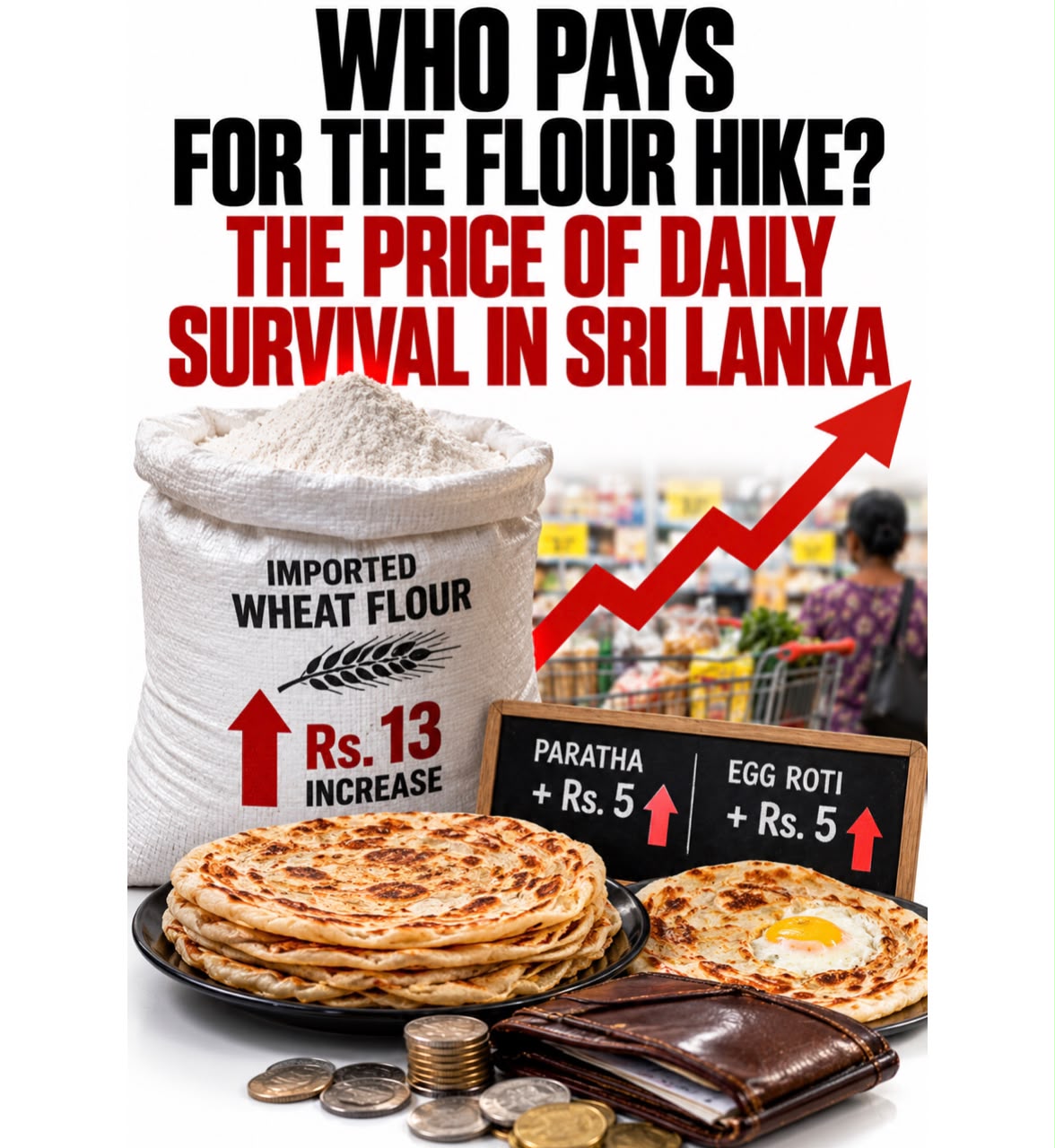
A Rs. 13 increase in imported wheat flour has prompted a Rs. 5 rise in the price of parathas and egg roti. For millions already struggling with household expenses, another seemingly minor adjustment raises a larger question: who protects consumers when essential food prices keep climbing?
In economic reports, a Rs. 13 increase in the price of a kilogram of imported wheat flour might appear insignificant. When the All Ceylon Canteen and Restaurant Owners’ Association subsequently announces a Rs. 5 increase for parathas and egg roti, effective from midnight, the adjustment may barely register in official policy discussions. Yet for ordinary Sri Lankans, these increases represent another erosion of already stretched household budgets.
There is no such thing as an insignificant increase in the cost of basic food for families living from one payday to the next. Daily-wage workers, students and low-income households cannot simply absorb repeated price adjustments without consequences. Every additional rupee spent on food reduces what remains available for transport, education, medicine and other essentials.
Submit Your Press Release
Get your company news, announcements, launches, appointments and events in front of a wider audience.


The immediate explanation for higher flour prices generally centres on international grain markets, shipping costs, exchange rates and import expenses. Sri Lanka’s wheat flour market remains heavily dependent on a small number of major suppliers, raising legitimate questions about competition and pricing transparency. When suppliers adjust their prices, the consequences quickly reach bakeries, restaurants and roadside food outlets.
But should consumers simply accept every increase as an unavoidable consequence of international market conditions? What mechanisms exist to independently verify the justification for price revisions, and how effectively are competition authorities monitoring the market? Equally importantly, when international prices decline, are reductions passed on to consumers with the same urgency?
Successive governments have demonstrated considerable enthusiasm for discussing economic recovery through inflation statistics, fiscal targets and international financial assessments. These indicators matter, but they provide an incomplete picture of household hardship. A slowing inflation rate does not mean prices have returned to earlier levels, particularly after years of substantial increases.
The consequences extend beyond individual consumers. Small restaurants and tea shops face higher operating costs while attempting to retain customers whose purchasing power remains constrained. Raising prices risks losing business, while absorbing additional costs threatens already narrow margins. Either way, the pressure ultimately falls on small enterprises and their customers.
Be that as it may, government intervention need not mean arbitrary price controls or commercially unsustainable subsidies. It should mean transparent pricing, effective competition enforcement, scrutiny of import costs and policies that encourage alternative suppliers. Authorities must also establish whether existing consumer protection mechanisms are functioning as intended.
Sri Lanka cannot claim meaningful economic recovery while substantial sections of its population struggle to afford everyday meals. Stability measured through financial indicators must eventually translate into improved purchasing power and greater household security.
A Rs. 5 increase may appear trivial to those determining economic policy. Multiply it across several purchases, several family members and an entire month, and its significance becomes considerably clearer.
The question is not simply why flour costs more. It is whether economic policy is delivering meaningful protection and relief to the people expected to pay for it.