
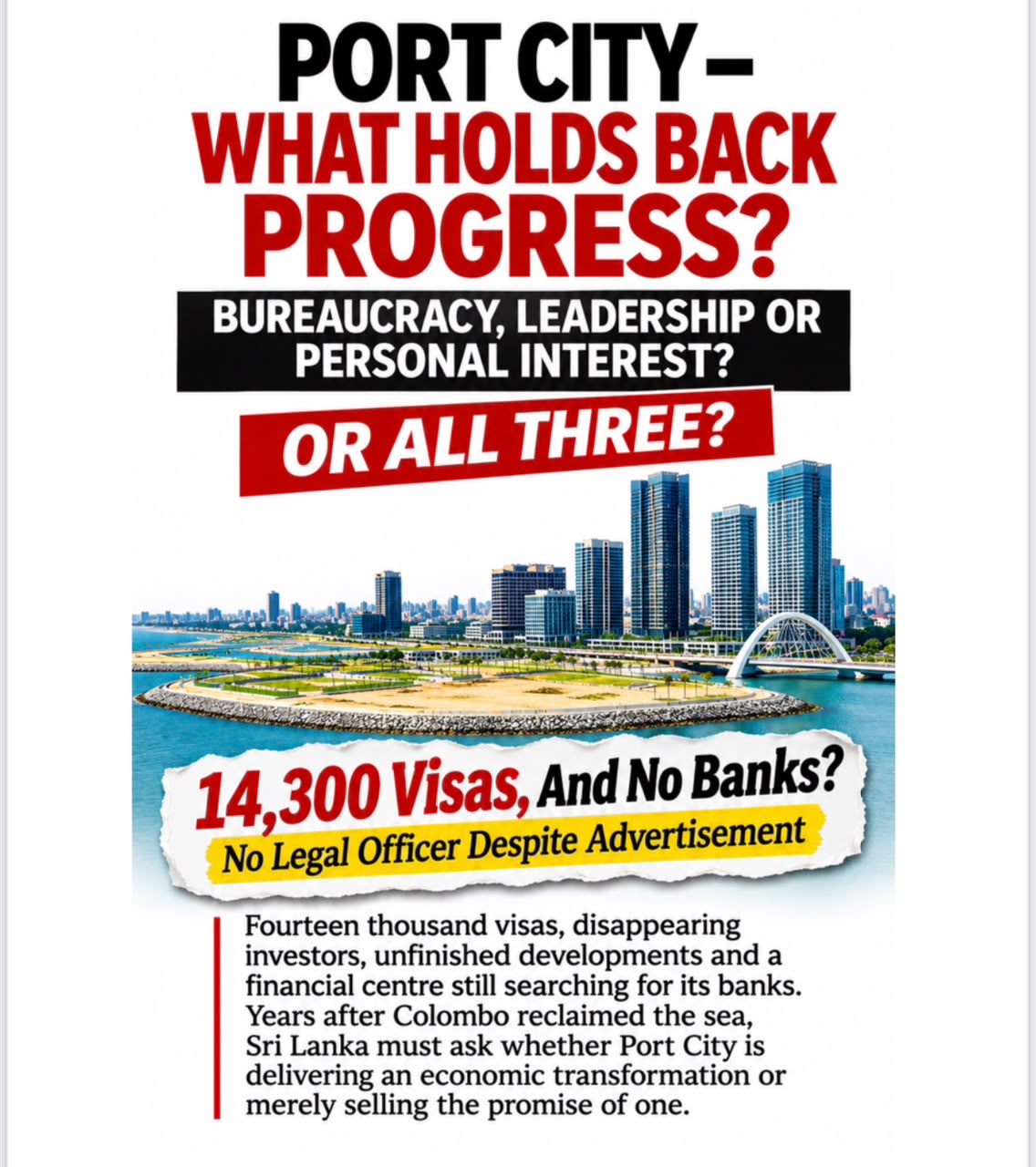
14,300 Visas, And No Banks? No Legal Officer Despite Advertisement
Fourteen thousand visas, disappearing investors, unfinished developments and a financial centre still searching for its banks. Years after Colombo reclaimed the sea, Sri Lanka must ask whether Port City is delivering an economic transformation or merely selling the promise of one.
Sri Lanka was promised a new Dubai. A world-class international financial centre, billions in foreign investment, thousands of skilled jobs and a commercial gateway connecting South Asia to the world’s financial markets. It was an audacious vision, perhaps the most ambitious urban development project in the country’s history. More than a decade after its launch, and years after the reclamation of 269 hectares from the Indian Ocean, the uncomfortable question is whether Colombo Port City has become a financial centre or remains principally an expensive construction project waiting for its economic purpose to materialise.
Submit Your Press Release
Get your company news, announcements, launches, appointments and events in front of a wider audience.


There has been progress. Roads, public spaces and supporting infrastructure have been developed. Construction has commenced on several commercial and residential projects. Investors have signed agreements and businesses have registered under the special economic zone framework. But progress must be measured against the extraordinary promises used to justify the project, not simply against the number of cranes visible on the skyline.
The evidence emerging from Parliament, the Auditor General and the Port City authorities themselves suggests that the gap between ambition and delivery remains substantial.
WHERE ARE THE INTERNATIONAL BANKS?
Perhaps the most revealing weakness is the absence of a demonstrably functioning international offshore banking ecosystem.
Port City was conceived as a financial and commercial centre capable of attracting international banking institutions, fund managers, professional services firms and businesses conducting substantial cross-border transactions. Yet in February 2026, Sri Lanka was still revising the legal architecture governing offshore banking operations.
The Colombo Port City Economic Commission (Amendment) Act, certified on January 20, 2026, restricted the special offshore banking licensing regime to foreign-incorporated banks. It also clarified the Central Bank’s supervisory responsibilities and the approvals required before such institutions could commence operations.
The amendments may strengthen regulatory credibility. But they also invite an obvious question. Why was such a fundamental component of the financial centre’s regulatory framework still being substantially revised so many years after the project’s commencement?
In July, Parliament was informed that several established Sri Lankan banks had committed to projects within Port City. That is encouraging, but domestic banks expressing interest in a development are not the same as major international institutions establishing offshore banking operations.
The Commission and the Central Bank should disclose precisely how many offshore banking licences have been granted, the institutions holding them, how many have commenced business and the value of international financial transactions generated.
Until those figures are publicly established, the claim that Port City is emerging as a serious international financial centre remains an ambition rather than a demonstrated commercial achievement.
14,300 VISAS. SIXTEEN STAFF. WHO IS WATCHING?
The most disturbing revelations concern the administration and supervision of foreign workers associated with Port City businesses.
At a meeting of Parliament’s Committee on Public Finance on October 8, the Commission disclosed that approximately 14,300 visas had been facilitated through its recommendation arrangements. The Commission also acknowledged that its entire staff numbered just sixteen.
The arithmetic is extraordinary. It represents approximately 894 visa cases for every Commission employee, although not every employee is responsible for immigration compliance and the figure does not necessarily represent 14,300 people currently resident in Sri Lanka.
The Commission is not the authority that ultimately issues visas. That responsibility belongs to the Department of Immigration and Emigration. Nevertheless, the Commission recommends applicants and supervises the businesses operating under its authorisations.
Parliamentarians questioned whether periodic inspections and company-submitted reports could provide adequate oversight of such a large foreign workforce.
Their concerns were not hypothetical.
Five Chinese nationals associated with two Port City-authorised businesses were refused entry and deported after immigration officials were reportedly dissatisfied with their explanations for entering Sri Lanka. The Commission temporarily suspended visa recommendations for the two businesses before lifting the suspensions following inspections.
The episode does not establish that those businesses engaged in criminal activity. It does, however, demonstrate that the system has encountered compliance problems serious enough to require intervention.
There is another uncomfortable dimension. Many Port City-authorised businesses operate from premises elsewhere in Sri Lanka because the permanent commercial accommodation envisaged within the reclaimed development is still being built.
Such operations may be legally permitted. But they raise an essential economic question.
If businesses are operating from ordinary commercial premises in Colombo while enjoying the privileges of a specially designated economic zone, what additional economic activity is Port City actually creating?
Are these genuinely new international enterprises bringing fresh investment, foreign earnings and employment into Sri Lanka? Or are some businesses benefiting from a preferential regulatory and fiscal framework without delivering commensurate national value?
Those questions demand answers based on verified data, not assurances.
THE CYBERCRIME QUESTION CANNOT BE IGNORED
Parliament’s concerns extended to the possibility that criminal networks displaced from other parts of Asia could exploit weaknesses in Sri Lanka’s immigration and investment supervision.
Parliamentary Committee Chairman Dr Harsha de Silva drew attention to sharp increases in arrivals from Myanmar, Vietnam and Cambodia, countries associated with regional cyber-scam operations.
These nationality statistics do not establish wrongdoing by any individual or Port City business. Nor should nationality become a substitute for evidence. But the concerns raised by parliamentarians deserve a serious regulatory response.
On November 1, the Sunday Times reported that law enforcement sources had raised questions about the use of Port City-related employment documentation by foreign nationals arrested in connection with suspected scam operations.
The Commission, responding to the newspaper, stated that it had received no police reports establishing that authorised businesses were conducting scam-related activities from approved premises.
It also said that it had not formally investigated or referred an authorised business for suspected fraud, money laundering, cybercrime or visa misuse since 2021.
That statement requires careful interpretation. It is not proof that criminal activity has occurred. Equally, an absence of formal referrals does not establish that the regulatory system has successfully detected every possible violation.
The Commission says it conducts background checks, requires police clearance documentation and has introduced additional compliance measures, including cybercrime-related audits.
The public should now be told how many such audits have actually been completed, how many businesses have been inspected, what irregularities were identified and what enforcement action followed.
Sri Lanka cannot afford to acquire a reputation as a convenient jurisdiction for dubious international operations while simultaneously advertising itself as a trusted financial centre.
BILLIONS ANNOUNCED. HOW MUCH HAS ACTUALLY ARRIVED?
The investment figures provide another revealing lesson in the difference between publicity and economic reality.
In July 2026, Deputy Finance Minister Dr Anil Jayantha informed Parliament that Port City had attracted investment commitments valued at approximately US$2.19 billion across 176 investments.
But the same parliamentary disclosure distinguished those commitments from approximately US$336.67 million in investments described as finalised.
The distinction is fundamental.
An investment announcement is not a bank transfer. A signed memorandum is not completed construction. An approved project is not necessarily a functioning enterprise employing Sri Lankans and earning foreign currency.
In October, the Commission presented further figures indicating approximately US$1.12 billion in primary investments associated with nine leased land parcels.
These figures may represent different categories and stages of investment. They cannot responsibly be added together or compared without reconciliation.
The Commission should publish a single, independently verifiable statement distinguishing announced commitments, legally binding agreements, actual foreign capital received, expenditure incurred, projects under construction and completed investments.
Without such transparency, impressive investment totals risk becoming an exercise in accounting presentation rather than evidence of economic transformation.
THE INVESTORS WHO WALKED AWAY
Perhaps the most damaging evidence of the distance between promise and delivery emerged during October’s parliamentary scrutiny.
The Commission acknowledged that five of ten previously identified projects had withdrawn.
Among the developments reported to have fallen away were the proposed Asiri Hospital, a Gateway educational facility and a mixed-use development. Universal Entertainment Colombo also withdrew during due diligence for a proposed integrated resort site.
These were not insignificant components of the vision.
An international hospital, educational institutions and major commercial developments were intended to create the supporting ecosystem of a functioning international business district.
Their withdrawal raises questions about investor confidence, commercial viability, regulatory certainty and the assumptions underlying the original development strategy.
There may be perfectly legitimate reasons for individual investors to abandon projects. Financing conditions change. Commercial calculations evolve. International investors reassess risks.
But when several prominent developments fail to proceed, the public deserves more than another announcement about the next investment pipeline.
It deserves an explanation of what went wrong and what has changed to prevent further withdrawals.
THE AUDITOR GENERAL’S UNCOMFORTABLE FINDINGS
The Auditor General’s 2024 annual report provides an independent assessment of development progress.
According to the report, as at January 31, 2025, only 74 percent of road-system works, 73 percent of passenger bridges and 77 percent of landscaping works had been completed against a March 2024 target for full completion.
More significantly, the report recorded that, as at December 31, 2024, the relevant ministry had not concluded agreements with the principal agencies responsible for supplying essential infrastructure to the Port City boundary.
These included the electricity, water and municipal authorities.
The report also identified a particularly troubling situation concerning government-owned land.
Although approximately 62 hectares had been allocated to the Sri Lankan Government from the commercially developable land, the Auditor General reported that no construction had commenced on that land as at April 22, 2025.
The development company, meanwhile, had already begun activities capable of generating revenue on land allocated to it.
This raises a question of direct national importance.
Why has the commercial potential of the government’s land remained unrealised while other parts of the project have progressed?
The Commission and the Government should explain what action has been taken since those audit findings and whether the deficiencies have now been corrected.
IS PORT CITY BECOMING ANOTHER LUXURY PROPERTY MARKET?
Construction activity is finally becoming visible on several development sites.
The Commission has reported progress on the Colombo International Financial Centre, the marina and residential projects. Its development partner has also highlighted a substantial pipeline of future investment.
These are legitimate developments, and their progress should be acknowledged.
But the strategic question remains whether the balance of investment is consistent with the original purpose of establishing an international financial and commercial centre.
Sri Lanka already possesses an extensive high-end apartment market. Questions about absorption rates, unsold inventory, rental yields and the sustainability of further luxury residential supply require serious examination.
Why should Port City become another destination for high-priced apartments if the international financial services industry that was supposed to sustain demand has not yet developed at comparable scale?
Residential property has a place in any successful international commercial district. But apartments cannot become a substitute for banks, financial institutions, internationally traded services and productive enterprises.
The Commission should disclose the proportion of committed investment allocated to residential developments compared with financial services, technology, education, healthcare and other sectors capable of generating recurring economic value.
A CULTURE THAT INVESTORS QUESTION
Beyond the published statistics, NEWSLINE has heard concerns from potential investors about the manner in which investment proposals have been handled.
One prospective investor described an approach characterised by the sentiment: “This is our way and there is no other way.”
Such accounts remain individual testimony and do not establish institutional misconduct. Nevertheless, they raise concerns about administrative flexibility, consistency and the predictability of investment decisions.
An international financial centre cannot operate successfully on the assumption that investors have nowhere else to go.
Dubai, Singapore and other established centres compete aggressively for international capital. Their attractiveness rests not merely on tax incentives or impressive buildings, but on legal certainty, regulatory competence, professional administration and the confidence that commercial decisions will be treated consistently.
Sri Lanka must compete on those terms.
RECRUITMENT – PERSONAL OR PROFESSIONAL?
There have also been allegations concerning senior management recruitment and whether established procedures have always been followed. The Director General would be the officer with the most likely final accountability. Revaan Wickramasuriya is due to be interviewed by our associated broadcast channel NEWSLINE – CORPORATE SRI LANKA when a multitude of questions will be posed.
No conclusion of improper appointment or personal favouritism can be drawn without examining the relevant records. But transparency would serve both the institution and those appointed.
The Commission should publish the applicable recruitment procedures, qualifications required for senior positions, appointment criteria and conflict-of-interest safeguards. Two advertisements were indeed placed although the position of Legal Director was not filled at the time.
An institution entrusted with advancing billions of dollars in investment must be prepared to demonstrate that its own governance meets the standards it seeks to attract and to not have its own in-house Legal Director may not be the best course notwithstanding that a prominent legal personality Harsha Amerasekera is the Chairman. Some accounts estimate that Mr Amerasekera is on the board of at least 7 publicly quoted corporates.
THE NATIONAL INTEREST MUST COME FIRST
Port City was never intended to be merely a collection of luxury buildings on reclaimed land.
It was presented as a transformational national economic project.
Its success should therefore be measured in genuine foreign investment received, international banking activity, sustainable employment, foreign exchange earnings, productive enterprises and long-term benefits to the Sri Lankan economy.
It is also necessary to recognise the difficulties the project has faced. Sri Lanka’s sovereign debt crisis, political instability, international economic uncertainty and changing investor sentiment have undoubtedly complicated development. Those circumstances help explain delays. They do not remove the obligation to account for performance.
Nor should criticism of Port City become an exercise in attacking Chinese investment. The development represents an opportunity for Sri Lanka, and its success would be welcome regardless of the nationality of its investors.
The responsibility for ensuring that the project serves Sri Lanka’s interests rests with the institutions empowered to regulate and administer it.
THE TIME FOR ANSWERS HAS ARRIVED
The Commission must now provide a comprehensive public account of its performance.
How many offshore banks are licensed and operational? How much foreign capital has actually entered Sri Lanka? How many authorised businesses are genuinely conducting commercial operations? What is the verified foreign exchange contribution of those businesses?
How many foreign workers are currently present under Port City-related visa arrangements? How many operate outside the reclaimed area? What compliance inspections have been conducted? What is the present status of projects that have withdrawn?
And perhaps most importantly, what is the timetable for delivering the international financial centre that Sri Lanka was promised?
These questions are neither anti-investment nor anti-development.
They are the questions that any responsible government, investor, taxpayer or citizen should ask of a project enjoying exceptional legislative attention, valuable economic concessions and extraordinary national expectations.
Be that as it may, Sri Lanka cannot continue confusing the announcement of investment with the arrival of investment, the registration of businesses with the creation of businesses, or the issuance of visas with the generation of economic value.



