
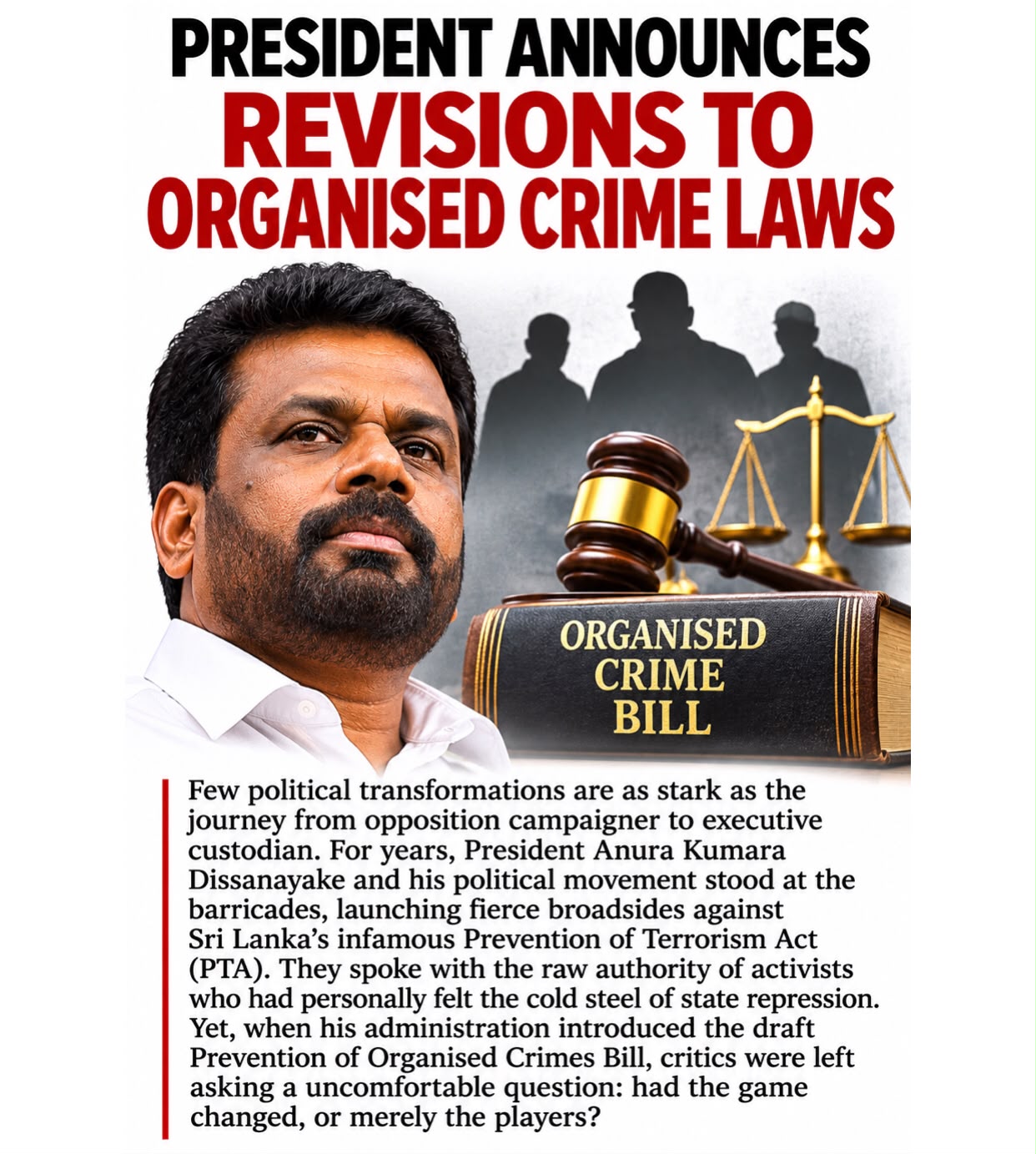
Few political transformations are as stark as the journey from opposition campaigner to executive custodian. For years, President Anura Kumara Dissanayake and his political movement stood at the barricades, launching fierce broadsides against Sri Lanka’s infamous Prevention of Terrorism Act (PTA). They spoke with the raw authority of activists who had personally felt the cold steel of state repression. Yet, when his administration introduced the draft Prevention of Organised Crimes Bill, critics were left asking a uncomfortable question: had the game changed, or merely the players?
The proposed legislation, designed to crack down on the nation’s escalating gang networks and underworld syndicates, immediately set off alarm bells across the legal and human rights landscape. What was marketed as a modern weapon against cartel violence began looking suspiciously like a recycled version of the very laws the governing coalition once pledged to dismantle.
The pushback was swift, loud, and multi-directional. Local legal bodies, civil rights advocates, and trade unions warned that the bill’s initial framework granted sweeping executive powers prone to abuse. Chief among the flashpoints was a clause permitting an initial 72-hour detention period without judicial oversight, a window long identified by human rights researchers as the most dangerous period for custodial abuse.
Submit Your Press Release
Get your company news, announcements, launches, appointments and events in front of a wider audience.


Internationally, watchdog organizations and UN observers weighed in with familiar concern, noting that vague definitions within the draft could easily be repurposed to clamp down on political dissent, labor protests, or investigative journalism. Perhaps the most bizarre addition to the draft was a clause targeting physical tattoos, attempting to codify visual body art into legal evidence of criminal gang membership. Critics quickly pointed out that importing gang-identification metrics from Latin America into a South Asian context was not only legally dubious, but practically absurd.
Facing an unprecedented wave of resistance from the very civil society groups that once supported his reform agenda, President Dissanayake used a public address at a “Ratama Ekata” national operation event to signal a tactical retreat.
”We have personally experienced the impact of repressive laws,” Dissanayake told the audience, addressing the growing unease directly. “Our government has no intention of introducing legislation similar to the PTA to combat organised crime, nor do we intend to suppress the public or violate fundamental rights.”
In a clear concession to critics, the President announced that the administration was actively revising key provisions of the bill. The proposed maximum detention period for suspects will be slashed from 72 hours to 48 hours, bringing it closer to standard criminal procedures. Dissanayake also confirmed that the controversial tattoo clause is on the chopping block, admitting it was unnecessary in the Sri Lankan context.
In a clear concession to critics, the President announced that the administration was actively revising key provisions of the bill. The proposed maximum detention period for suspects will be slashed from 72 hours to 48 hours, bringing it closer to standard criminal procedures. Dissanayake also confirmed that the controversial tattoo clause is on the chopping block, admitting it was unnecessary in the Sri Lankan context.
While the government’s willingness to listen and recalibrate is a welcome departure from the unyielding arrogance of past administrations, the episode highlights the delicate tightrope Dissanayake must walk. Balancing the urgent need to dismantle sophisticated criminal syndicates against the sacred duty to protect civil liberties is no easy task. For a government built on the promise of systemic transformation, drafting tough laws might be easy, but convincing a vigilant public that those laws won’t be turned against them requires far more than mere good intentions.



