
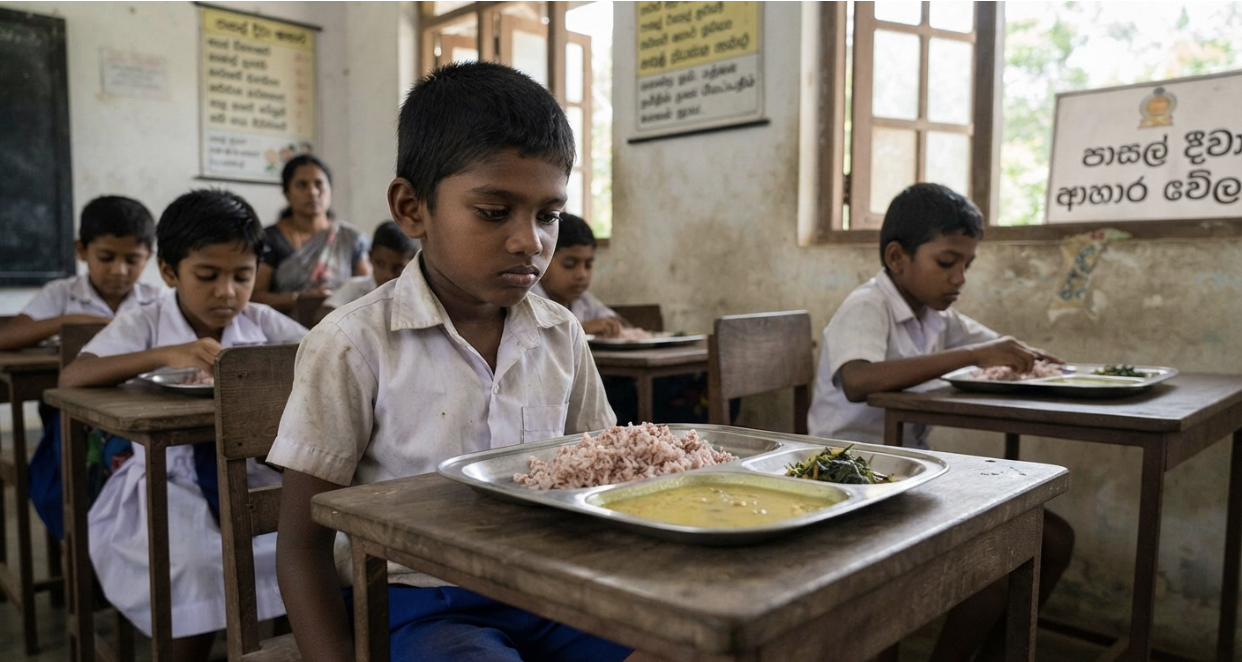
How does a state spend Rs. 33.6 billion feeding 1.4 million schoolchildren and still end up sitting in Parliament asking why the food is not up to scratch? That awkward question hovered over the Ministerial Consultative Committee on Education, Higher Education and Vocational Education when it met under the chairmanship of Prime Minister and Education Minister Dr. Harini Amarasuriya. Behind the polite parliamentary phrasing about “instances where guidelines had not been properly followed” lies a far sharper reality: an ambitious, expensive welfare lifeline is being undermined by sloppy execution on the ground.
First, consider why Sri Lanka cannot afford to treat school lunches like an afterthought. Child malnutrition in this country is neither an abstract seminar topic nor evenly spread across postcodes. Central Bank data following the economic crisis showed 15.3% of children under five were underweight, 10.1% suffered from wasting, and 9.2% were stunted, while a third of children aged zero to four lived in multidimensional poverty. Step onto the tea estates and the numbers turn bleak. World Bank assessments have long flagged estate stunting and underweight rates at 36%, roughly triple urban levels, while post-crisis clinical surveys in Nuwara Eliya recorded stunting surging to 31.3% and severe household food insecurity hitting nearly 20%. Class and geography dictate what lands on a child’s plate long before a school bell rings: children born to mothers without formal education face stunting rates of 37.6%, compared with 12.1% among mothers holding degrees.
In that context, a hot school meal is not charity. It is basic cognitive infrastructure. You cannot lecture a hungry eight-year-old about quadratic equations or national productivity when their blood sugar crashed before the first interval. Sri Lanka understood this as far back as 1931, when midday meals were first introduced, and successive governments expanded the current universal primary push across roughly 8,900 schools to keep attendance up and fainting spells down. By 2026, the treasury’s Rs. 33.6 billion allocation works out to roughly 1% of all government expenditure, feeding one in sixteen citizens on any given school day.
Submit Your Press Release
Get your company news, announcements, launches, appointments and events in front of a wider audience.


So how do you take a policy that noble and bruise it in broad daylight? You write detailed nutrition manuals, fix per-meal allocations around Rs. 110, mandate teacher taste-tests and Public Health Inspector sign-offs, and then let monitoring quietly go to sleep. When suppliers cut corners on protein, stretch menus with cheap starch, or ignore hygiene rules, the failure is not merely culinary. It is a quiet theft of public money and a breach of trust with families who rely on that single meal to bridge the gap left by stagnant wages and inflated grocery bills. Even more absurd is the wider patchwork laid bare at the same committee meeting: stalled teacher transfers, creaking infrastructure, and preschools operating with weak oversight while the state simultaneously pledges to link school kitchens to local agriculture and women’s empowerment.



