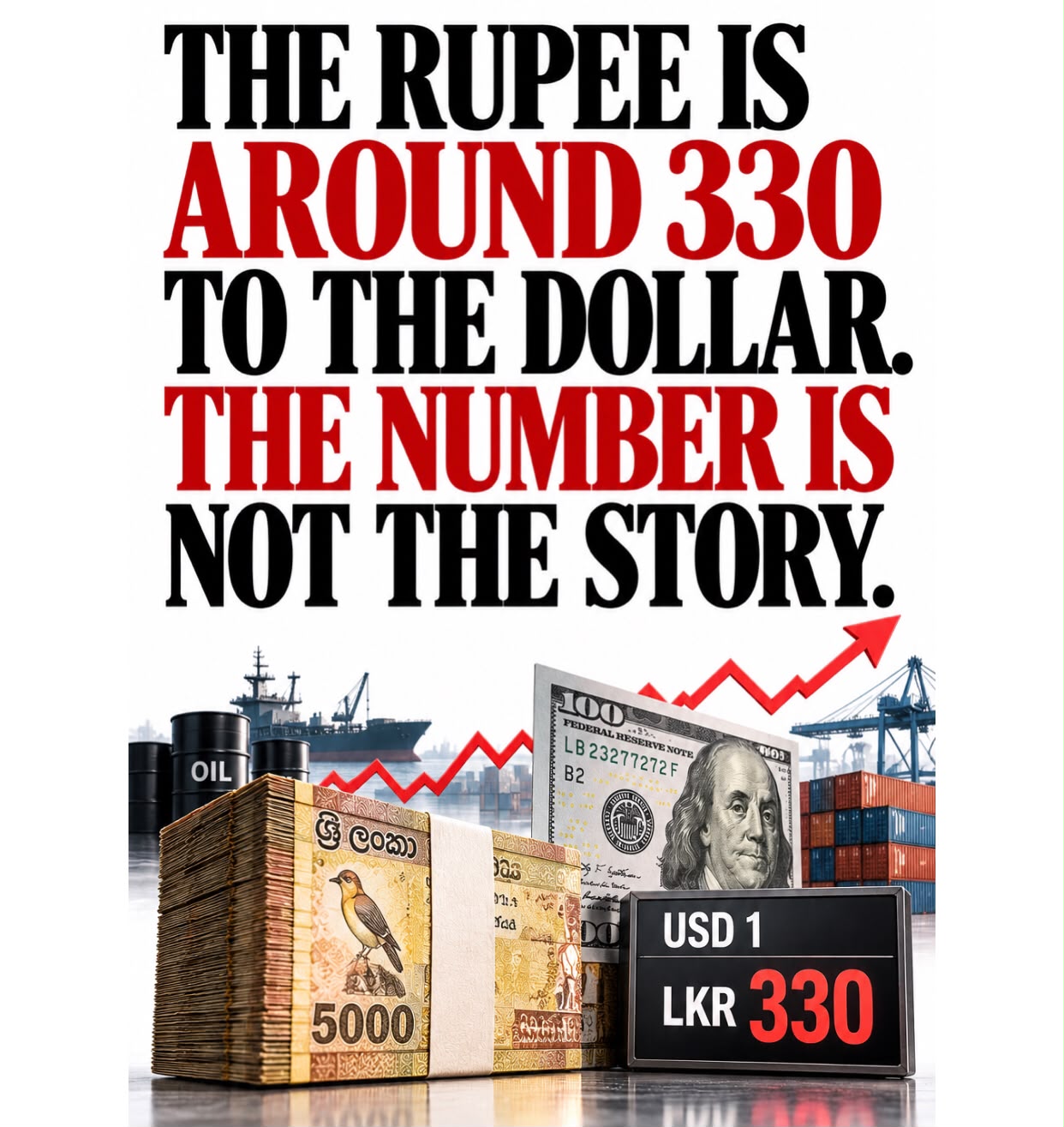
The Sri Lankan rupee is again trading around 330 to the US dollar as the country absorbs higher energy costs and renewed external uncertainty. There is no reason for panic, but there is every reason to understand what is moving underneath the exchange rate.
Sri Lanka has traditionally treated the exchange rate as though it were a national scorecard. A stronger rupee is presented as evidence that economic management is succeeding, while a weaker currency immediately becomes evidence for the opposite argument. Neither interpretation tells us very much without examining why the currency is moving.
The exchange rate is fundamentally a price. Sri Lanka requires dollars to purchase fuel, medicines, machinery, food, vehicles, industrial inputs and thousands of other imports, while foreign currency enters through exports, tourism, workers’ remittances, investment and borrowing. The balance between those flows ultimately influences what a dollar costs in rupees.
Submit Your Press Release
Get your company news, announcements, launches, appointments and events in front of a wider audience.


The Middle East has complicated that balance. Sri Lanka imports petroleum and higher international oil prices mean more dollars are required to purchase the same physical quantity of fuel. Shipping disruption, insurance costs and other consequences of the conflict can add further pressure even before a cargo reaches Colombo.
Import demand has also been recovering with the economy. Vehicle imports have returned, businesses are purchasing more inputs and economic normalisation naturally increases demand for foreign currency. That is not necessarily unhealthy. A recovering economy is supposed to import machinery, equipment and productive inputs, but those purchases still have to be financed.
Against this, Sri Lanka is earning substantial foreign exchange from workers’ remittances and tourism while official reserves had reached approximately US$6.9 billion by the end of August. That leaves the country in an incomparably stronger position than during 2022, when shortages of foreign currency became shortages of fuel, medicine and other essentials.
US$6.9 billion is nevertheless a buffer rather than an inexhaustible bank account. The Central Bank can intervene to prevent disorderly movements in the currency market, but permanently defending an exchange rate that underlying economic conditions do not support eventually consumes reserves. Sri Lanka has already experienced the consequences of attempting that.
A moderate depreciation is therefore not automatically evidence of economic failure. What matters is whether the currency is adjusting to changing supply and demand in an orderly market or coming under sustained pressure because the country’s external position is deteriorating.
The rupee also matters because depreciation can feed directly into inflation. A product costing US$100 requires Rs 32,000 when the dollar is Rs 320 and Rs 33,000 when it reaches Rs 330, even if the international price of the product has not changed. When the dollar price itself is also rising, as has happened with petroleum, the two effects compound each other.
That connects the exchange rate directly to the Central Bank’s interest-rate decision. Inflation is already at 8 percent, oil remains expensive and the policy rate is being held at 8.75 percent while previous monetary tightening works through the economy. A sustained deterioration in the rupee would make that balancing exercise more difficult.
There is no single exchange rate at which Sri Lanka suddenly develops a problem. Rs 330 is not a magical boundary any more than Rs 320 was a guarantee of economic health. What matters is the direction of travel and the forces producing it.
Watch oil prices, imports, tourism receipts, remittances, Central Bank intervention and reserves. Taken together, they will tell us whether the present movement is an ordinary adjustment or something requiring more serious attention.
The question is therefore not why the dollar costs around Rs 330.
It is what Sri Lanka must spend, earn and borrow to keep it there.