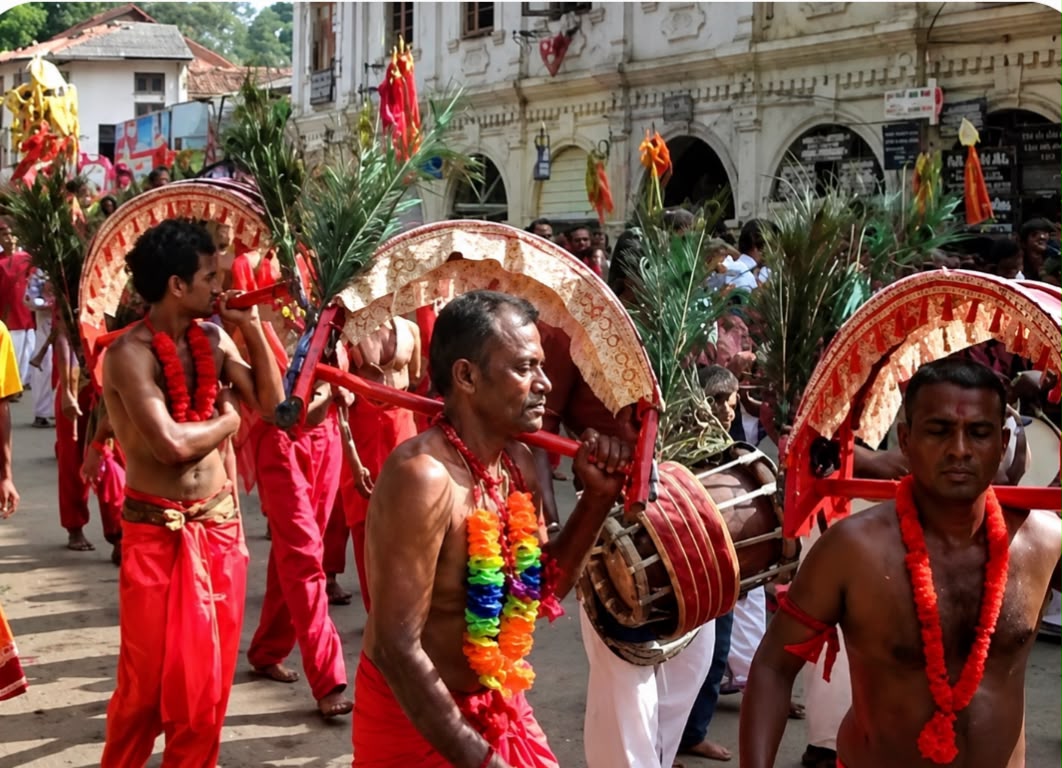
Cabinet Clears Participation of Kavadi Dancers In Esala Perahara
The Government has brought to an end weeks of uncertainty by approving the participation of Kavadi dancers in this year’s Kandy Esala Perahera, reaffirming what ministers described as the long-standing multicultural traditions associated with one of Sri Lanka’s most revered religious pageants.
Cabinet approval follows public debate over whether the traditional Hindu performers should continue to take part in the historic procession after objections were raised by several groups.
The decision means the Kavadi dancers will once again participate in the annual pageant, preserving a custom that has existed for generations alongside the Buddhist ceremonies centred on the Sacred Tooth Relic.
The issue generated considerable public interest, extending well beyond the organisation of the Perahera itself.
For many observers, the debate became a wider discussion about Sri Lanka’s identity as a multi-religious and multiethnic nation and whether traditions that have evolved over centuries should be altered in response to contemporary pressures.
Historians point out that while the Esala Perahera is fundamentally a Buddhist religious procession, it has long reflected the island’s intertwined cultural and religious heritage.
The participation of the four Devales dedicated to Natha, Vishnu, Kataragama and Pattini has for centuries formed an integral part of the wider Perahera tradition.
Supporters of the Cabinet decision argue that the inclusion of Kavadi dancers represents cultural continuity rather than religious dilution.
They maintain that Sri Lanka’s greatest traditions have endured precisely because they have accommodated different communities while preserving the central religious significance of the event.
Others had argued that the Perahera should reflect a more exclusively Buddhist character, leading to the recent controversy.
By approving the participation of the dancers, the Government appears to have signalled that preserving historical practice outweighs attempts to redefine traditions that have existed for generations.
The decision is also likely to be viewed as an effort to avoid unnecessary religious tensions at a time when successive governments have emphasised reconciliation and national unity.
As thousands of pilgrims and visitors converge on Kandy for this year’s Esala festivities, attention is now expected to shift away from controversy and back towards one of Asia’s oldest and most celebrated religious pageants.
Whether the debate has now been settled permanently remains to be seen.
For the moment, however, Cabinet has chosen continuity over change, ensuring that a tradition which has accompanied the Perahera for generations will continue for at least another year.