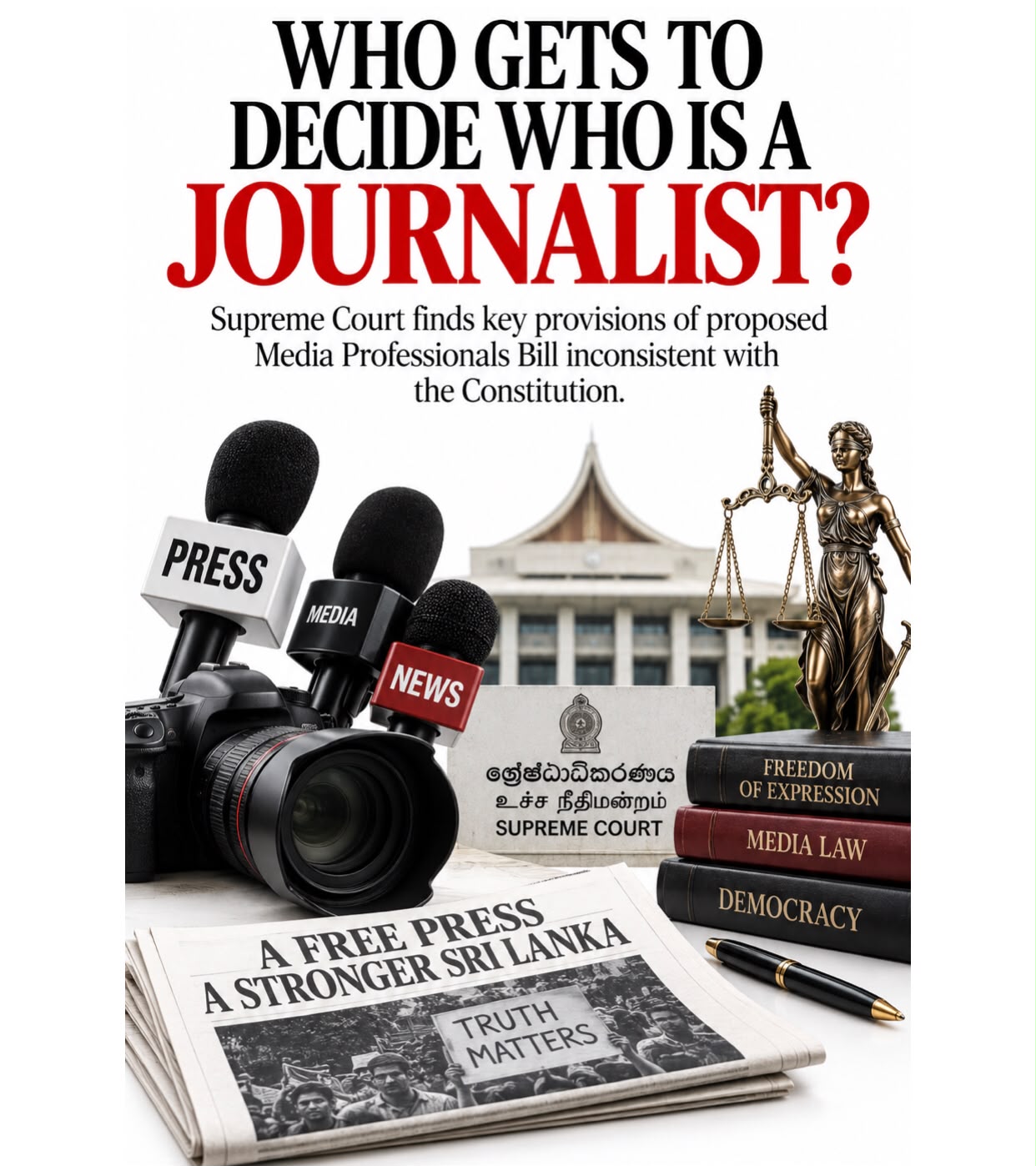
Supreme Court finds provisions of proposed Chartered Institute of Media Professionals Bill inconsistent with the Constitution, raising a much larger question about who should have the power to define, regulate or credential journalism
Who decides who is a journalist?
It sounds like a simple question until Parliament attempts to provide the answer.

The Supreme Court has determined that several provisions of the proposed Chartered Institute of Media Professionals of Sri Lanka (Incorporation) Bill are inconsistent with the Constitution and would require amendment or, in certain circumstances, a special majority in Parliament to become law.
The Court’s determination was announced to Parliament yesterday by the Speaker.
Among the constitutional concerns identified were provisions affecting equality before the law and the freedom to engage in a lawful occupation, profession, trade, business or enterprise.
The Bill proposes establishing a professional body for people working across journalism, broadcasting, digital media and related fields, with objectives including professional development, training, ethical standards and recognition of media practitioners.
Those objectives, considered alone, are hardly controversial. Journalism desperately needs professionalism, ethical standards, training and accountability, just as the public is entitled to expect accuracy and responsibility from those who claim to inform it.
The difficulty begins when professional recognition risks becoming professional permission.
Journalism is not medicine. Nor is it engineering or accountancy. A person does not require a State-issued licence before asking a Minister a question, investigating the expenditure of public money or publishing evidence of wrongdoing.
That distinction becomes even more important in the digital age.
A reporter employed by a newspaper is plainly a journalist. But what about an independent investigative reporter working through YouTube? A documentary maker? A freelance photographer? A citizen who uncovers corruption and publishes the evidence online?
Any statutory structure which effectively creates an approved class of journalists therefore needs extraordinarily careful scrutiny.
Professional associations can perform valuable functions. They can establish standards, provide training, defend journalists and encourage ethical conduct.
But the moment membership, accreditation or certification becomes a gateway to exercising journalism, the relationship between the press and the State begins to change.
There is another side to the argument which should not be ignored.
Sri Lanka’s media landscape includes genuine problems of misinformation, political propaganda masquerading as journalism, character assassination and social-media operators who publish allegations without elementary verification.
Freedom of expression does not relieve journalists of responsibility for what they publish. Existing laws relating to defamation, contempt, privacy and criminal conduct remain capable of applying where appropriate.
The solution, however, must not become more dangerous than the problem.
A democratic State should be extremely reluctant to decide who qualifies to scrutinise that democratic State.
The Supreme Court determination does not necessarily kill the proposed Institute. Parliament can amend the offending provisions and construct a body which promotes professional standards without creating unconstitutional restrictions.
Indeed, a voluntary professional institution with credible standards and genuine independence could strengthen journalism.
The line that must not be crossed is equally clear.
Journalists should be accountable for their journalism.
They should not require permission to practise it.
Be that as it may, whenever the State starts defining who may properly question the State, the media should start asking rather more questions.