
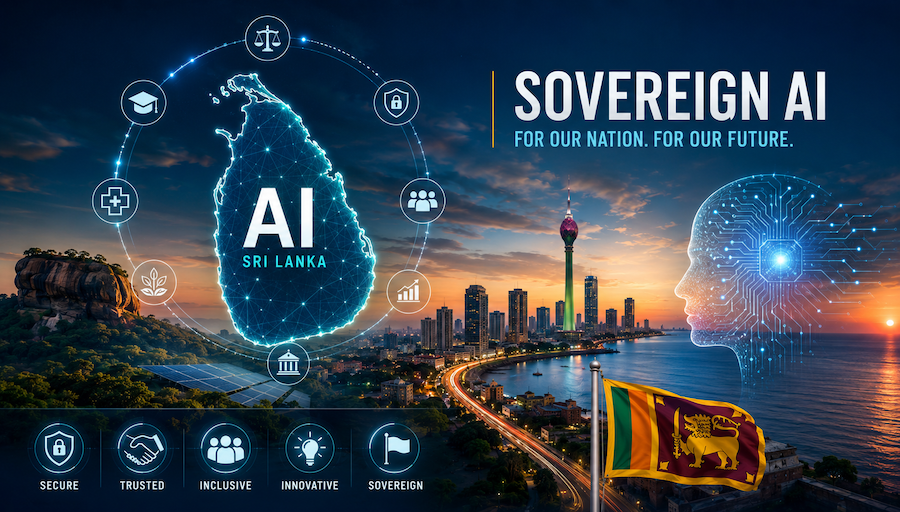
Artificial intelligence is rapidly becoming the defining technology of the 21st century, but a new race is now unfolding beyond the development of ever more powerful AI models. Governments across the world are investing billions of dollars to achieve what has become known as Sovereign AI—the ability to build, train and deploy artificial intelligence using their own infrastructure, datasets, languages and expertise.
For countries ranging from India and France to the United Arab Emirates and Singapore, AI is no longer viewed simply as a commercial technology. It is increasingly regarded as critical national infrastructure, comparable to electricity, telecommunications or financial systems. The central question is no longer whether AI will transform economies, but who will control the intelligence powering governments, businesses and public services.
The New Digital Independence
Sovereign AI refers to a nation’s capacity to develop AI systems using domestic or trusted computing infrastructure, locally governed data, national regulations and home-grown expertise. Rather than depending entirely on foreign AI platforms, sovereign AI enables governments to retain greater control over sensitive information while ensuring AI systems reflect local languages, laws and cultural contexts.
The concept has gained momentum as governments recognise that large language models (LLMs) are becoming foundational digital infrastructure. Healthcare, education, taxation, judicial systems, defence, agriculture, banking and public administration are all expected to rely heavily on AI over the coming decade.
Countries fear that excessive dependence on foreign AI providers could expose them to strategic vulnerabilities, including data governance risks, geopolitical uncertainty and technological dependence.
Why Governments Are Investing Billions
The world’s leading economies are responding with unprecedented investments.
India has emerged as one of the strongest advocates of sovereign AI through its IndiaAI Mission, supporting indigenous foundation models, expanding GPU computing infrastructure and encouraging multilingual AI development. The initiative aims to ensure that AI understands India’s diverse languages while strengthening domestic technological capabilities.
France has backed Mistral AI as Europe’s flagship open-weight AI company while supporting broader European initiatives to strengthen AI independence from the United States and China. Similar efforts are underway across the European Union to build sovereign AI infrastructure.
The United Arab Emirates has invested heavily in Arabic-language AI through organisations such as G42 and the Falcon family of models, positioning AI as a pillar of national economic diversification.
Singapore has focused on regional language models through projects such as SEA-LION, recognising that Southeast Asian languages remain underrepresented in global AI systems. Meanwhile Saudi Arabia and Japan continue investing in domestic AI infrastructure, national datasets and local-language foundation models.
These initiatives differ in execution but share a common objective: ensuring AI reflects national priorities rather than relying exclusively on foreign technology providers.
Why Sri Lanka Needs Sovereign AI
For Sri Lanka, the argument extends beyond technological competitiveness.
Most global AI models have been trained predominantly on English-language content and international datasets. While increasingly capable, they often lack deep understanding of Sinhala, Tamil, Sri Lankan legal systems, administrative structures and cultural nuances.
A locally developed sovereign AI ecosystem could support:
- Government digital services
- Healthcare decision support
- Legal research and judicial analysis
- Tax administration
- Agriculture advisory services
- Education platforms
- Business intelligence
- Public information systems
Critically, locally trained models could provide more accurate responses grounded in Sri Lankan laws, institutions and multilingual communication.
Data sovereignty also remains an important consideration. Government records, legal databases, healthcare information and citizen services represent strategic national assets. Retaining greater control over how these datasets are processed and governed is increasingly viewed internationally as a matter of digital resilience rather than merely technology policy.
Beyond Language: Economic Opportunity
Sovereign AI is also an economic development strategy.
Countries investing in domestic AI create demand for high-performance computing infrastructure, cloud services, research institutions, startups and highly skilled employment.
Rather than remaining consumers of imported AI services, nations seek to become producers of AI technologies tailored to local markets and export opportunities.
India illustrates this approach, combining public investment, private-sector participation and startup ecosystems to build indigenous AI capabilities while attracting substantial international investment.
Sri Lanka’s Emerging AI Ecosystem
Although still at an early stage, Sri Lanka has begun developing its own AI capabilities.
One of the most notable recent developments has been the public release of Chat2Find-Instruct-v1, described by its developers as Sri Lanka’s first open-source trilingual large language model supporting Sinhala, Tamil and English. The model has been positioned as a foundation for domain-specific AI applications spanning legal research, taxation, business intelligence, education and news.
The broader Sri Lankan AI ecosystem also benefits from research undertaken by institutions including the University of Moratuwa and the University of Colombo School of Computing, which have contributed to natural language processing, machine translation, speech technologies and multilingual language resources over many years.
Academic initiatives such as multilingual document datasets covering Sri Lankan law, policy and parliamentary proceedings are also expanding the availability of locally relevant training resources for future AI systems.
The Challenge Ahead
Developing sovereign AI remains an expensive undertaking.
Training modern foundation models requires significant computing power, specialised AI talent, large-scale datasets and sustained financial investment. Even larger economies increasingly combine government support with private-sector participation.
Experts argue that sovereign AI should not be interpreted as technological isolation. Instead, the emerging consensus is that countries should remain globally connected while retaining meaningful control over critical AI infrastructure, data governance and strategic capabilities.
A Strategic Choice
As artificial intelligence becomes embedded across every sector of society, governments are increasingly treating AI as a matter of national capability rather than simply commercial innovation.
Just as previous generations invested in roads, ports, electricity and telecommunications, today’s investments increasingly focus on computing infrastructure, national datasets and multilingual AI models.
For Sri Lanka, sovereign AI represents more than an opportunity to preserve Sinhala and Tamil within the next generation of intelligent systems. It offers the possibility of building domestic technological capability, strengthening digital resilience and creating a knowledge economy capable of competing in an increasingly AI-driven world.
The countries leading this transformation are not waiting for global technology companies to define their digital future. They are building it themselves. Whether Sri Lanka can do the same may become one of the country’s most important technology policy questions of the coming decade.


