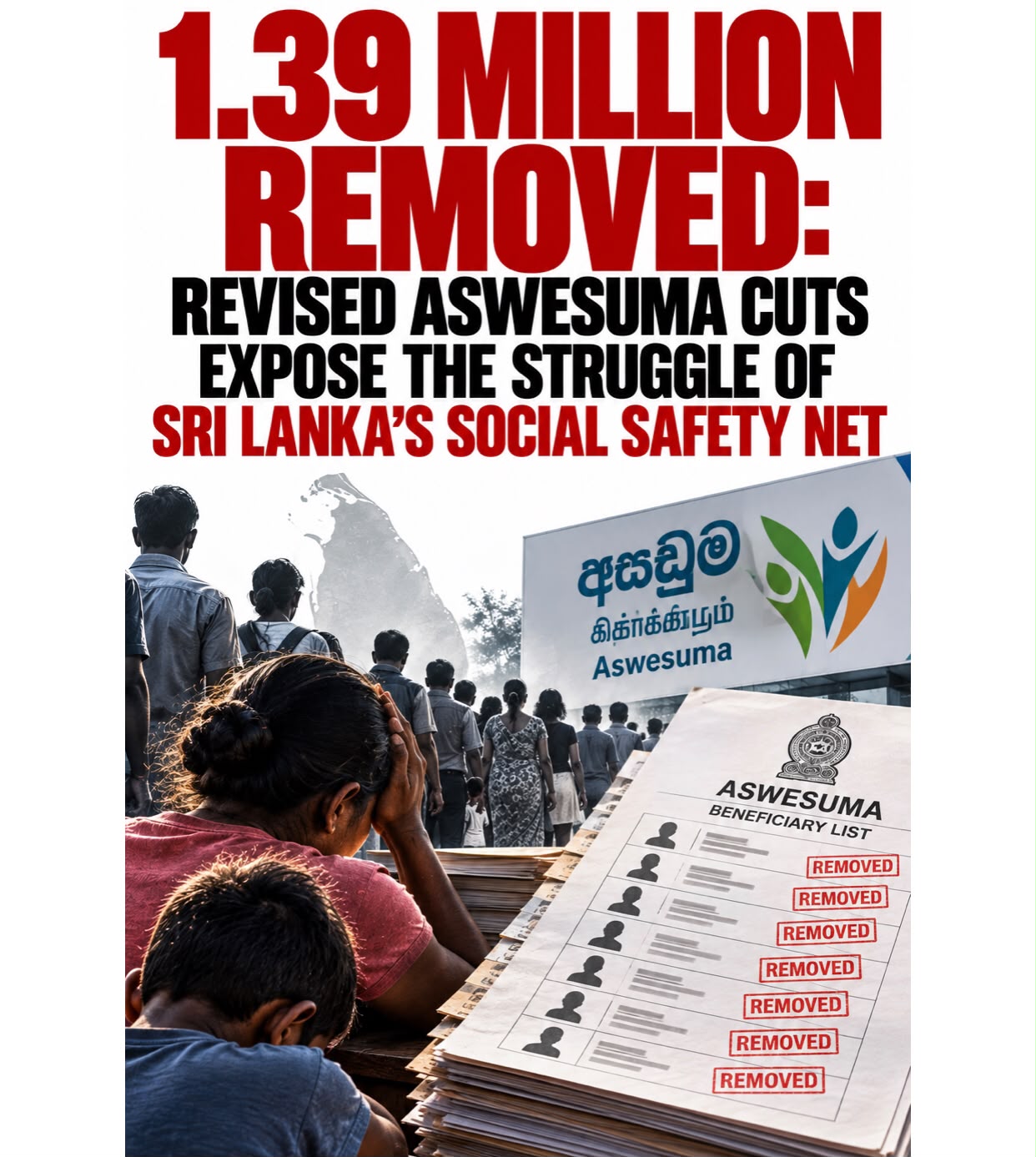
Sri Lanka’s state welfare arm has executed one of the largest structural contractions in its history, officially striking 1,391,830 beneficiaries off the rolls of the Aswesuma welfare benefits programme. The massive removal, executed under the revised selection process of the Welfare Benefits Board, drastically shrinks the state assistance umbrella at a time when millions of households continue to navigate severe economic pressure, soaring cost-of-living index numbers, and eroded real incomes.
The legal foundation for this sweeping purge rests on Extraordinary Government Gazette No. 2497/03, issued on December 15, 2025. Under these updated regulatory guidelines, state cash transfers have been strictly restricted to households that meet the narrowest definitions of economic distress, categorizing eligible citizens exclusively under two tiers: “Extremely Poor” and “Poor.” All transitional, vulnerable, or borderline categories that previously received temporary cushions have been completely eliminated from the primary roster.
Following a nationwide data collection and verification drive, the Welfare Benefits Board confirmed that a total of 991,800 individuals qualified under the newly published first phase list. A forensic breakdown of the approved recipients reveals the stark math governing state spending:
Submit Your Press Release
Get your company news, announcements, launches, appointments and events in front of a wider audience.


•Extremely Poor Tier: Exactly 363,142 beneficiaries have been classified under this top-priority group, qualifying them for a monthly allowance of Rs. 17,500 each.
•Poor Tier: A total of 628,658 beneficiaries fall into this secondary bracket, making them eligible for a monthly cash transfer of Rs. 10,000 each.
While nearly 1.4 million former recipients lose state relief, administrative officials have pointed to a secondary intake phase aimed at capturing overlooked households. The Welfare Benefits Board announced that approximately 740,127 families are projected to be selected for the second list, which is scheduled for official release in December once the ongoing information-updating process wraps up nationwide.
In an effort to facilitate public scrutiny and manage widespread discontent, the complete registry of current approved recipients has been physically posted on notice boards across all Divisional Secretariat offices and Grama Niladhari divisions. However, the window for marginalized citizens to fight their exclusion is tight. The formal appeals and objections process opened on October 29 and will permanently close on November 11, giving disenfranchised families just fourteen days to navigate red tape, secure administrative documentation, and lodge formal challenges against their removal.
The purge is a very clear display of the deep tension between international monetary stabilization targets and ground-level social survival. While fiscal authorities defend the tighter criteria as an essential measure to eliminate proxy-means testing errors, prevent political patronage, and allocate scarce treasury funds strictly to the most destitute, community organizers warn that millions sitting just above the arbitrary poverty baseline are being pushed into extreme vulnerability.
As thousands flood Grama Niladhari offices across the island between now and November 11 to check their names, the success of the Aswesuma program will be judged not by the efficiency of its budget cuts, but by whether its rigid algorithms have abandoned the very people they were created to protect.