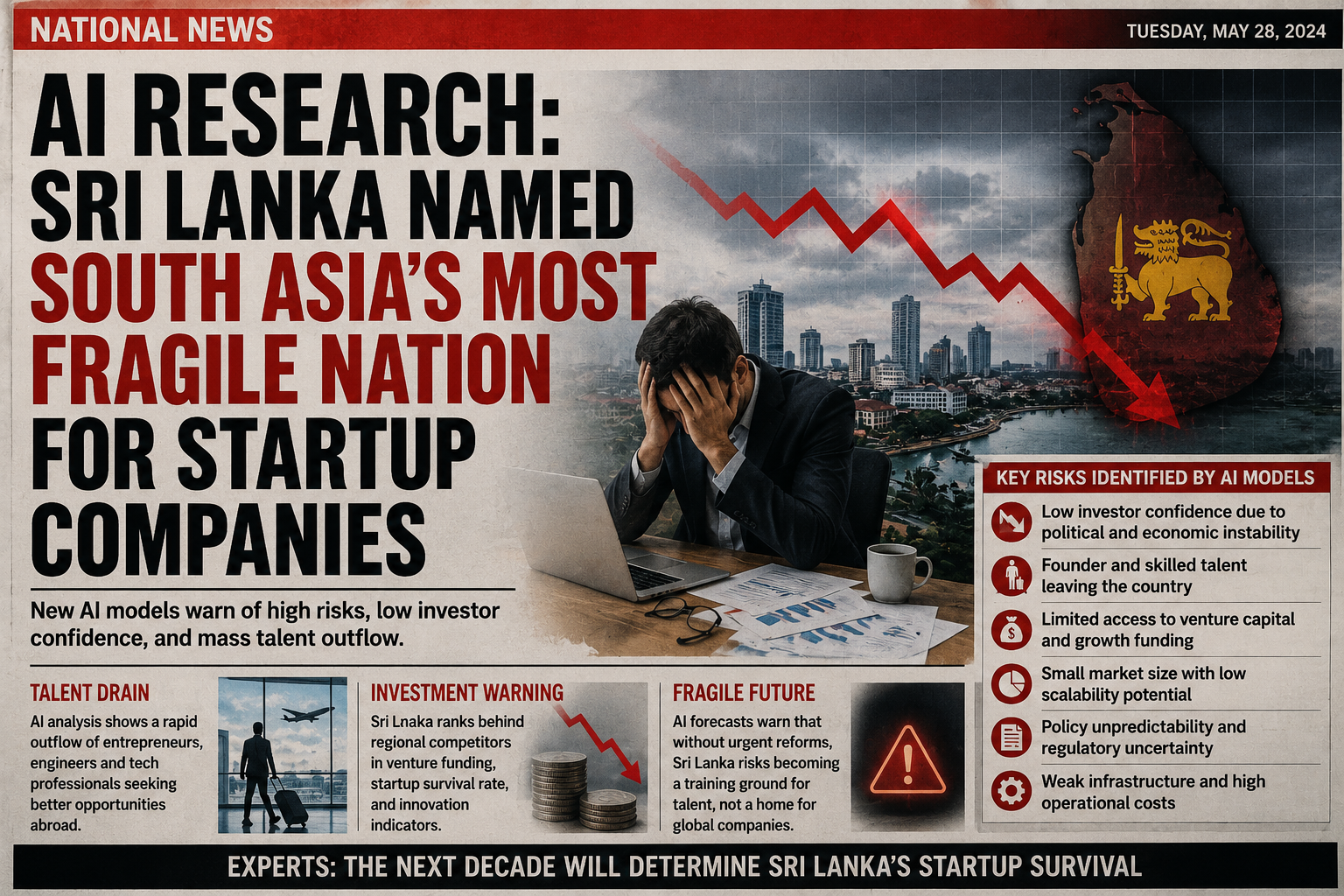
Colombo — Artificial intelligence-driven forecasting systems used by global venture capital firms, financial intelligence platforms, and technology analysts are increasingly identifying Sri Lanka as one of the most fragile countries in South Asia for startup companies. According to emerging AI-based assessments, the country is showing multiple warning signals commonly associated with startup ecosystem decline, founder migration, weak investment confidence, and long-term innovation stagnation.
While Sri Lanka continues promoting itself as a future digital and technology destination, machine-learning systems reportedly present a sharply different picture. These AI models analyze thousands of indicators simultaneously, including startup survival rates, investor behavior, founder relocation patterns, digital infrastructure, policy stability, workforce mobility, and market scalability. Analysts say Sri Lanka is now performing poorly across several of the most critical areas required for startup growth.
One of the strongest concerns identified by AI systems is the collapse of long-term confidence among founders and skilled professionals. In successful startup environments, ambitious entrepreneurs usually believe they can build large companies within their home country. In Sri Lanka, AI sentiment analysis reportedly shows the opposite trend. Increasing numbers of startup founders, software engineers, AI specialists, and digital professionals now view migration as the safest path for career growth and financial stability.
This shift is becoming one of the country’s biggest structural weaknesses. A startup ecosystem cannot mature if its most experienced builders continuously leave. AI forecasting models reportedly warn that Sri Lanka is developing a “startup evacuation pattern,” where talented individuals acquire skills locally but relocate before scaling companies domestically. Countries trapped in this cycle often struggle to build sustainable innovation industries because mentorship, leadership, investor networks, and technical experience disappear faster than they can be replaced.
The 2022 economic collapse significantly accelerated this problem. Sri Lanka’s debt default, inflation crisis, fuel shortages, currency crash, and political unrest severely damaged investor confidence. Although macroeconomic conditions have partially stabilized, AI-driven investment systems reportedly continue categorizing Sri Lanka as a high-risk and unstable operating environment. Machine-learning financial models place enormous importance on predictability, and Sri Lanka’s recent history of abrupt tax changes, import restrictions, policy reversals, and political uncertainty continues to negatively affect long-term startup confidence.
Another major issue highlighted by AI systems is the country’s weak venture capital environment. Compared with competing Asian markets, Sri Lanka attracts extremely limited startup investment. AI investment analysis reportedly identifies this as one of the country’s most dangerous weaknesses because startups cannot survive on talent alone. Without reliable access to early-stage funding, growth capital, and international investor participation, startups struggle to scale beyond small operational levels.
AI systems reportedly conclude that many global investors see Sri Lanka as too unstable, too small, and too unpredictable for aggressive startup investment. As a result, founders increasingly establish companies in Singapore, Dubai, Australia, or the United Kingdom even when technical operations remain partially based in Sri Lanka. This creates a damaging pattern where intellectual property, legal ownership, investor relationships, and future profits move abroad while Sri Lanka retains only fragments of the operational workforce.
The domestic market itself is also viewed as a major weakness. AI market analysis reportedly shows that Sri Lanka lacks the consumer scale necessary for rapid startup expansion. Purchasing power remains weak, digital spending capacity is limited, and economic uncertainty continues reducing consumer confidence. In practical terms, many Sri Lankan startups quickly realize that the local market alone is not large enough to support meaningful growth.
This forces companies into premature international expansion before achieving stable foundations. AI systems identify this as a high-risk condition because startups that expand internationally too early often face operational collapse due to financial pressure, weak investor backing, and limited scalability.
Infrastructure concerns continue adding further pressure. Although Colombo contains modern office spaces and improving connectivity, AI operational-risk systems reportedly identify serious weaknesses involving transportation efficiency, energy reliability, cloud infrastructure scale, research ecosystems, and regulatory speed. For startups operating in fast-moving industries such as AI, fintech, cybersecurity, or cloud computing, these weaknesses create operational uncertainty that discourages long-term investment.
AI systems also reportedly flag Sri Lanka’s policy inconsistency as a major structural risk. Startup ecosystems depend heavily on trust in future conditions. Investors and founders need confidence that taxation systems, import regulations, digital laws, and business policies will remain stable over time. Sri Lanka’s repeated history of sudden policy shifts reportedly causes AI forecasting systems to classify the country as institutionally unpredictable. This significantly reduces its attractiveness compared with competing Asian startup destinations.
The contrast with regional competitors is becoming increasingly severe. Vietnam has aggressively expanded startup financing networks and industrial technology ecosystems. Indonesia benefits from massive digital consumer growth and strong investor interest. India continues dominating software and AI development through scale and funding depth. Even smaller countries across Asia now maintain more structured support systems for startup growth and innovation investment.
Sri Lanka, by comparison, risks becoming trapped in what AI analysts reportedly describe as a “low-scale outsourcing dependency.” Under this model, the country continues generating freelance development work, support services, and outsourcing operations while failing to create globally competitive technology companies. Although outsourcing generates export income, AI forecasting systems suggest this model rarely produces major innovation leadership without deeper structural transformation.
Perhaps the most alarming signal identified by AI analysis is the growing psychological shift among younger professionals. Machine-learning sentiment systems monitoring startup discussions, professional networks, and migration trends reportedly show increasing pessimism about building long-term futures within Sri Lanka. Many talented young professionals no longer see local entrepreneurship as a realistic path to stability or success. Instead, migration, remote foreign employment, or overseas company formation are increasingly viewed as safer alternatives.
This psychological collapse in national startup confidence may ultimately become more damaging than financial instability itself. Startup ecosystems depend heavily on optimism, risk-taking, and belief in future opportunity. AI systems reportedly warn that once a generation loses confidence in building locally, reversing the trend becomes extremely difficult.
Despite these warnings, Sri Lanka still retains important strengths. The country continues producing highly educated professionals, maintains relatively strong English-language capability, and possesses strategic geographic positioning. However, AI forecasting systems increasingly suggest that talent alone is no longer enough to sustain a competitive startup environment.
Without major improvements in investment confidence, institutional stability, infrastructure modernization, founder retention, and long-term policy consistency, Sri Lanka risks becoming known not as a startup nation, but as a country where talented founders are trained before leaving to build successful companies somewhere else.