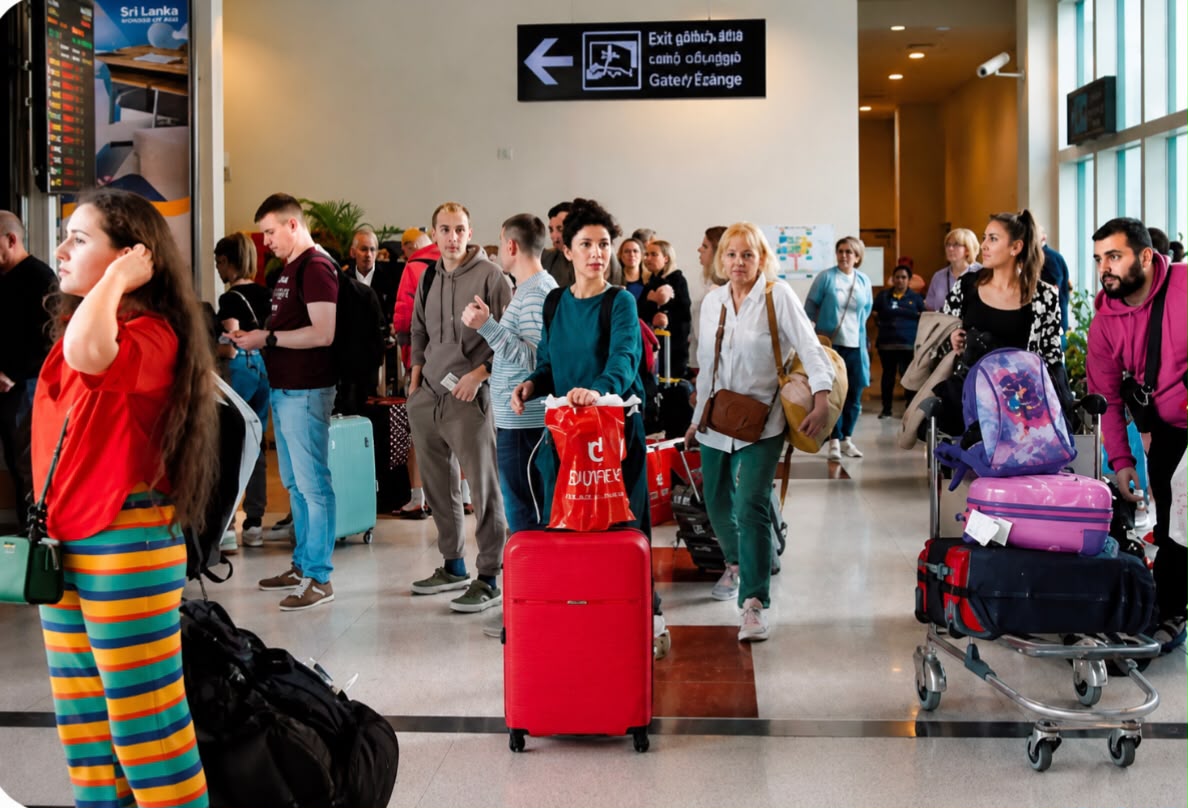
Sri Lanka crosses another impressive arrivals milestone, but the more important measure may be how long visitors stay, how much they spend and how much of that money remains in the economy
COLOMBO, Wednesday – Sri Lanka has welcomed more than 1.4 million tourists during 2026, passing another significant milestone for an industry on which the country is relying heavily to generate foreign exchange, employment and economic activity. Yet the headline number tells only part of the story, with increasingly important questions emerging over whether growth in arrivals is being matched by sufficient growth in tourism earnings.
Sri Lanka Tourism Development Authority figures show 1,408,620 visitors had entered the country by August 9, with 65,202 arriving during the first nine days of August alone. India remained comfortably Sri Lanka’s largest source market, contributing 351,713 visitors so far this year, followed by the United Kingdom with 137,861 and China with 92,940.
The achievement is significant. Tourism was one of the sectors most severely damaged by the Easter Sunday attacks, the pandemic and the subsequent economic crisis, and the return of international visitors in substantial numbers represents an important restoration of confidence in Sri Lanka as a destination.
But arrival numbers alone cannot establish the economic success of tourism. A visitor staying for three weeks and spending heavily within the formal economy has a very different economic value from one staying several days on a tightly controlled budget, even though both appear identically as a single arrival in the statistics.
That distinction has become particularly relevant as Sri Lanka debates the kind of tourism it wants to attract. Former Deputy Tourism Minister Faizer Musthapha PC has questioned whether policies including the new Digital Nomad Visa are sufficiently ambitious in attracting higher-spending long-stay visitors, arguing that the country should focus much more closely on yield rather than simply accumulating arrivals.
There are reasons for examining that argument seriously. Sri Lanka’s average length of stay has declined from the levels achieved before the pandemic, while official estimates of average tourist spending have also been revised. The consequence is that an impressive increase in the number of people passing through immigration does not automatically produce a proportionate increase in dollars entering the economy.
The latest arrival figures themselves also contain a warning worth examining. July recorded 196,845 visitors, 1.7 per cent fewer than in July last year, marking the fourth month during 2026 in which arrivals declined on a year-on-year basis. The cumulative 1.4-million figure therefore sits alongside evidence that the underlying monthly growth trajectory is not uniformly positive.
Sri Lanka consequently faces a strategic choice. It can compete primarily for volume, attempting to maximise visitor numbers through relatively inexpensive accommodation, liberal visa regimes and mass-market tourism, or increasingly position itself towards longer stays and higher expenditure through improved infrastructure, premium experiences and better connectivity beyond the established tourism corridors.
The two approaches are not necessarily mutually exclusive, but the distinction matters enormously to an island with finite hotel capacity, infrastructure and natural attractions. Two million visitors producing substantially higher expenditure may ultimately be worth considerably more to the economy than three million visitors spending considerably less.
Passing 1.4 million is therefore worthy of recognition, but it should not become the sole measure of success. The question Sri Lanka should increasingly ask is not simply how many tourists arrived, but how many dollars each visitor left behind when they departed.