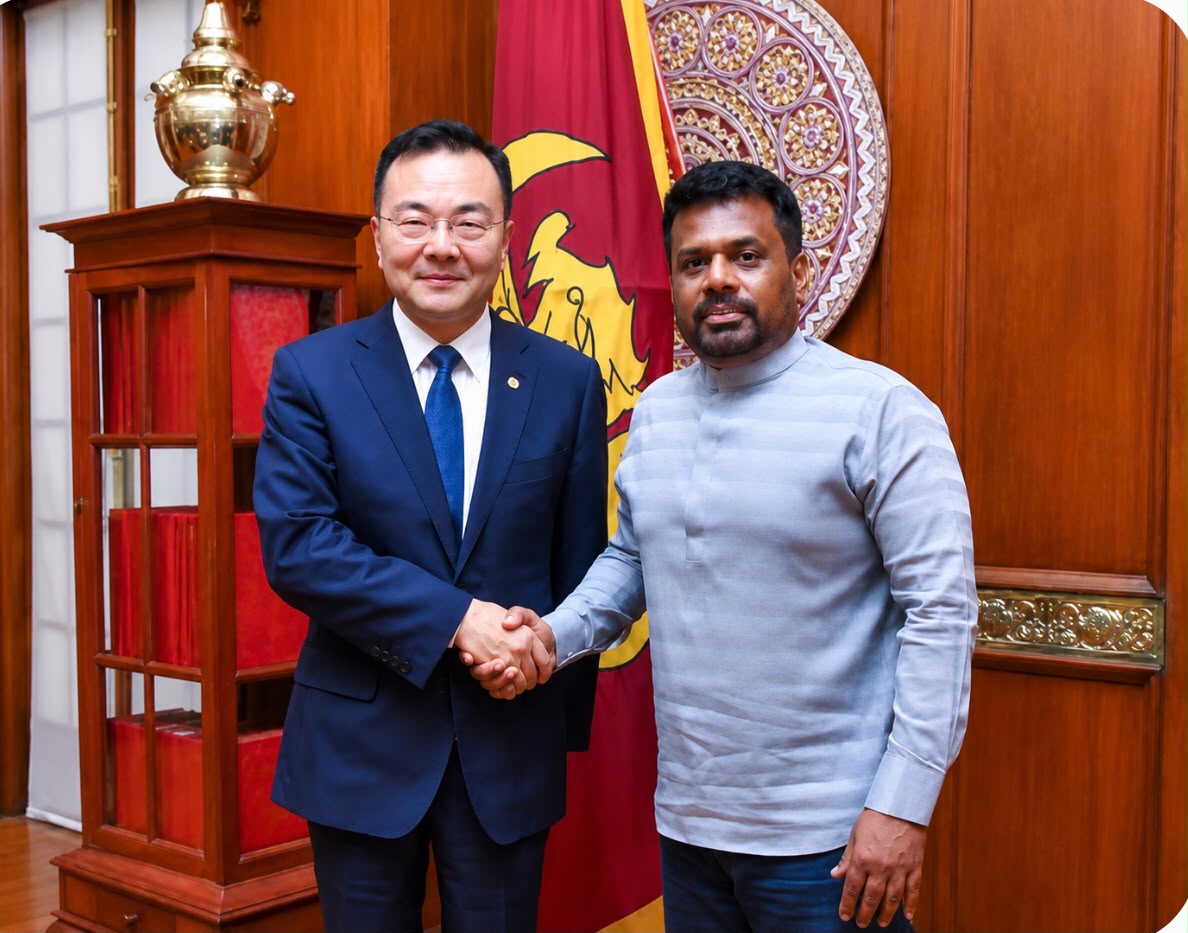
Chinese construction giant CCCC tells President Dissanayake it wants to expand investment into renewable energy, logistics and digital services as Colombo seeks to turn its relationship with Beijing towards new investment
COLOMBO, Wednesday – China Communications Construction Company Limited, one of the principal Chinese corporate players already involved in Sri Lanka’s infrastructure landscape, has expressed interest in expanding its investments in the country following discussions with President Anura Kumara Dissanayake.
A senior CCCC delegation led by company President Zhang Bingnan met President Dissanayake at the Presidential Secretariat on Tuesday, with discussions covering existing and proposed projects associated with Colombo Port City and potential investment in other sectors.
Submit Your Press Release
Get your company news, announcements, launches, appointments and events in front of a wider audience.


According to accounts of the meeting, the Chinese company identified renewable energy, trade and logistics and digital services as areas in which it sees opportunities for further investment, while describing Sri Lanka as having the potential to develop into a regional hub in those sectors.
CCCC is hardly a newcomer to Sri Lanka. The Chinese state-controlled engineering giant has been central to the development of Colombo Port City, one of the largest foreign-backed infrastructure projects undertaken in the country and one which has become closely associated with the broader economic relationship between Colombo and Beijing. CCCC itself describes Port City as a major investment and construction project undertaken with its subsidiaries and the Sri Lanka Ports Authority.
That history makes Tuesday’s meeting more significant than an ordinary courtesy call by a prospective investor. The question is whether Sri Lanka’s economic relationship with China is beginning to move towards a different phase, with the Government attempting to attract Chinese capital into commercially productive sectors rather than relying principally upon the large infrastructure projects that characterised an earlier period.
President Dissanayake has consistently sought to reassure foreign investors that Sri Lanka intends to provide a more transparent and predictable investment environment. During a visit to China last year, he explicitly invited Chinese state-owned and private enterprises to examine opportunities in Sri Lanka, stressing political stability and transparency as part of the country’s investment proposition.
The Government’s challenge, however, is considerably greater than attracting expressions of interest. Sri Lanka needs foreign direct investment that creates employment, generates exports or foreign-exchange earnings, transfers technology and produces measurable economic returns without creating unsustainable liabilities for the State.
The areas identified by CCCC are therefore particularly noteworthy.
Renewable energy could reduce Sri Lanka’s dependence on imported fuel, logistics could exploit the country’s geographical position alongside major Indian Ocean shipping routes, while digital services potentially offer economic activity requiring comparatively little physical infrastructure.
There will nevertheless be questions about the terms under which any new projects proceed. Sri Lanka’s experience with large foreign-backed infrastructure projects has demonstrated the importance of transparent procurement, clearly allocated commercial risk and public disclosure of obligations undertaken by the State.
The Government should therefore welcome serious foreign investment, whether it originates in China, India, Europe, the United States or elsewhere, while applying the same test to each: what does Sri Lanka receive in return?
For CCCC, Port City has already established a substantial footprint on Colombo’s shoreline. The more interesting question after Tuesday’s meeting is where the Chinese giant intends to place its next one.