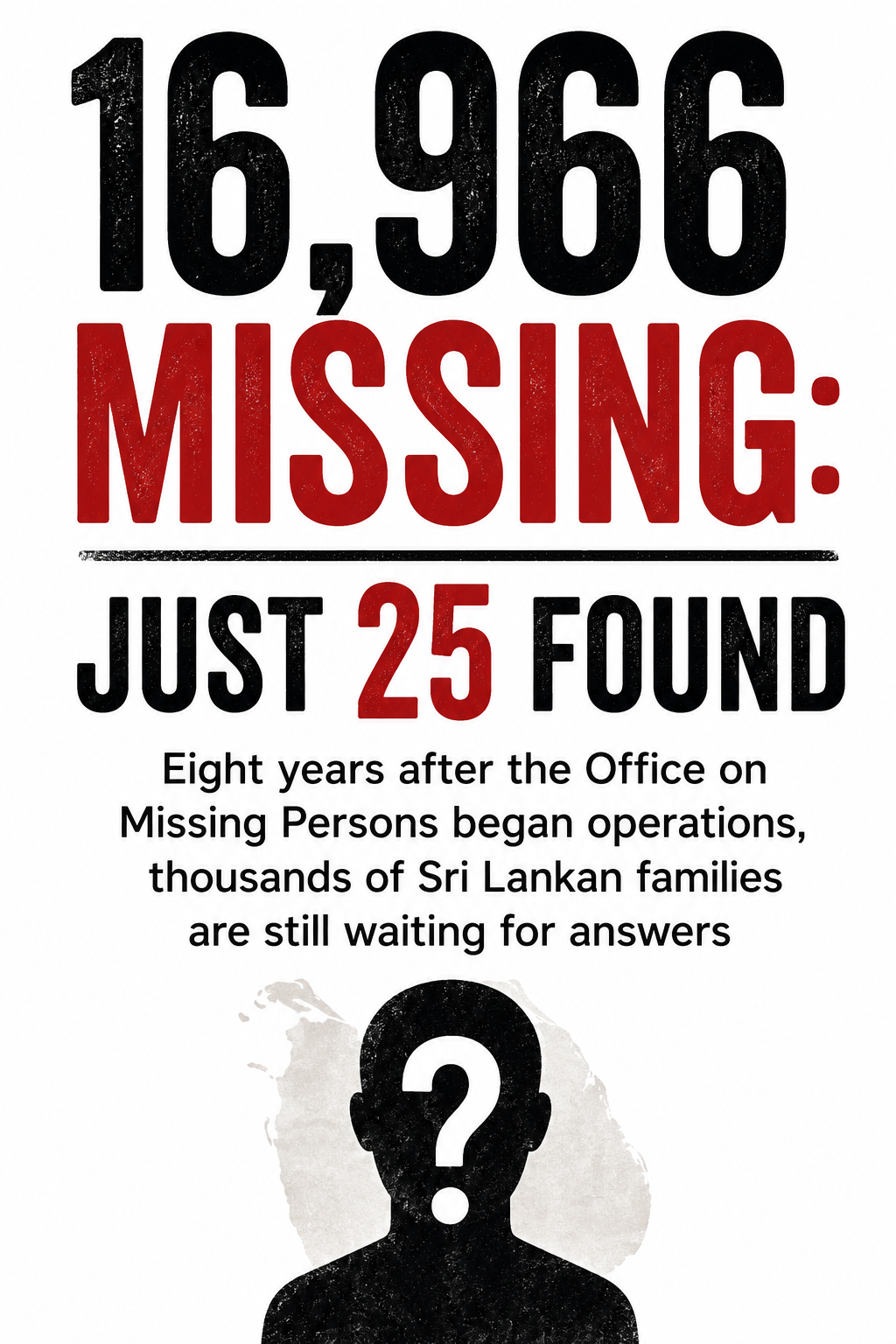
Eight years after the Office on Missing Persons began operations, thousands of Sri Lankan families are still waiting for answers
COLOMBO, Friday. Sri Lanka’s Office on Missing Persons has disclosed that 16,966 civilian cases remain active on its books while only 25 missing people have so far been traced and their whereabouts formally verified, figures that raise searching questions about the effectiveness of one of the country’s principal transitional-justice institutions.
The OMP says its consolidated database contains 23,352 missing persons after records inherited from previous commissions, the International Committee of the Red Cross and other organisations were brought together and duplicate complaints identified.
Of those cases, 16,966 involving civilians remain active. The OMP says it has found and verified the whereabouts of 25 people, while another six are believed to be alive but their circumstances have yet to be formally verified.
The numbers are striking not merely because of their scale but because the OMP has been operational since 2018. For thousands of families, the issue is therefore not an historical statistic but an unresolved question that has followed them through successive governments, commissions and investigations.
The Office says it has conducted face-to-face inquiries with 9,072 families and plans to meet approximately another 5,000 families before the end of this year. The Government has allocated more than Rs.375 million to support the process of meeting affected families and progressing inquiries.
The OMP was established as an independent institution to search for and trace missing persons, clarify the circumstances in which they disappeared and provide families with information concerning their fate. Its mandate encompasses disappearances connected to the armed conflict as well as other periods of political violence and unrest.
The difficulty confronting the institution is formidable. Records accumulated over decades are frequently incomplete, witnesses may have died or become difficult to locate, families have moved and evidence capable of establishing what happened to an individual can become increasingly difficult to recover with the passage of time.
Yet those difficulties cannot obscure the extraordinary disparity contained in the latest figures. If nearly 17,000 civilian cases remain active while the whereabouts of only 25 people have been formally established, the inevitable question is whether the machinery created to provide answers is functioning with sufficient speed, resources and effectiveness.
There is also a larger question of public confidence. Sri Lanka has established numerous commissions and investigative mechanisms over several decades to examine disappearances. For families who have repeatedly provided statements and documentation, the ultimate measure of success is not the number of files opened, interviews conducted or institutions created. It is whether they finally discover what happened to the person who disappeared.
Eight years after the OMP began its work, that remains an answer thousands of Sri Lankan families are still waiting to hear.