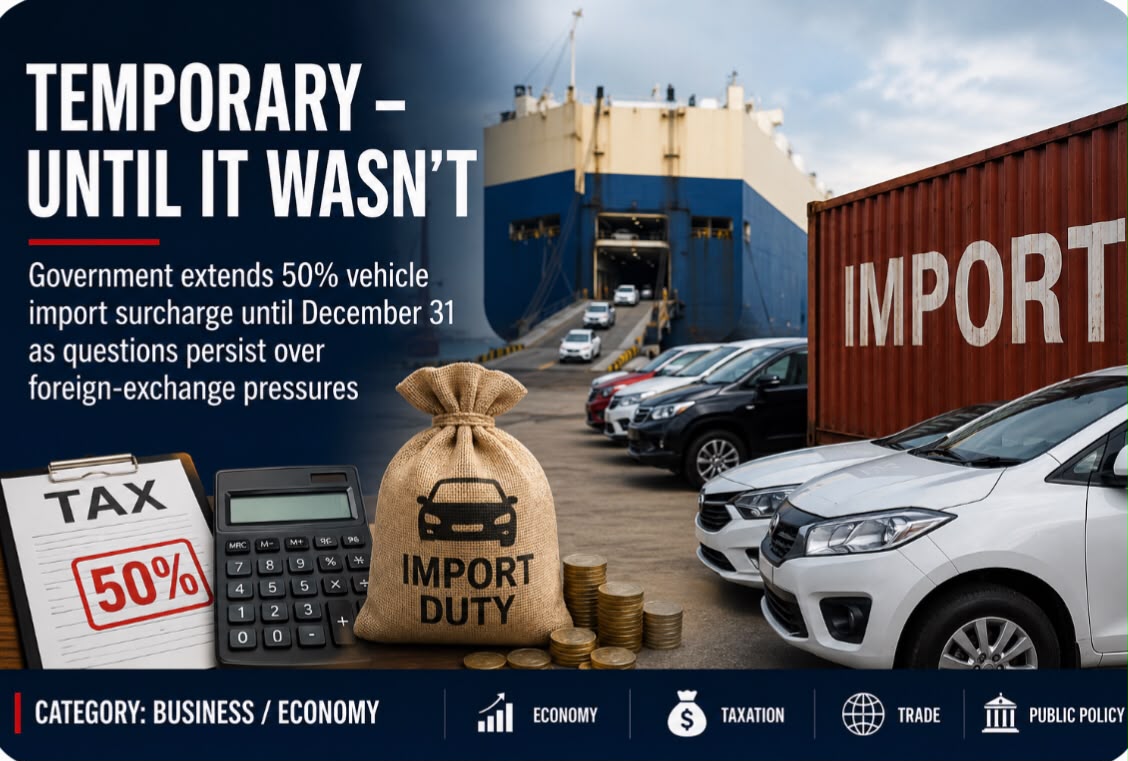
Government extends 50% vehicle import surcharge until December 31 as questions persist over foreign-exchange pressures
COLOMBO, Friday – The Government has extended the temporary 50 per cent surcharge on Customs Import Duty imposed on specified motor vehicle imports until December 31, prolonging a measure introduced earlier this year to restrain foreign-exchange outflows amid renewed pressure on Sri Lanka’s external finances.
The surcharge, introduced on May 16 for an initial period of three months, was due to expire on August 15. Its extension means importers and prospective vehicle buyers will continue to face the additional duty burden for the remainder of 2026.
The order was issued by President Anura Kumara Dissanayake in his capacity as Minister of Finance. Motorcycles, three-wheelers and specified commercial vehicles are reported to remain outside the additional levy.
The decision comes after Sri Lanka gradually reopened vehicle imports following restrictions imposed during the economic crisis, when dwindling foreign-exchange reserves forced the country to severely restrict a range of non-essential imports. Restoring vehicle imports has since generated substantial Customs revenue but has simultaneously increased demand for foreign currency.
The Government’s original decision to impose the surcharge was presented as a temporary response to external pressures.
Extending it by another four-and-a-half months therefore raises a larger question over whether policymakers remain concerned that unrestricted vehicle demand could place renewed pressure on reserves and the exchange rate.
There is also a substantial fiscal dimension. Vehicle imports have traditionally been an important source of Government revenue, and the additional duties provide the Treasury with significant receipts at a time when Sri Lanka remains committed to demanding revenue targets under its post-crisis economic programme.
For consumers, however, the consequences are straightforward. Higher import taxes translate into higher showroom prices, making already expensive vehicles considerably less affordable and potentially suppressing demand.
The policy therefore performs two functions simultaneously: discouraging foreign-exchange expenditure while increasing Government revenue from vehicles that continue to enter the country.
The question is how long a measure introduced as temporary can remain part of the tax structure before the market begins treating it as permanent. For motorists and the vehicle trade, December 31 has now become the next date to watch.