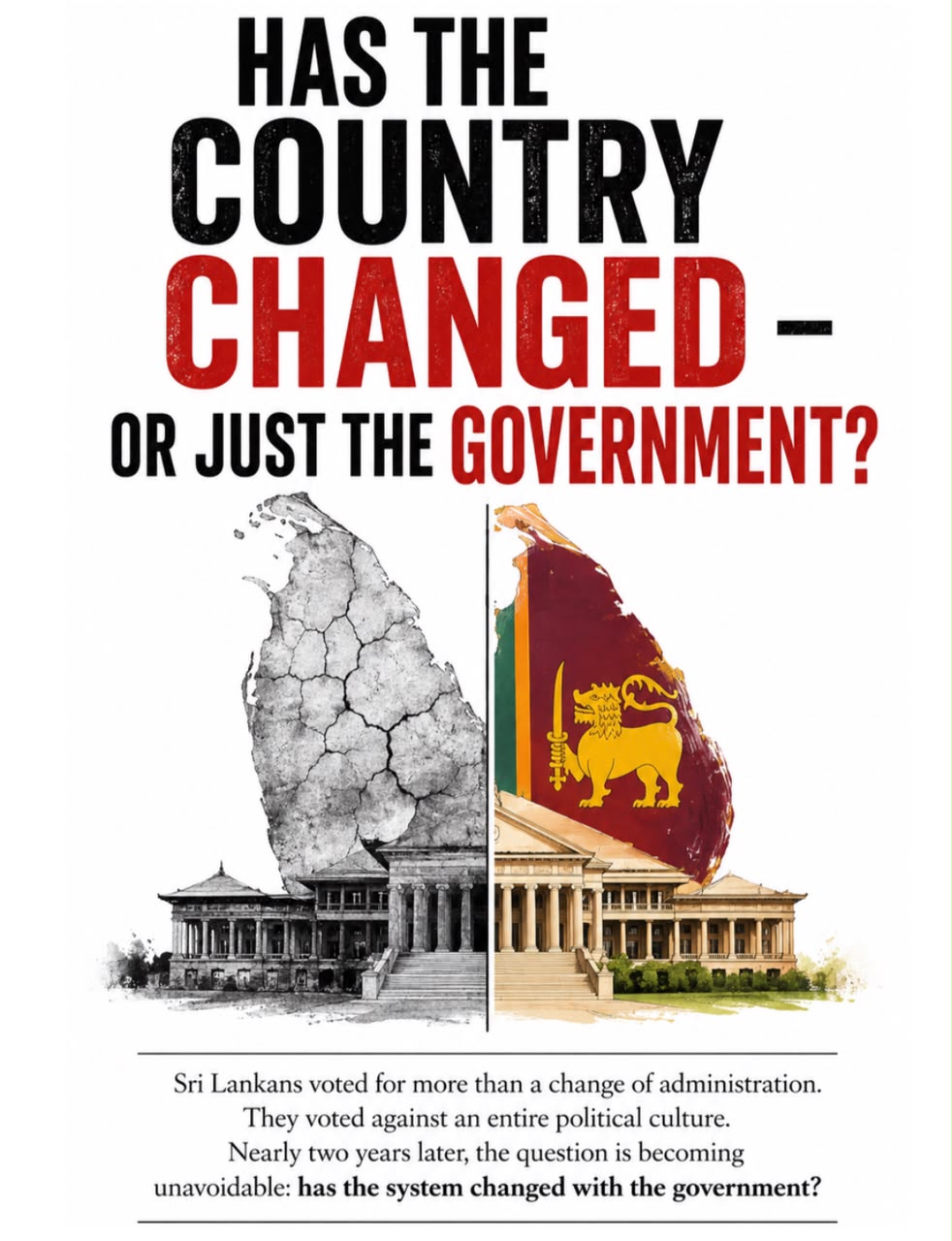
Sri Lankans voted for more than a change of administration. They voted against an entire political culture. Nearly two years later, the question is becoming unavoidable: has the system changed with the government?
There was little ambiguity about the message delivered by Sri Lankan voters in 2024.
They did not simply vote one government out and another government in. They voted against a political culture – privilege without accountability, public money without adequate scrutiny, questionable appointments,political influence over institutions and the deeply embedded belief that there was one set of rules for those who governed and another for those who were governed.
Submit Your Press Release
Get your company news, announcements, launches, appointments and events in front of a wider audience.


Anura Kumara Dissanayake and the National People’s Power rode an extraordinary public appetite for change into office.
The promise was not merely: give us a turn.
The promise, as understood by millions of voters, was something considerably bigger: we will do things differently.
Nearly two years later, that creates perhaps the most important test of this administration.
Has Sri Lanka actually changed – or has Sri Lanka merely changed its government?
There is no serious argument that the country today is where it was during the nightmare of 2022. The queues have disappeared. The shortages have largely disappeared. Fuel is available. Electricity is stable. Sri Lanka is no longer staring over the edge of immediate economic collapse.
The Government is entitled to acknowledge that progress.
But economic stabilisation and political transformation are not the same thing.
Much of the economic architecture being followed today – fiscal consolidation, debt restructuring, revenue reform and the IMF programme itself – was constructed before the present Government came to office.
The NPP administration chose, broadly, to continue that course. That may well have been economically prudent. But it also means that recovery alone cannot answer the much larger question of whether the promised political transformation has taken place.
The Real Test Is Power
Governments invariably believe they are different from their predecessors.
Citizens have a rather simpler test: how does the State behave when nobody is applauding?
How transparent are appointments? How readily is information involving public money disclosed? How independent are institutions when their decisions inconvenience the Government? How does the administration react to criticism?
Does accountability apply to friends as readily as it applies to opponents?
Does Parliament become stronger? Does the public service become more professional? Are regulators allowed to regulate, auditors allowed to audit and officials permitted to say no?
Most importantly, does the rule of law remain equally uncomfortable for everybody?
Those questions matter more than slogans because system change cannot simply mean replacing one collection of powerful people with another.
It means changing what powerful people are permitted to do.
There has unquestionably been movement on corruption and accountability. Investigations have proceeded. Cases have been brought. People once regarded as politically untouchable have found themselves answering questions before investigators and courts.
There are also reforms involving asset declarations, beneficial ownership, procurement and the institutional framework surrounding anti-corruption enforcement.
These are important developments and should not be casually dismissed.
But Sri Lanka must distinguish between two very different achievements.
Prosecuting yesterday’s alleged corruption is accountability. Preventing tomorrow’s corruption is system change.
The second is considerably harder.
It requires institutions capable of resisting whichever political party happens to occupy the Presidential Secretariat or Temple Trees. Procurement rules must operate irrespective of who is buying. Asset declarations must mean something. Regulators must regulate. Auditors must audit.
And politicians must occasionally be prepared to hear the word no from public officials.
That is what a changed system looks like.
The Trap Of “Our People”
Every government eventually encounters the same temptation.
Their appointments were political. Ours are suitable.
Their supporters were cronies. Ours are professionals.
Their interference was improper. Ours is necessary.
Their secrecy was suspicious. Ours is justified.
That is precisely the point at which system change either survives or dies.
Good governance cannot depend upon the proposition that good people should simply be trusted with enormous discretion.
Good governance means constructing institutions in which nobody needs enormous discretion in order to govern effectively.
Institutions must ultimately become stronger than personalities.
And there is another measurement which governments sometimes find less comfortable than economic statistics.
Ask the citizen.
Ask the pensioner buying medicine. Ask the family paying the electricity bill. Ask the small businessman calculating taxes. Ask the graduate looking for employment. Ask the parent wondering whether a son or daughter should build a future in Sri Lanka or somewhere else.
For them, reform is eventually measured not in communiqués, presentations or percentages, but in lived experience.
Economic stability remains fragile. Sri Lanka remains vulnerable to events over which Colombo exercises little control – energy prices, wars, tourism shocks and global financial conditions.
Avoiding catastrophe was therefore only the first job.
Building a country capable of resisting the next catastrophe is the considerably harder one.
The Opposition Cannot Escape the Test
System change cannot be demanded exclusively from the Government.
An Opposition which merely waits for the Government to fail is not offering transformation either.
Political parties cannot condemn patronage while practising it internally. They cannot demand transparency from government while remaining opaque themselves. They cannot preach democracy nationally while tolerating personality cults within their own organisations.
Sri Lanka will not acquire a new political culture if only the Government is expected to practise one.
Nor can citizens outsource democracy entirely to politicians.
The public demanded change. It must continue demanding evidence of it.
No reasonable person could expect decades of institutional decay to disappear within two years. Sri Lanka’s economic collapse was not created overnight. Neither were corruption, patronage, bureaucratic lethargy, political interference or the culture of impunity.
Repairing them will take time.
But there is a considerable difference between saying transformation is incomplete and arguing that scrutiny must therefore wait.
It must not.
Indeed, this is precisely when scrutiny matters most.
A government elected promising system change should expect a higher standard of accountability, not a lower one.
The more ambitious the promise, the greater the scrutiny that must follow. The eventual verdict on the NPP Government will therefore not simply be whether it prosecuted Rajapaksas, defeated the old political establishment or successfully navigated an IMF programme.
History will ask something considerably more important.
Did Sri Lanka’s institutions become stronger?
Did public money become more transparent?
Did corruption become more difficult – rather than merely more dangerous for yesterday’s politicians?
Did merit begin defeating patronage?
Did citizens acquire a greater right to know?
And, perhaps most importantly, did those exercising power accept scrutiny when that scrutiny became inconvenient?
If the answers eventually become yes, 2024 may indeed be remembered as the beginning of something consequential.
If they do not, Sri Lanka will have performed an exercise with which it is painfully familiar: changing the occupants while leaving the house essentially untouched.
The country did not endure bankruptcy, queues, shortages, political upheaval and an extraordinary collapse of public confidence merely for a change of nameplates.
Sri Lankans demanded something considerably more difficult.
A change in the way Sri Lanka is governed.
There are signs of change. There are reforms worthy of recognition. There are achievements which should not be dismissed simply because they belong to a government one may or may not support.
But the jury remains out on the bigger promise.
Has the country changed?
Be that as it may, changing a government takes an election. Changing a country takes considerably more.