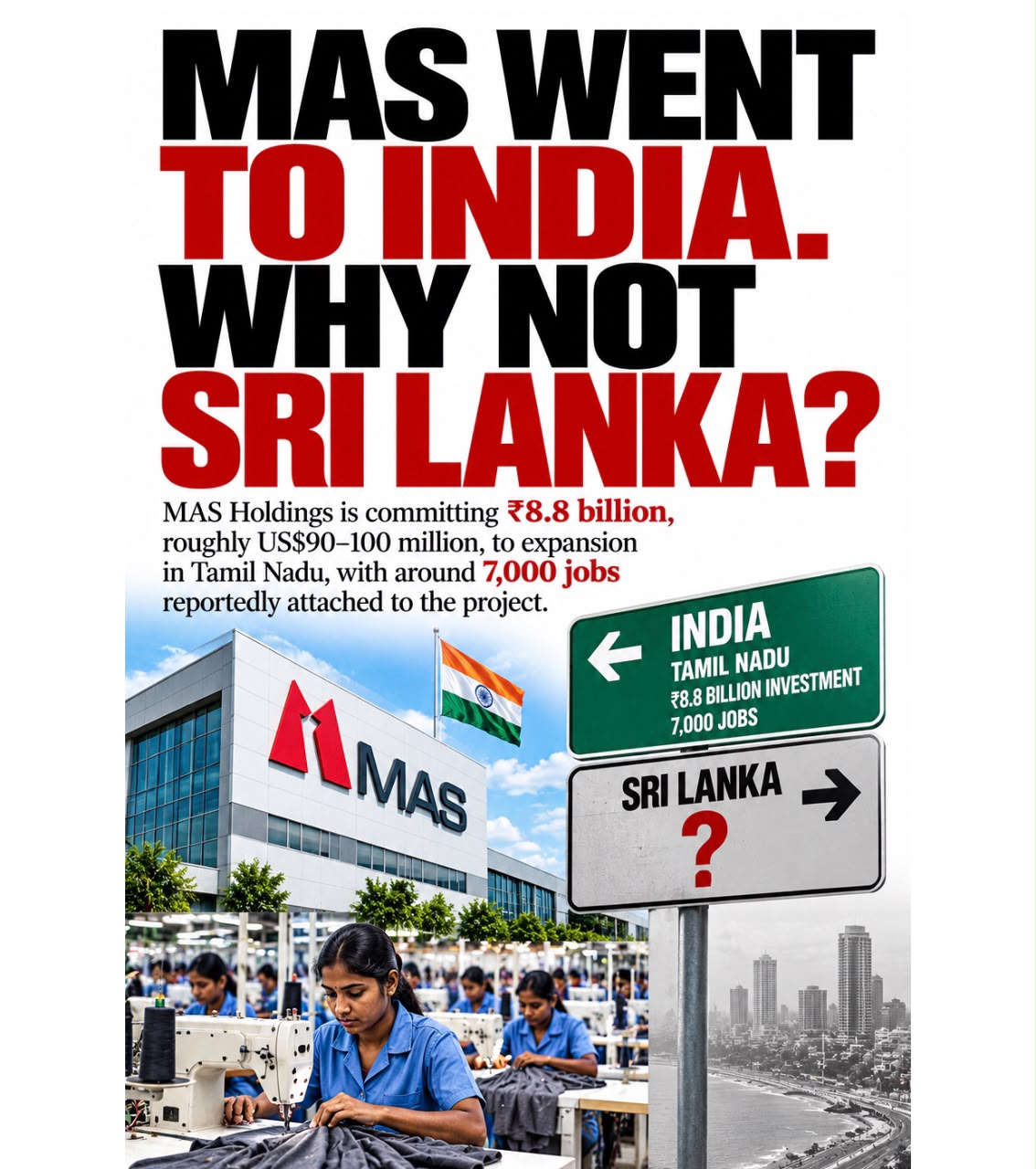
MAS Holdings is committing ₹8.8 billion, roughly US$90–100 million, to expansion in Tamil Nadu, with around 7,000 jobs reportedly attached to the project. The story caused a brief stir in Sri Lanka and then quietly slipped from view. The investment has not disappeared, however, and neither has the question that really matters: why not Sri Lanka?
There is no reason to make MAS Holdings the villain of this story. A company born in Sri Lanka has grown into one of the country’s most successful multinational businesses and is perfectly entitled to invest wherever its directors believe the best commercial opportunities exist. Indeed, the ability of a Sri Lankan company to make an investment of this magnitude overseas should itself be regarded as evidence of corporate success.
That, however, is not the end of the story. Tamil Nadu did not simply wake up one morning to discover MAS on its doorstep carrying nearly US$100 million and looking for somewhere to put it. The state has been aggressively competing for investment, and MAS formed part of a much larger investment drive involving scores of agreements, international companies and the promise of more than 100,000 jobs.
Submit Your Press Release
Get your company news, announcements, launches, appointments and events in front of a wider audience.


Sri Lanka therefore needs to ask a question which appeared briefly after the announcement and has since become strangely quiet. What did Tamil Nadu offer MAS that Sri Lanka could not, or did not, offer?
The answers may be perfectly straightforward. India offers an enormous domestic market, Tamil Nadu possesses a formidable textile and manufacturing ecosystem, and the state has the labour, suppliers, infrastructure and industrial depth that can make expansion commercially attractive. There may also be compelling strategic reasons for MAS to increase its manufacturing footprint in India irrespective of what Sri Lanka offered.
But that is precisely why the answers matter. If electricity costs, land availability, taxation, regulatory certainty, labour, logistics, incentives or the speed at which government approvals can be obtained influenced the decision, Sri Lanka needs to know. If none of those factors mattered and this was simply an investment designed specifically for the Indian market, that is worth establishing too.
There is another question which should be directed not at MAS but at Sri Lanka’s investment machinery. Did anyone seriously attempt to persuade the company to put some or all of this expansion here? Did somebody sit across a table from MAS and ask what Sri Lanka would have to do to secure those factories, that capital and those thousands of jobs, or was the first serious conversation about the investment held only after we discovered it was going somewhere else?
Sri Lanka spends considerable time and money telling foreign investors why they should come here. Presidents and ministers travel, investment forums are organised and presentations remind audiences about our strategic location, educated workforce and access to important markets. Yet some of the most obvious potential investors already understand Sri Lanka because they were created here, and when one of them decides that its next major expansion belongs somewhere else, that decision deserves considerably more attention than another investment seminar.
There is also an uncomfortable media and corporate-governance question. The MAS announcement initially attracted attention, generated questions and produced the inevitable debate about whether Sri Lanka was losing investment and jobs to India. Then the subject slowly slipped away from the national conversation without those underlying questions ever really being answered.
That does not establish that anybody suppressed anything, and NEWSLINE makes no such allegation. But large corporations have become exceptionally skilled at managing reputational discomfort, while governments are rarely enthusiastic about stories suggesting that their investment environment may have lost a competition. Journalism should be particularly careful that legitimate questions do not simply expire because everybody concerned would find it more comfortable to move on.
MAS should therefore be encouraged to explain the commercial reasoning behind the decision, not because it owes Sri Lanka an apology but because its experience could tell policymakers something valuable. Government should be equally willing to explain whether Sri Lanka competed for this investment and, if it did, why Tamil Nadu won.
There is a much bigger issue beneath all of this. Capital has no sentimental obligation to remain where it was born. It will increasingly travel towards the combination of cost, market, skills, infrastructure, certainty and opportunity that produces the best return, and governments that fail to understand that competition will eventually discover that investment announcements are being made somewhere else.
Tamil Nadu appears to understand the contest very well. It is not merely waiting for investors but actively building an industrial ecosystem around them and competing with other Indian states and countries for the next factory, the next technology centre and the next thousand jobs.
Sri Lanka says it wants precisely the same thing.
The question Sri Lanka still has not adequately answered is why almost US$100 million and thousands of potential jobs made greater commercial sense across the Palk Strait than they did here.
Until we know that, “Why Not Sri Lanka?” remains a question worth asking.
Be that as it may.