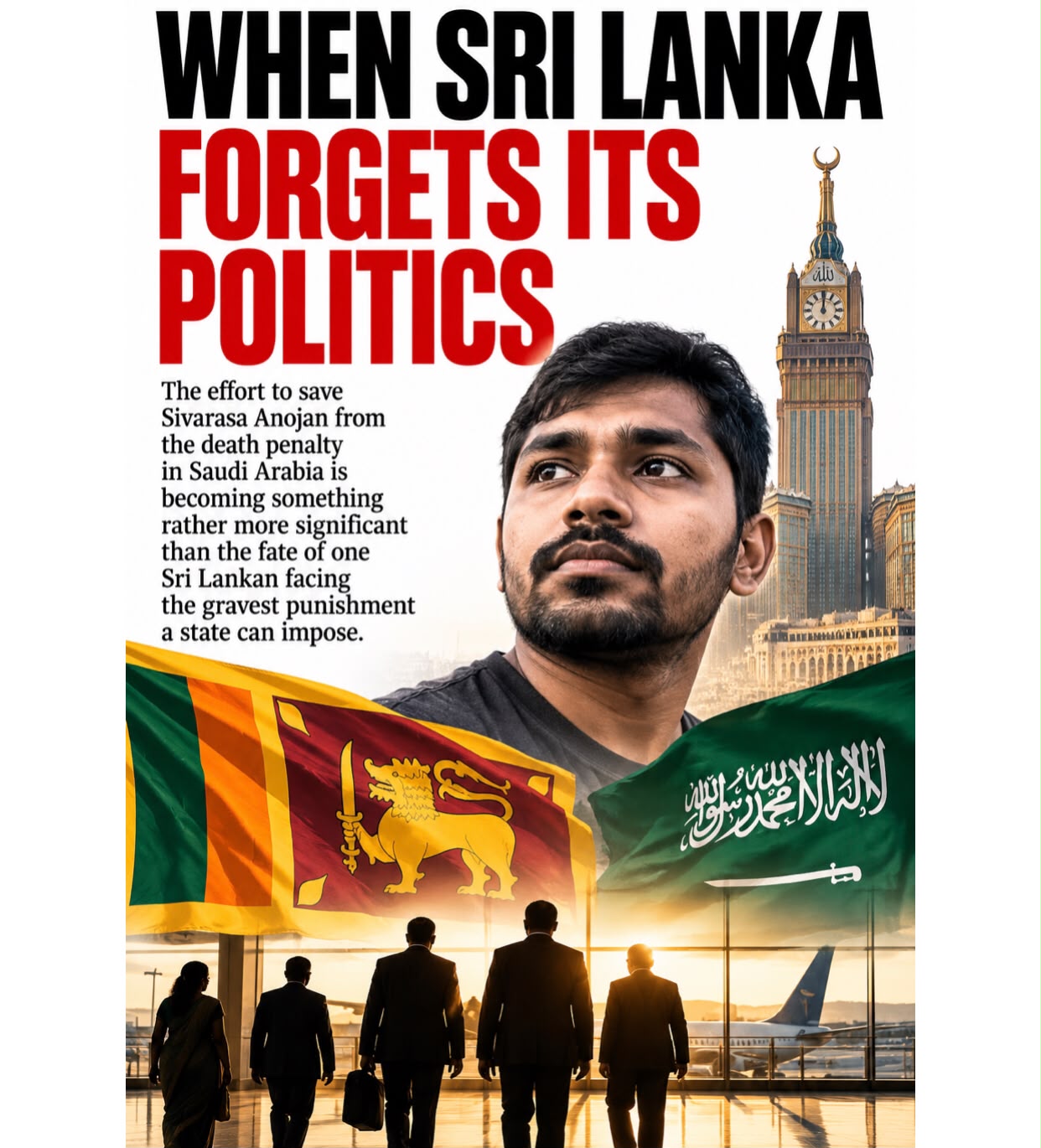
The effort to save Sivarasa Anojan from the death penalty in Saudi Arabia is becoming something rather more significant than the fate of one Sri Lankan facing the gravest punishment a state can impose. It is becoming a rare demonstration of what Sri Lanka can do when politics is put aside and the country decides that the nationality of the person in trouble matters more than who receives the credit for helping him.
Faiszer Musthapha PC MP and Upul Kumarapperuma PC are moving towards the Saudi capital – at their own personal cost – as efforts intensify on several fronts. State lawyers are also expected to coordinate the legal effort surrounding Anojan’s appeal before the Kingdom’s highest judicial authorities, while separate humanitarian representations are understood to be directed towards Crown Prince Mohammed bin Salman.
There will be time enough to examine the legal case, the avenues available under Saudi law and precisely what intervention may still be possible. Nothing about a death-penalty case should encourage false hope. Saudi Arabia is a sovereign jurisdiction and Sri Lanka cannot dictate the outcome of proceedings before its courts.
Submit Your Press Release
Get your company news, announcements, launches, appointments and events in front of a wider audience.


What Sri Lanka can do, however, is use every legitimate legal, diplomatic and humanitarian avenue available to it. And that appears increasingly to be what is happening.
There is something else worth recognising.
The effort has crossed political boundaries. Government officials, parliamentarians, lawyers and others who would ordinarily find themselves on very different sides of Sri Lanka’s political arguments appear united around one objective: if there remains a lawful way of saving a Sri Lankan life, it should be pursued.
That should not be remarkable. Unfortunately, in our deeply divided politics, it sometimes is.
Sri Lanka has repeatedly demonstrated this capacity to forget its divisions when confronted by a genuine national crisis. We saw versions of it during natural disasters and moments of national tragedy. We see it too, in a rather happier form, when a Sri Lankan athlete or team achieves something extraordinary overseas.
For a few hours, sometimes a few days, Sinhala, Tamil and Muslim cease to be the first description. Government and Opposition matter a little less. Colombo and Jaffna, Hambantota and Batticaloa can celebrate the same victory or worry about the same tragedy.
We simply become Sri Lankan.
There is an important lesson in the Anojan effort, irrespective of its eventual outcome. National unity does not require political uniformity. Faiszer Musthapha does not have to agree politically with Upul Kumarapperuma. The Opposition does not have to endorse the Government. Nor does anybody have to abandon legitimate criticism of the state.
They merely have to recognise that sometimes the national interest is larger than the political contest.
Saving the life of a Sri Lankan citizen facing execution abroad is surely one of those occasions.
And perhaps Sri Lanka could do with rather more reasons to experience that feeling of collective purpose.
The last time Sri Lanka’s men’s cricket team won the ODI World Cup was in 1996. More than thirty years later, we are still waiting for another World Cup victory of that magnitude to produce the sort of nationwide celebration that makes almost every other distinction temporarily disappear. The art may well be to turn that away from temporary to permanent and sustainable unity.
A country should not need a death sentence to discover its unity. Neither should it have to wait three decades for a cricket trophy to rediscover its national pride.
But when those moments come, they remind us of something easily forgotten amid the daily political noise: underneath all the arguments, Sri Lanka retains an extraordinary capacity to come together.
The immediate task now is Anojan.
Let the lawyers argue every available point. Let the diplomats open every available door. Let political leaders use whatever relationships they possess. And let humanitarian appeals reach whoever has the authority to exercise mercy.
Foreign Minister Vijitha Herath put it rather beautifully: Sri Lanka he said, is a small country with a big heart. Iranian sailors stuck on the high seas closer to Sri Lanka than anywhere else, must be waiting to see how big that heart is. Not to fight sanctions – but to survive another day.
There can be arguments about who did what later. For now, there is a Sri Lankan life to try to save.
Be that as it may.