
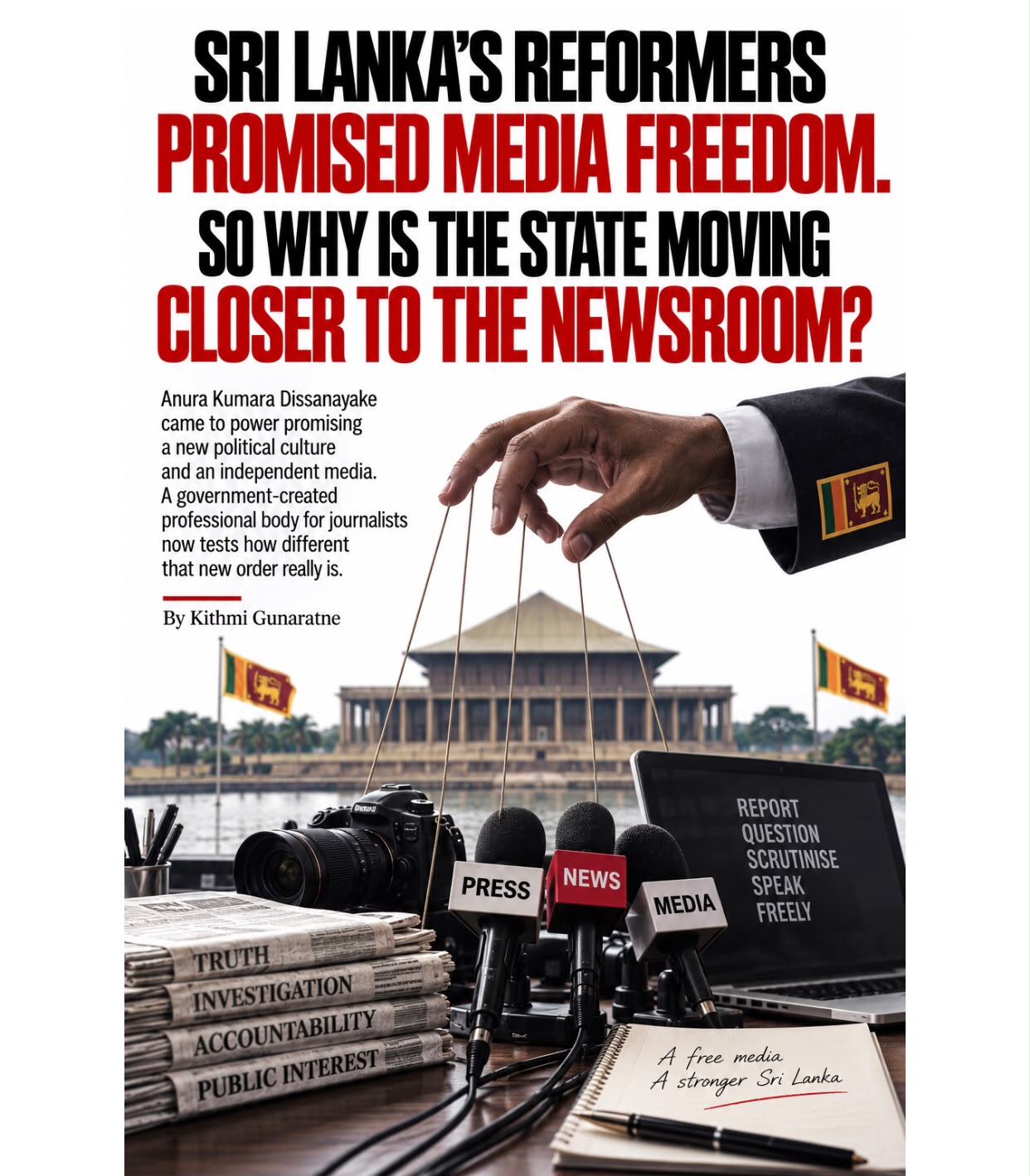
Anura Kumara Dissanayake came to power promising a new political culture and an independent media. A government-created professional body for journalists now tests how different that new order really is.
Sri Lanka’s government came to power promising to dismantle the habits of an old political order. Now it is asking Parliament to approve legislation that would create a statutory institute responsible for maintaining professional standards among journalists and other media workers, beginning its life under an interim council appointed by the media minister. For an administration elected on the promise of political transformation, the contradiction deserves far more scrutiny than it has received.
On 23 September, Parliament is scheduled to hold the second-reading debate on the Chartered Institute of Media Professionals of Sri Lanka Bill. The legislation, first gazetted on 5 June and presented to Parliament in July, proposes an institute intended to introduce and maintain professional standards, conduct training and examinations, enrol members, promote ethical conduct and advance media education.
Submit Your Press Release
Get your company news, announcements, launches, appointments and events in front of a wider audience.


There are genuine problems behind the government’s case. Sri Lankan journalism has been damaged by political ownership, commercial pressure, sensationalism and weak employment protections, while many provincial reporters work under precarious conditions. Better training and stronger professional institutions are not unreasonable objectives. The question is why achieving them requires placing political authority so close to the institution being created to define professional journalism.
That question became considerably harder to dismiss on 8 September, when the Speaker announced the Supreme Court’s determination on the Bill. The Court found clause 3(i) vague and inconsistent with Articles 12(1) and 14(1)(g) of the Constitution, while clause 4(o) was also inconsistent with those provisions and clause 5(4)(b) was inconsistent with Article 12(1). The relevant provisions would require the special majority prescribed by Article 84(2) if passed unchanged, although the Court set out amendments or deletion that would remove the inconsistencies. The remainder of the Bill was found not inconsistent with the Constitution.
This distinction matters: Article 14(1)(g) protects the freedom to engage in a lawful occupation, profession, trade, business or enterprise, rather than being the Constitution’s freedom-of-expression provision. But the determination still means concerns about the design of the legislation cannot simply be dismissed as political alarmism.
Nor has opposition come from a fringe of the media industry. The Sri Lanka Press Institute, Newspaper Society of Sri Lanka, Editors’ Guild, Free Media Movement, Sri Lanka Working Journalists’ Association, Muslim Media Forum, Tamil Media Alliance, Federation of Media Employees Trade Union and the Sri Lankan chapter of the South Asia Free Media Association have objected to the legislation. Their primary concern is particularly revealing: the government-led nature of the initiative.
They have argued that credible professional bodies are normally developed by the professions themselves before receiving statutory recognition, rather than being designed by the state for the profession it intends to organise.
The actual text of the Bill explains why that objection matters. Until the institute’s permanent council is elected and appointed, the minister would appoint an interim council consisting of the secretary to the relevant ministry and six people with at least 20 years’ experience in media nominated by that secretary. That interim council would have the power to make the initial rules governing how many members are selected, the criteria by which they are selected and the process for creating the permanent council.
In other words, the institution’s founding membership architecture would be built by a body whose existence begins with a ministerial appointment.
The Bill goes further than training and professional development. It provides for a disciplinary committee to investigate allegations of “professional misconduct” by members.
That does not automatically make the legislation an instrument of censorship. Governments have legitimate interests in education, professional development and creating institutional structures capable of raising standards. Journalism itself cannot demand immunity from criticism while complaining about everybody else’s lack of accountability.
But journalism occupies an unusual place in a democracy. Its job frequently requires journalists to investigate, challenge and embarrass the same political authorities responsible for making laws. That relationship makes institutional distance from government particularly important.
Sri Lanka certainly needs better journalism. It needs stronger professional standards, better training, more protection for provincial reporters, improved employment conditions and a serious conversation about ethics in an industry transformed by social media and collapsing traditional business models.
The question is not whether journalism should improve.
It is who gets to build the machinery that decides what improvement looks like.
President Dissanayake promised Sri Lanka a different political culture. A government confident in that promise should not need to keep its hand anywhere near the architecture



