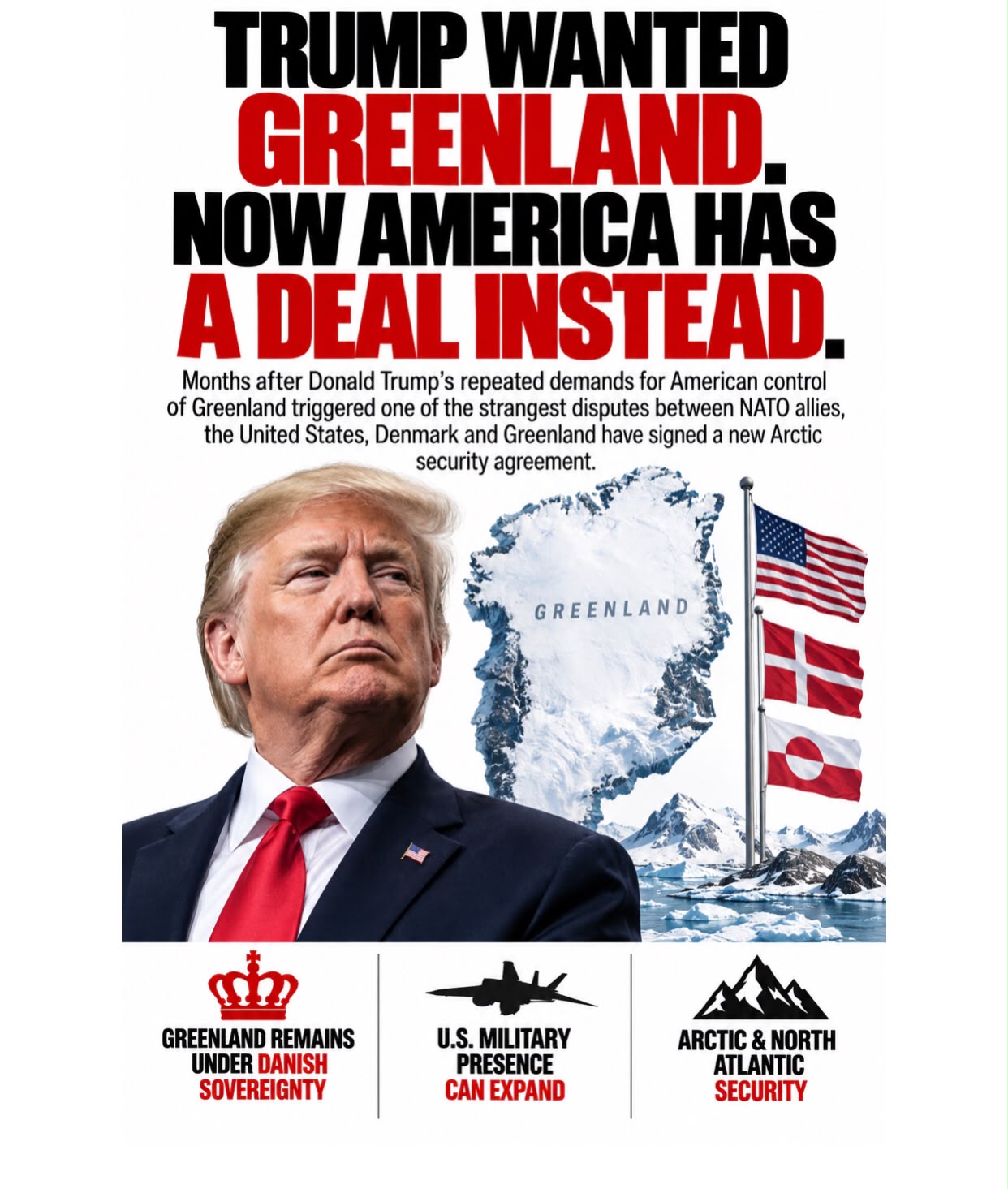
Months after Donald Trump’s repeated demands for American control of Greenland triggered one of the strangest disputes between NATO allies, the United States, Denmark and Greenland have signed a new Arctic security agreement. Washington has not acquired Greenland. It has, however, secured a framework for greater military cooperation in a region rapidly becoming one of the world’s most important strategic frontiers.
Donald Trump did not get Greenland.
What the United States has now obtained may prove considerably more practical.
Submit Your Press Release
Get your company news, announcements, launches, appointments and events in front of a wider audience.


The United States, Denmark and Greenland have signed an Arctic security agreement aimed at strengthening military cooperation and addressing growing security concerns in the far north, bringing a measure of resolution to a dispute that at one stage had the American President openly talking about acquiring territory belonging to a NATO ally.
The agreement was signed in New York on the sidelines of the United Nations General Assembly following months of negotiations between Washington, Copenhagen and Nuuk. It establishes a framework for closer cooperation on Arctic security while leaving the fundamental constitutional position unchanged: Greenland remains a self-governing territory within the Kingdom of Denmark.
That distinction matters because Trump’s earlier language went considerably further than seeking additional military access.
The President repeatedly argued that the United States needed Greenland for national and international security and refused for a time to rule out coercive measures to obtain it. Denmark responded that Greenland was not for sale, while Greenland’s own leaders made the more fundamental point that decisions about Greenland’s future belong to Greenlanders.
The resulting confrontation was extraordinary because Denmark is not an American adversary. It is a NATO member and longstanding US ally.
The strategic concern underneath Trump’s rhetoric, however, was real.
The Arctic is changing rapidly. Melting ice is opening greater possibilities for shipping, access to minerals and military movement. Russia possesses an enormous Arctic coastline and substantial military infrastructure across the region, while China has increasingly sought economic and strategic involvement despite not being an Arctic state.
Greenland sits directly inside that competition.
Its location between North America and Europe gives it enormous importance for missile warning, surveillance and the defence of the North Atlantic. The United States already operates Pituffik Space Base in north-west Greenland under longstanding arrangements with Denmark.
Washington therefore did not need to own Greenland to have a significant military presence there. What it wanted was greater strategic flexibility as the Arctic became more contested.
The new agreement appears to move the three parties towards that objective without requiring Denmark to surrender sovereignty or Greenlanders to accept American ownership.
That represents an important shift from the confrontation that dominated the relationship earlier this year. It also demonstrates the difference between political rhetoric and strategic negotiation. Threatening to acquire another country’s territory produced headlines, anger and anxiety within NATO. Negotiating a security framework has produced something Washington can actually use.
For Denmark, the agreement provides a route towards strengthening Arctic defence while preserving sovereignty. Copenhagen has itself acknowledged that the changing security environment requires significantly greater investment in the region.
For Greenland, the issue is more complicated.
Greenlanders have increasingly asserted their right to determine their own political future, including the possibility of eventual independence from Denmark. They have also made clear that independence from Copenhagen does not mean becoming part of the United States.
Any expansion of American military activity therefore has to accommodate Greenlandic political authority rather than treating the island simply as strategically useful territory on a map.
That may be one of the most important consequences of the dispute.
Trump’s attempt to place ownership of Greenland at the centre of international debate inadvertently reinforced the principle that Greenlanders themselves must have a voice in decisions affecting their territory.
The new security agreement does not end American interest in the Arctic, nor should it. Russia and China are unlikely to reduce theirs.
What it may do is return the argument to a more conventional question: how three partners can defend strategically important territory without one of them claiming it should own the territory of another.
There is a lesson in that distinction.
The United States wanted greater security in Greenland. Denmark wanted its sovereignty respected. Greenland wanted its people treated as participants rather than property.
After months of confrontation, the three have finally produced an agreement which attempts to accommodate all three objectives.
Trump did not get Greenland.
America may have obtained much of the security cooperation it actually needed.