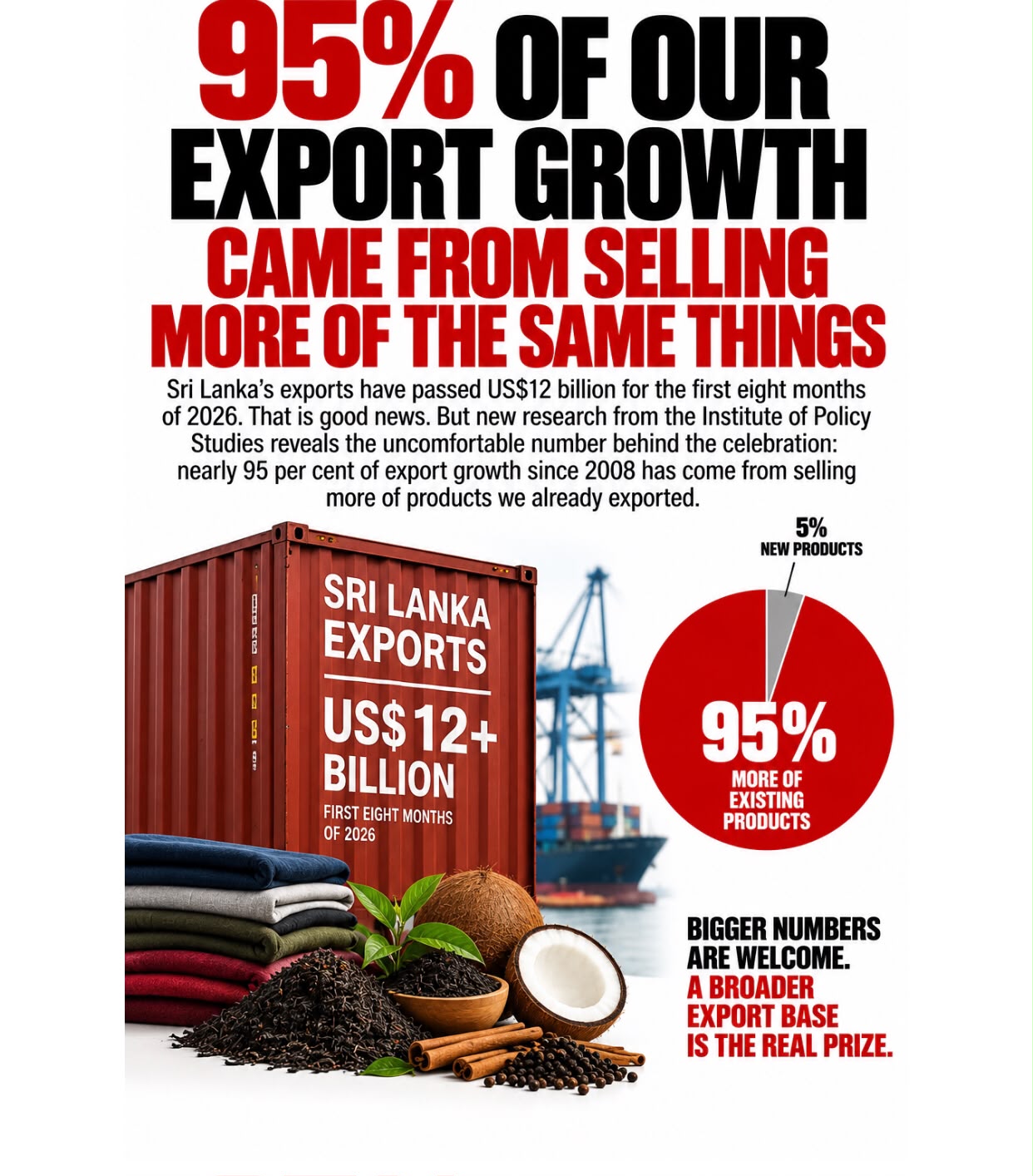
Sri Lanka’s exports have passed US$12 billion for the first eight months of 2026. That is good news. But new research from the Institute of Policy Studies reveals the uncomfortable number behind the celebration: nearly 95 per cent of export growth since 2008 has come from selling more of products we already exported. Nearly 1,000 new products were introduced. Only 43 became competitive.
Sri Lanka’s exports have just crossed US$12 billion for the first eight months of this year, giving the country another encouraging economic number to place alongside 4.2 per cent GDP growth and improving foreign reserves.
Total exports reached approximately US$12.01 billion between January and August, compared with US$11.52 billion during the corresponding period last year. That represents growth of 4.26 per cent. Merchandise exports increased by 3.63 per cent to US$9.41 billion, while services exports performed better, increasing by 6.59 per cent to approximately US$2.60 billion.
Submit Your Press Release
Get your company news, announcements, launches, appointments and events in front of a wider audience.


August itself produced exports of approximately US$1.60 billion. Services were particularly encouraging, increasing 13.97 per cent year-on-year to US$331.87 million, while merchandise exports amounted to approximately US$1.27 billion.
There are individual sectors producing impressive numbers too. Electrical and electronic components have expanded strongly this year. Processed food and beverages, spices, rubber products and coconut-based exports have also recorded growth, while ICT and business-process services continue to provide an increasingly important source of foreign exchange.
So far, so good.
Then comes the number that should make Sri Lanka considerably less comfortable. Research by the Institute of Policy Studies shows that nearly 95 per cent of Sri Lanka’s export growth since 2008 has come from selling greater quantities of products the country was already exporting. Over that period, nearly 1,000 new export products were introduced, but only 43 became
competitive.
That is a very different picture of export growth.
There is nothing wrong with selling more of something Sri Lanka already produces well. If the country can sell more garments, tea, rubber products, coconut products or spices competitively and profitably, it should do precisely that.
The problem arises when increasing volumes of existing exports becomes the principal engine of expansion for almost two decades.
It means Sri Lanka remains heavily dependent on an export structure that has proved remarkably difficult to change. New products are appearing, but very few are successfully establishing themselves as internationally competitive exports.
That matters because the Government has considerably larger ambitions than maintaining the present export base.
Sri Lanka’s National Export Development Plan 2026 to 2030 has set an export revenue target of US$36 billion by 2030 and describes the objective as transforming the country into a competitive, knowledge-based export hub. The Government has also spoken of achieving medium-term economic growth of around 7 per cent.
Those ambitions require something more than simply selling additional quantities of what Sri Lanka already sells.
The IPS analysis points to another vulnerability. Sri Lanka continues to depend on non-reciprocal preferential arrangements such as GSP+, while competing exporters including India and Indonesia have reciprocal trade agreements with major destinations such as the European Union and United Kingdom. Preferential access granted unilaterally can be withdrawn because of income status or compliance issues. A negotiated trade agreement provides a different degree of certainty.
The United States adds another layer of uncertainty because of its changing trade policy and tariff environment. IPS argues that Sri Lanka has a strong incentive to pursue arrangements that provide favourable and predictable access to the American market.
But trade agreements alone will not create competitive products.
Sri Lanka also has to confront what happens inside its own borders. IPS points to tariff complexity and para-tariffs which can increase the effective tax burden on imports beyond the statutory VAT rate. Inputs imported by Sri Lankan manufacturers ultimately become part of the cost of the goods those manufacturers attempt to sell overseas.
There is a difficult balance here. Removing protective tariffs exposes domestic businesses, particularly smaller manufacturers, to stronger foreign competition. Maintaining excessive protection can make the entire economy less competitive and discourage firms from developing products capable of surviving outside the protected domestic market.
That is why export diversification is considerably harder than announcing another target.
It requires capital, technology, research, reliable energy, efficient ports, competitive logistics, trade agreements, skilled workers and businesses willing to take the risk of developing products for markets where Sri Lanka receives no special treatment.
There are signs that diversification is possible. Electrical and electronic components recorded exceptionally strong growth during parts of this year, while activated carbon provides a useful example of taking a domestic raw material, coconut shell, and turning it into a higher-value industrial export. ICT and business-process services demonstrate that export earnings need not arrive inside a shipping container.
Those examples matter because Sri Lanka cannot export its way to substantially higher living standards simply by producing more of everything it produced twenty years ago.
Crossing US$12 billion in eight months deserves recognition. Exporters have achieved that performance despite volatile global conditions, Middle East disruption and uncertainty in major markets.
But the IPS numbers prevent the celebration from becoming complacency.
Nearly 1,000 new products entered Sri Lanka’s export story after 2008. Only 43 became competitive, while almost 95 per cent of export growth continued to come from existing products.
The question facing Sri Lanka is therefore no longer simply whether exports are growing.
It is whether the country is becoming better at creating new things the rest of the world actually wants to buy.