The headline number in Sri Lanka’s 2027 Appropriation Bill is Rs. 4.99 trillion. But that is only part of the picture. Add expenditure already charged to the Consolidated Fund under existing law and the expenditure provided for under the Bill approaches Rs. 9.92 trillion. Before the Budget Speech begins, those numbers deserve examination.
Sri Lanka’s 2027 Budget process has begun before the President has uttered a word of the Budget Speech.
The Appropriation Bill for the coming financial year has been gazetted, providing the first detailed view of the enormous sums Parliament will be asked to authorise or recognise for the operation of the State in 2027.
Submit Your Press Release
Get your company news, announcements, launches, appointments and events in front of a wider audience.


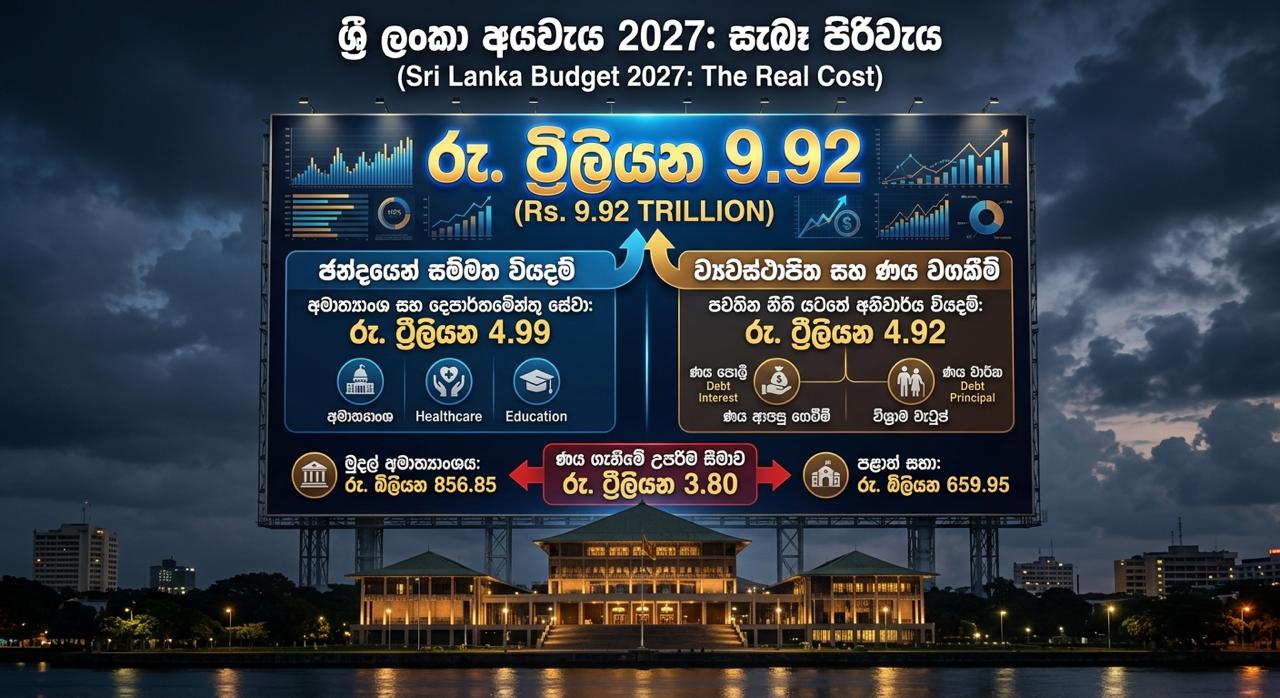
The figure attracting immediate attention is Rs. 4.993 trillion.
That is the estimated service expenditure for Government ministries and departments which the Bill seeks authority to meet from the Consolidated Fund, other government funds or borrowings.
But it is not the entire expenditure picture.
The Bill separately identifies approximately Rs. 4.92 trillion in statutory expenditure – expenditure already charged to the Consolidated Fund under existing laws.
Put the two together and expenditure provided for under the Bill reaches approximately Rs. 9.92 trillion.
That distinction matters.
A Budget is often presented to the public through announcements: a new programme here, another subsidy there, a tax concession, infrastructure project or welfare measure.
But long before a government decides what new things it would like to do, enormous financial commitments already exist.
The State has employees to pay, pensions and institutions to support, existing programmes to finance and, critically, debt obligations to meet.
That is why the Appropriation Bill deserves attention before the political theatre of Budget Day.
Among individual ministries, the Ministry of Finance, Planning and Economic Development carries the largest allocation at approximately Rs. 856.85 billion, while expenditure associated with Provincial Councils is separately budgeted at approximately Rs. 659.95 billion.
There is another number that should command attention.
The Bill proposes that the net outstanding balance of Government borrowings raised during the 2027 financial year be capped at Rs. 3.8 trillion.
Sri Lanka therefore enters another Budget cycle carrying the same fundamental challenge that has confronted successive governments: the distance between what the State wishes to spend, what it can raise through revenue and what ultimately has to be financed.
That issue has become even more important after the sovereign default and subsequent debt restructuring.
Borrowing is not inherently irresponsible. Governments borrow throughout the world to finance investment, manage cash flows and spread the cost of long-lived infrastructure.
The question is what is being financed, at what cost, and whether tomorrow’s taxpayers receive something of lasting value in return.
Borrowing to build economically productive infrastructure is one proposition.
Borrowing because the State cannot sustainably finance its recurring obligations is another.
The Appropriation Bill therefore provides Parliament with considerably more than a set of accounting numbers. It provides the starting point for asking what Sri Lanka’s Government actually costs.
The First Reading is scheduled for October 7. The Budget Speech and Second Reading are scheduled for November 12, followed by weeks of parliamentary scrutiny before the process concludes in December.
By then there will be promises, arguments and political claims from both sides of the House.
But the more useful questions can begin now.
How much of 2027 expenditure is genuinely discretionary? How much is already committed? How much goes into maintaining the machinery of government? How much creates assets or services citizens will actually experience? And how much borrowing will be necessary to keep the whole structure operating?
Sri Lanka has learned painfully that a Budget can appear manageable until the assumptions beneath it cease to hold.
That is why Rs. 4.99 trillion should not be read in isolation.
The larger figure – approximately Rs. 9.92 trillion when statutory expenditure is included – tells us something more important.
Before asking what the Government intends to give Sri Lanka in 2027, perhaps the first question should be:
What will the Sri Lankan State cost us in 2027?