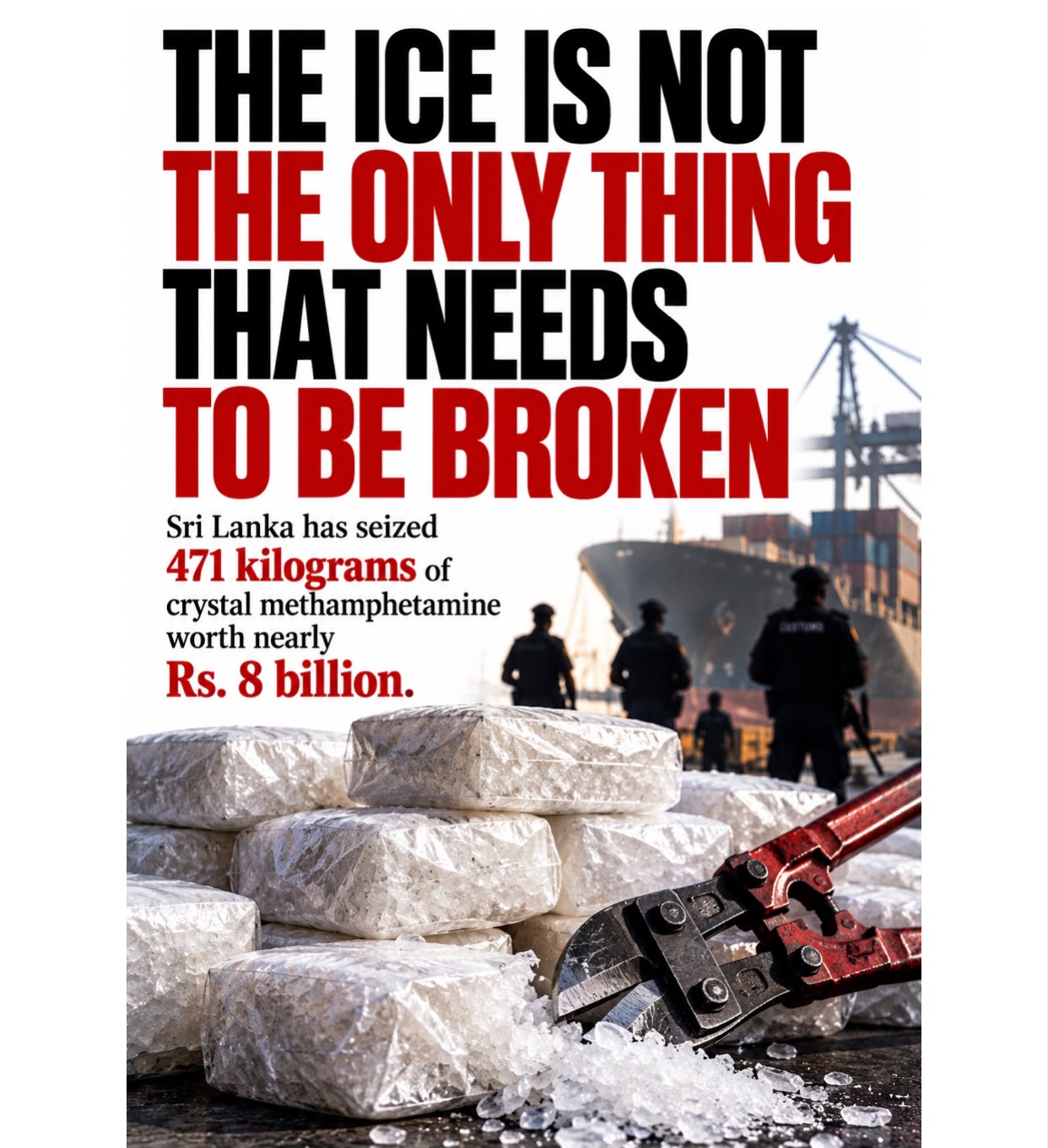
Sri Lanka has seized 471 kilograms of crystal methamphetamine worth nearly Rs. 8 billion. That should have been an unqualified victory for the country’s war against narcotics. Instead, an investigation into the investigation has created questions which cannot be answered by political accusation, police silence or social-media speculation.
The seizure of 471 kilograms of crystal methamphetamine from two containers at the Colombo Port ought to have been one of the Government’s strongest exhibits as it prepares to mark the first anniversary of its Ratama Ekata anti-narcotics programme.
Instead, it is rapidly becoming a test of the programme itself.
Submit Your Press Release
Get your company news, announcements, launches, appointments and events in front of a wider audience.


On August 31, officers from the Police Narcotics Bureau, Central Crime Investigation Bureau and Sri Lanka Customs opened two containers at the CICT Terminal after obtaining judicial authority to inspect them. What they allegedly found was extraordinary: 471 kilograms of crystal methamphetamine, commonly known as “ice”, with an estimated street value approaching Rs. 8 billion.
Seven suspects have subsequently been arrested and the investigation continues.
On the face of it, this is precisely what an effective anti-narcotics operation should look like. Intelligence is received. Investigators act upon it. Judicial authority is obtained. Customs and police agencies cooperate. Hundreds of kilograms of dangerous narcotics are prevented from entering the country.
Then something unusual happened.
Inspector General of Police Priyantha Weerasooriya ordered the Police Special Investigation Unit to investigate what police themselves described as “certain shortcomings and omissions” in the original investigation.
That changes the story.
The public is now entitled to know exactly what those shortcomings and omissions were.
This is where both Government and Opposition must exercise some restraint. Opposition politicians cannot simply convert suspicion into evidence and declare that officers are being targeted because the narcotics belonged to somebody politically connected. That is an extremely serious allegation and requires extremely serious evidence.
Equally, the Government and police cannot dismiss the resulting questions merely because some of them are being asked by political opponents.
There is a very simple way to end speculation.
Tell the country what went wrong.
Was evidence improperly handled? Was the chain of custody compromised? Were investigative procedures ignored? Were suspects not pursued quickly enough? Was information withheld? Did officers act outside their authority? Was there disagreement about which police unit should control the investigation? Or did the internal inquiry arise from something entirely different?
These are not operational details that necessarily require suspects, informants or intelligence methods to be exposed. They are fundamental questions about the integrity of an investigation involving nearly half a tonne of narcotics.
There is another question that deserves attention.
Police say the original information about the containers was received by Senior DIG Ranmal Kodithuwakku, who was responsible for Crimes and Traffic. If that information ultimately resulted in one of the country’s largest recent methamphetamine seizures, the public deserves to understand how that intelligence travelled through the police system, who authorised what happened next and precisely where the alleged “shortcomings and omissions” occurred.
That is not an argument for protecting any police officer.
Quite the opposite.
If officers mishandled an investigation involving Rs. 8 billion worth of narcotics, investigate them without fear or favour. Rank should offer no immunity. Neither should a successful seizure erase misconduct that may subsequently be discovered.
But if officers acted properly, they should not have their reputations destroyed by insinuation, political theatre or an unexplained internal investigation hanging indefinitely over their heads.
The same standard must apply upwards.
If anybody attempted to influence this investigation, whether politician, businessman, police officer, public official or intermediary, that person must be identified and investigated. It should make absolutely no difference whether the telephone call came from Government, Opposition or somewhere considerably more powerful than either.
That is what Ratama Ekata ultimately has to mean.
An anti-drugs campaign cannot be measured merely in kilograms seized, suspects photographed and press conferences conducted. Its credibility depends upon what happens when an investigation becomes inconvenient.
Sri Lanka has seen enough spectacular narcotics seizures to understand the problem. The drugs appear on television. The suspects are marched before cameras. Enormous street values are announced.
Then the public hears considerably less about who financed the shipment, who arranged it, who expected to receive it, where the money came from, where it was going and whether the people at the top of the operation were ever prosecuted.
Finding 471 kilograms of ice is important.
Finding out who owns 471 kilograms of ice is considerably more important.
And discovering whether anybody tried to prevent investigators from answering that question may be more important still.
The Government therefore has an opportunity rather than merely a problem.
If there were shortcomings in this investigation, disclose their nature and correct them. If police officers committed misconduct, proceed against them. If the allegations circulating about political interference are false, establish that through facts rather than indignation. If there was interference, expose it regardless of whose name appears at the end of the trail.
That would strengthen Ratama Ekata, not weaken it.
The worst possible outcome would be ambiguity: a massive narcotics seizure, an unexplained investigation into the investigators, political accusations flying in every direction and eventually silence.
Rs. 8 billion worth of methamphetamine did not accidentally climb into two containers and make its own way to Colombo.
Somebody financed it. Somebody shipped it. Somebody expected it. Somebody stood to make an enormous amount of money from it.
Those are the people Sri Lanka needs to find. The 471 kilograms have already been caught.Now catch the network.
Be that as it may.