
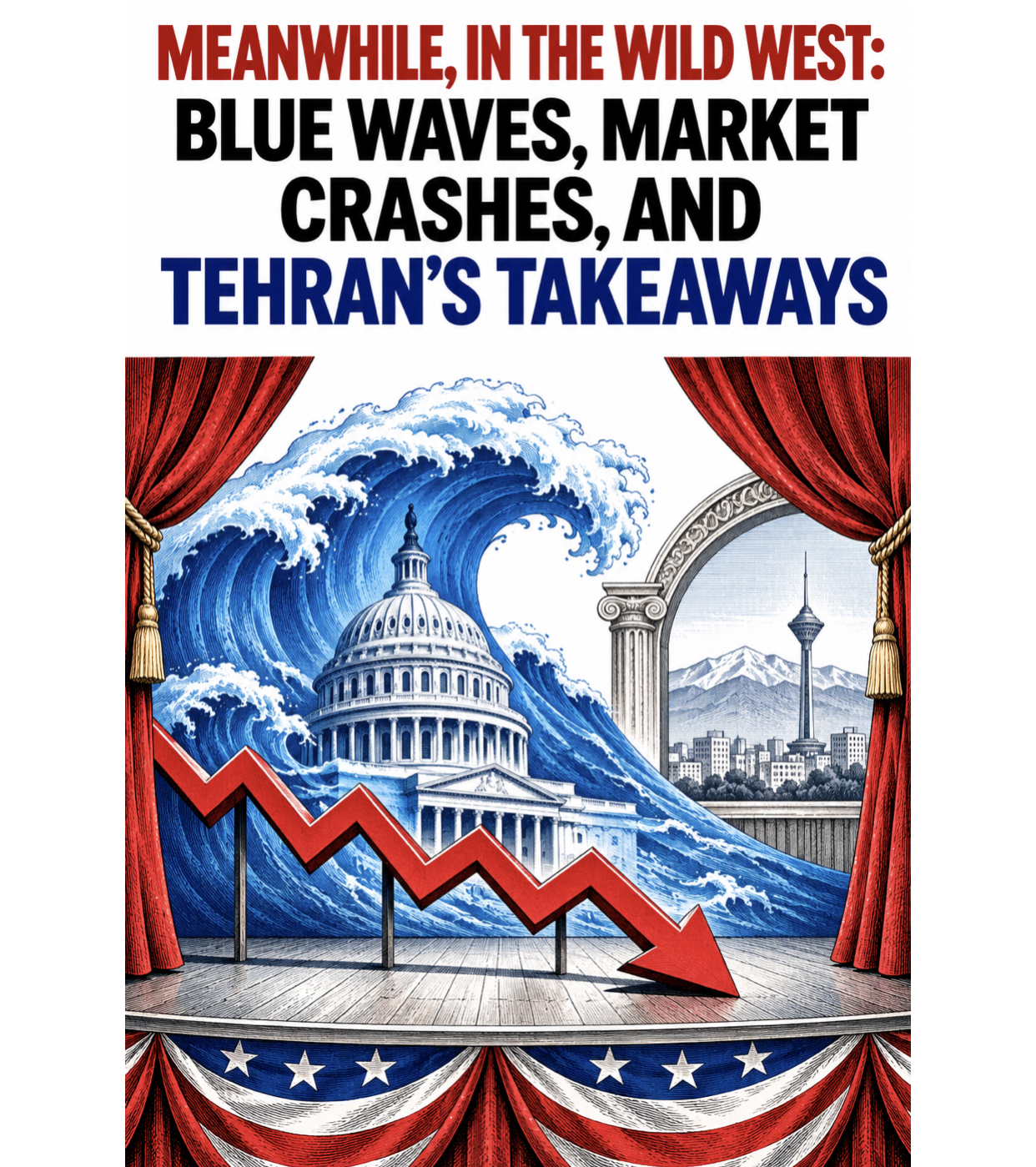
The factual sequence of events following the November 2026 U.S. midterm elections reads less like standard statecraft and more like an absurdist political theatre. In the span of forty-eight hours, American voters delivered a sweeping legislative eviction to the ruling party, Wall Street responded to democratic decision-making with a trillion-dollar panic attack, the President blamed the public for destroying their own retirement funds, and an authoritarian foreign regime claimed to be the true voice of the American voters’ conscience.
The numerical reality of Tuesday night upended the political map. Democrats flipped control of both chambers, securing at least 256 seats in the House of Representatives by winning in deep-red districts across the country. In the Senate, Democrats expanded their reach into traditionally conservative terrain, taking seats in Kansas, electing the state’s first Democratic senator since 1932, alongside victories in Iowa, South Carolina, and Texas. In Texas, the outcome carried an added layer of political irony: Ken Paxton, handpicked and heavily endorsed by Donald Trump after defeating incumbent Senator John Cornyn in the primary, lost the general election to Democrat Colin Allred.
The midterm election results also set historic demographic precedents across the country. In Michigan, former public health director and physician Dr. Abdul El-Sayed defeated Republican former congressman Mike Rogers to become the first Muslim ever elected to the United States Senate. El-Sayed built his victory on strong turnouts in Wayne and Washtenaw counties, driven by voter frustration over healthcare costs, daily expenses, and the humanitarian crisis in Gaza. Simultaneously, Illinois Lieutenant Governor Juliana Stratton won her race to become the state’s first Black female senator, while Georgia elected Keisha Lance Bottoms as governor. Coalition groups, including Palestinian-Americanand Muslim voter organizations, mobilized heavily against the administration’s foreign policy choices and military spending, converting anti-war sentiment into tangible voting blocks in key suburban districts.
Submit Your Press Release
Get your company news, announcements, launches, appointments and events in front of a wider audience.


The financial reaction to the election outcome arrived on Thursday, transforming Wall Street’s brief post-election pause into a violent selloff. Investors, terrified that a Democratic-controlled Congress would restrict land use, local zoning, and environmental permits for power-hungry artificial intelligence data centers, began dumping tech equities at scale. The tech-heavy Nasdaq Composite Index dropped 5.5 percent, or 1,422 points, falling to 24,315 and entering technical correction territory. The Dow Jones Industrial Average plunged 1,833 points to close at 51,868, while the S&P 500 dropped 4.4 percent to 7,354. In a single trading session, companies within the Nasdaq-100 saw approximately 2.5 trillion dollars in market value evaporate. Chipmaker Nvidia fell 9.3 percent, SanDisk collapsed 22 percent, and Western Digital dropped 17 percent.
The President’s response to the market destruction was direct and unflinching. Rather than offering economic reassurances, Donald Trump took to social media to inform citizens that they had brought the financial carnage upon themselves. Writing on Truth Social, Trump posted: “The Stock Market crashed today because the Dumocrats had a big Tuesday, so sad to see, you only have yourselves to blame!” He followed up by dismissing the loss of both legislative chambers entirely, declaring: “I wasn’t on the Ballot and if I was, we would have won IN A LANDSLIDE!”
While the electoral loss was sinking in, administrative real estate and monumental architecture took center stage at the White House. In the immediate aftermath of the vote, President Trump signed an executive order designating his gold-accented, renovated Oval Office as a national monument to prevent future presidents from altering its layout or interior design. “Nobody can touch it,” Trump told reporters, adding that stupid people would not be allowed to destroy or rip it down to build something in a slightly different shape.
However, his broader architectural ambitions hit a judicial brick wall. Just hours after a federal planning panel voted eight to four to approve Trump’s planned 250-foot triumphal arch near Arlington National Cemetery, U.S. District Judge Tanya Chutkan issued an emergency injunction halting all construction-related activity for fourteen days while courts consider legal challenges to the project’s validity.
Halfway across the world to the Land Of The Free™️ and closer to us, the Iranian government chose to step into the role of spokesperson for the American electorate. Observing the eight-month-old military conflict between the U.S. and Iran, Iranian Parliament Speaker Mohammad Bagher Ghalibaf declared on social media: “Americans said NO TO WAR, and we endorse this message”. Ghalibaf cited the rising cost of living and a sudden awakening of “conscience” as the reasons for the Republican losses, before adding a warning: “If the U.S. govt betrays their public will to serve international paymasters and blackmailers, it will learn our NO comes with a Nightmare”.
At the same time, Iran’s Supreme Leader, Ayatollah Mojtaba Khamenei, issued a statement rejecting any suggestion that the American democratic process mattered at all. Published on his official website, Khamenei warned: “If there are still people who harbor even the slightest hope for a change in behavior or for party and factional shifts within the system of domination, or who believe that by making concessions to America they can dissuade it from hostility toward the Iranian nation, they are gravely mistaken”. He concluded with a cold assessment of global power: “The United States sees the end of its dominance as distant, but we consider it near”



