
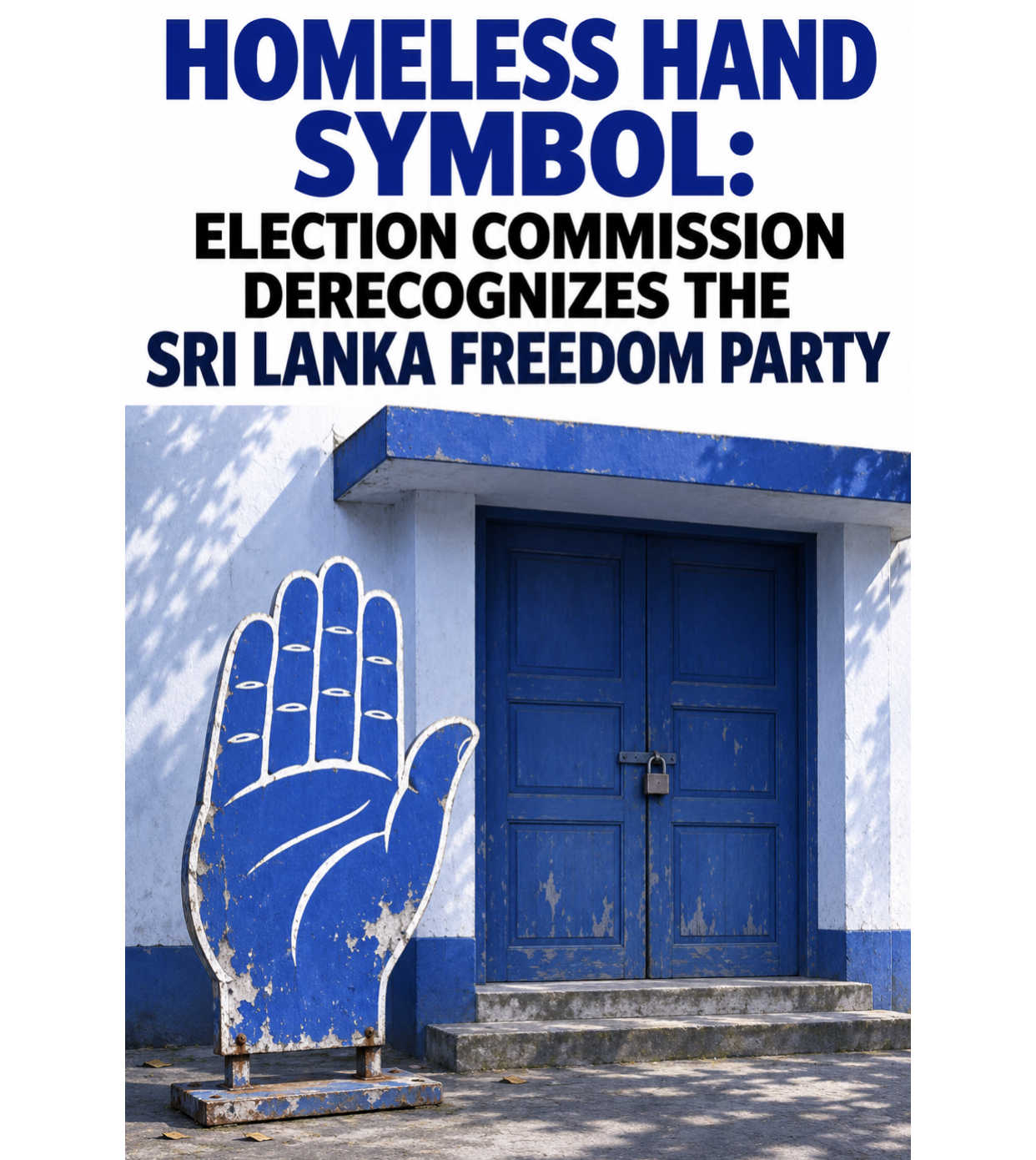
The political entity that dominated Sri Lankan governance for decades and birthed prime ministers, presidents, and historic coalitions has effectively been declared legally non-existent. In a landmark decision, the Election Commission of Sri Lanka officially informed the competing factions of the Sri Lanka Freedom Party that the organization can no longer be considered a recognized political party.
The ruling represents a catastrophic milestone in the long-running post-presidential decline of the country’s grand old party. For months, rival factions led by competing executive committees have waged a bitter war of attrition across party headquarters, press conferences, and district courts, each claiming to hold legitimate custodianship over the iconic blue banner and its famous hand symbol. However, the Election Commission made clear that state regulators will no longer act as referees for internal chaos. Under existing electoral statutes, when a political party splits into warring camps that produce conflicting executive rosters, constitution filings, and office-bearer nominations, the state simply suspends recognition entirely.
Instead of acknowledging either side, the Commission advised both factions to start from square one. If the Sri Lanka Freedom Party wishes to regain its seat at the official political table, its members must file a completely fresh application for party recognition. That process requires fulfilling rigid statutory criteria, starting with conducting a unified, formal party conference and election that strictly aligns with registration rules.
Submit Your Press Release
Get your company news, announcements, launches, appointments and events in front of a wider audience.


The technical requirements for a brand-new application present a near-insurmountable wall for a divided party. Beyond proving continuous political activity for four years, an applicant party must submit audited financial statements, a clear policy declaration, and an official constitution approved by a undisputed general assembly. Crucially, the application requires the signature of a single, undisputed General Secretary and an accepted list of office-bearers that includes female representation. With rival factions holding separate meetings and filing competing injunctions against one another, convening a recognized party election remains a distant dream.
The broader implications for electoral strategy are severe. Without formal recognition, the party loses its statutory entitlement to field candidates under its registered name and symbol in upcoming elections. Candidates aligned with the Sri Lanka Freedom Party will be forced to contest under independent groups or seek shelter beneath the banners of newer third-party platforms.
For anyone who has even the slightest clue about Sri Lankan politics across the past five decades, the derecognition of the party founded by S.W.R.D. Bandaranaike in 1951 carries immense symbolic weight. Having spent the better part of seven decades shaping the island’s economic and constitutional trajectory, the party has been brought low not by external electoral wipeouts, but by self-inflicted internal fragmentation.
The Election Commission’s directive leaves the warring factions with a harsh reality check. While both sides continue to squabble over keys to Darley Road and debate who holds legitimate authority, the state regulator has effectively pulled the plug on their political life support. Rebuilding a party from an empty registration form requires unified leadership and statutory elections, two concepts that have proven entirely foreign to a party currently intent on destroying itself from within.



