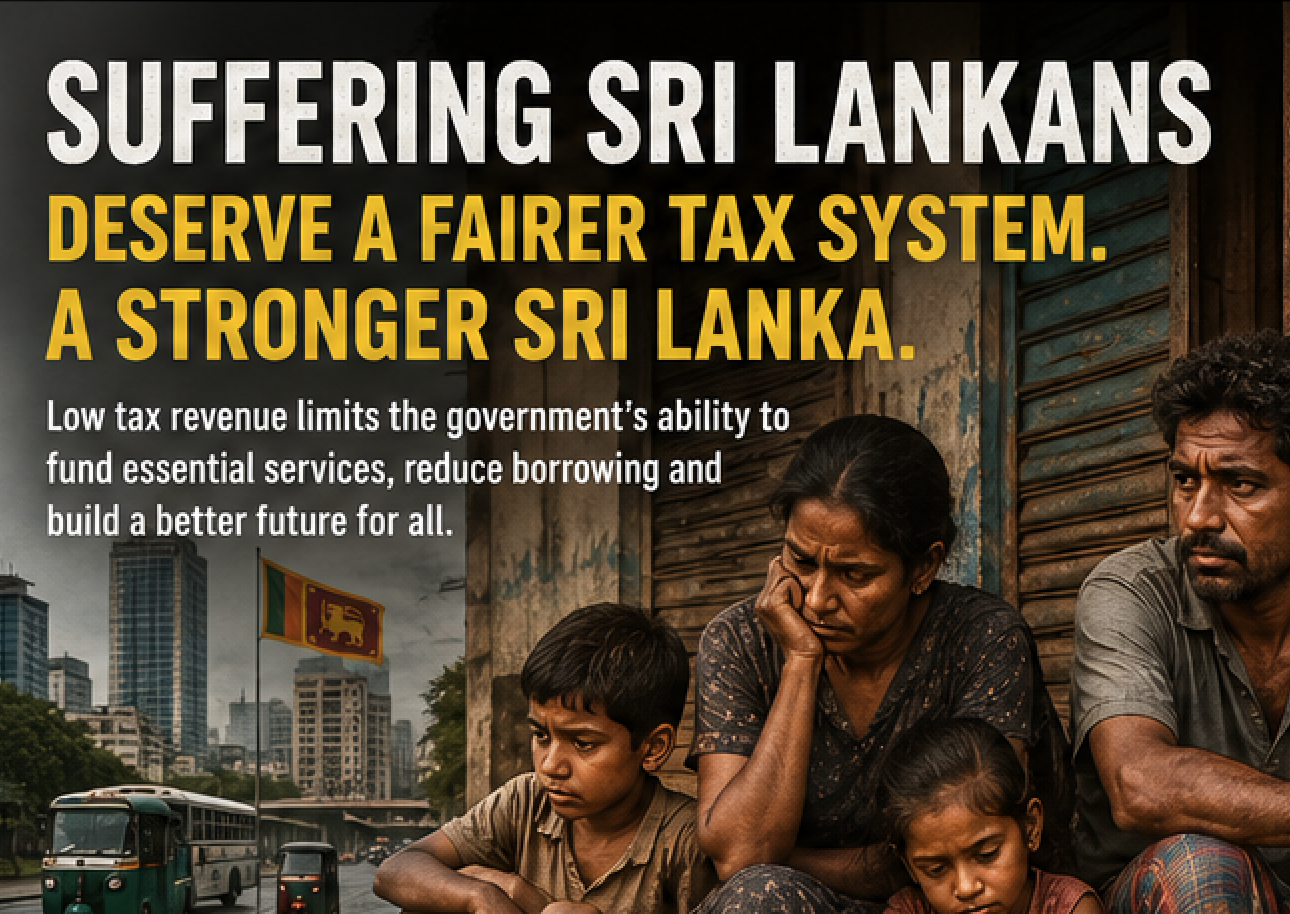
Sri Lanka’s fiscal recovery has made significant progress over the past two years, with tax revenues rebounding following sweeping reforms introduced under the International Monetary Fund (IMF)-backed economic programme. Yet despite these gains, the country continues to operate with one of the lowest tax-to-GDP ratios in Asia, limiting the Government’s ability to finance infrastructure, healthcare, education and social welfare while reducing dependence on borrowing.
According to the latest OECD Revenue Statistics for Asia and the Pacific, Sri Lanka’s tax-to-GDP ratio stood at approximately 9.9% in 2023, recovering from the historic low of 7.5% recorded in 2021 following tax cuts and the economic crisis. While the recovery marks an important milestone, Sri Lanka remains well below the Asia-Pacific average of nearly 20% and substantially behind many of its regional peers. The IMF has repeatedly noted that countries require tax revenues of at least 15% of GDP to sustainably finance essential public services and maintain fiscal stability.
International experience suggests that increasing tax revenue does not necessarily require higher tax rates. Instead, countries that have successfully expanded government revenue have focused on broadening the tax base, improving compliance, digitising tax administration and reducing leakages. These reforms have enabled governments to collect more revenue while maintaining a competitive business environment and encouraging economic growth.

One of Sri Lanka’s most pressing challenges is the narrow tax base. Despite a working-age population exceeding 14 million, only a relatively small proportion of individuals actively pay income tax. A significant number of professionals, self-employed individuals, landlords, consultants, freelancers and online businesses continue to operate outside the formal tax system. Bringing these segments into the tax net could substantially increase revenue without imposing additional burdens on existing taxpayers.
A modern tax system begins with accurate and comprehensive taxpayer identification. Countries such as Estonia, Singapore and Georgia have successfully implemented integrated taxpayer identification systems that automatically link tax records with national identity cards, company registrations, property ownership, vehicle registrations, banking information and immigration records. Such integration enables tax authorities to identify previously unregistered taxpayers while reducing opportunities for tax evasion. Sri Lanka already possesses many of these databases across different government institutions, but greater interoperability could significantly strengthen revenue administration.
Technology is increasingly becoming the foundation of effective tax collection. Around the world, artificial intelligence and advanced data analytics are helping revenue authorities detect hidden income, identify suspicious financial transactions, analyse spending patterns and prioritise high-risk taxpayers for audit. Rather than relying on broad investigations, modern tax administrations now use predictive models that focus enforcement efforts where the greatest revenue risks exist. Similar technologies could enable Sri Lanka’s Inland Revenue Department to improve compliance while reducing administrative costs.
The introduction of electronic invoicing represents another reform capable of transforming revenue collection. Countries including Brazil, Mexico, Italy and Saudi Arabia now require businesses to issue invoices electronically, allowing tax authorities to receive transaction data in real time. Electronic invoicing has significantly reduced VAT fraud, improved tax compliance and simplified accounting processes for businesses. As Sri Lanka continues to digitise its economy, implementing a nationwide e-invoicing framework could strengthen VAT administration while reducing opportunities for under-reporting.
Reducing tax exemptions also remains a critical policy priority. Over several decades, numerous sector-specific incentives, investment concessions and VAT exemptions have narrowed the country’s effective tax base. While targeted incentives remain important for attracting investment, international evidence consistently shows that broad tax bases combined with moderate tax rates generate more stable and predictable government revenue than systems characterised by extensive exemptions. Regular reviews of tax incentives based on measurable economic outcomes would improve both transparency and fiscal sustainability.
The country’s sizeable informal economy presents another opportunity. Many micro and small enterprises operate outside the formal tax system due to complex compliance requirements and administrative costs rather than deliberate tax avoidance. Several countries have addressed this challenge by introducing simplified tax regimes, digital bookkeeping applications and mobile tax filing platforms that encourage voluntary registration. Formalising these businesses expands the tax base while improving access to finance, government procurement opportunities and social protection.
Property taxation remains one of Sri Lanka’s least developed revenue sources. Internationally, annual taxes on residential, commercial and high-value properties provide stable and predictable revenue for local governments. Advances in digital land registries, geographic information systems and satellite mapping have made property valuation significantly more accurate and efficient. Strengthening property taxation would diversify government revenue while reducing excessive reliance on income and consumption taxes.
The digital economy also requires greater attention from policymakers. As online marketplaces, digital advertising, streaming services and cross-border digital platforms continue to expand, many countries have introduced frameworks to ensure these activities contribute fairly to national tax revenues. Developing an effective taxation framework for digital services would help preserve revenue as economic activity increasingly shifts online.
Customs administration offers further scope for improvement. Artificial intelligence can assist customs authorities in detecting under-invoicing, misclassification of imports and valuation discrepancies by comparing declared values with international trade databases. Closer integration between Customs and the Inland Revenue Department would provide a more complete view of business activity while reducing opportunities for tax evasion across multiple revenue streams.
Perhaps the most important lesson from successful tax administrations is that voluntary compliance improves when tax systems are simple, transparent and efficient. Estonia has become a global benchmark by enabling most taxpayers to complete annual tax returns in just a few minutes through pre-filled digital forms and seamless online services. Simplified filing, faster refunds and user-friendly digital platforms reduce compliance costs while strengthening public confidence in the tax system.
Research by the IMF indicates that developing countries can increase tax revenue by between six and nine percentage points of GDP through comprehensive reforms that combine stronger tax administration, broader tax bases, improved compliance and digital transformation. For Sri Lanka, this would place a tax-to-GDP ratio of between 18% and 20% within reach over the medium term, provided reforms are implemented consistently and supported by sustained investment in technology and institutional capacity.
The next phase of Sri Lanka’s fiscal reform should therefore move beyond increasing tax rates. A strategy centred on expanding the tax net, integrating government data, leveraging artificial intelligence, digitising tax administration and strengthening voluntary compliance offers a more sustainable pathway to higher government revenue. Such reforms would not only improve fiscal resilience but also create a fairer and more efficient tax system capable of supporting the country’s long-term economic development ambitions.