Alcohol and drugs are to be prohibited at events carrying a school’s name or logo, with the Education Ministry extending its reach beyond the school gate and directly into the culture surrounding major school sporting encounters. The objective is difficult to quarrel with. Enforcement may prove considerably more complicated.
Sri Lanka’s school Big Match is an institution unto itself.
There is the cricket, of course, but around it has grown an enormous social occasion involving present pupils, old boys, families, tents, music, reunions and celebrations which sometimes bear only a passing relationship to what is happening in the middle of the ground.

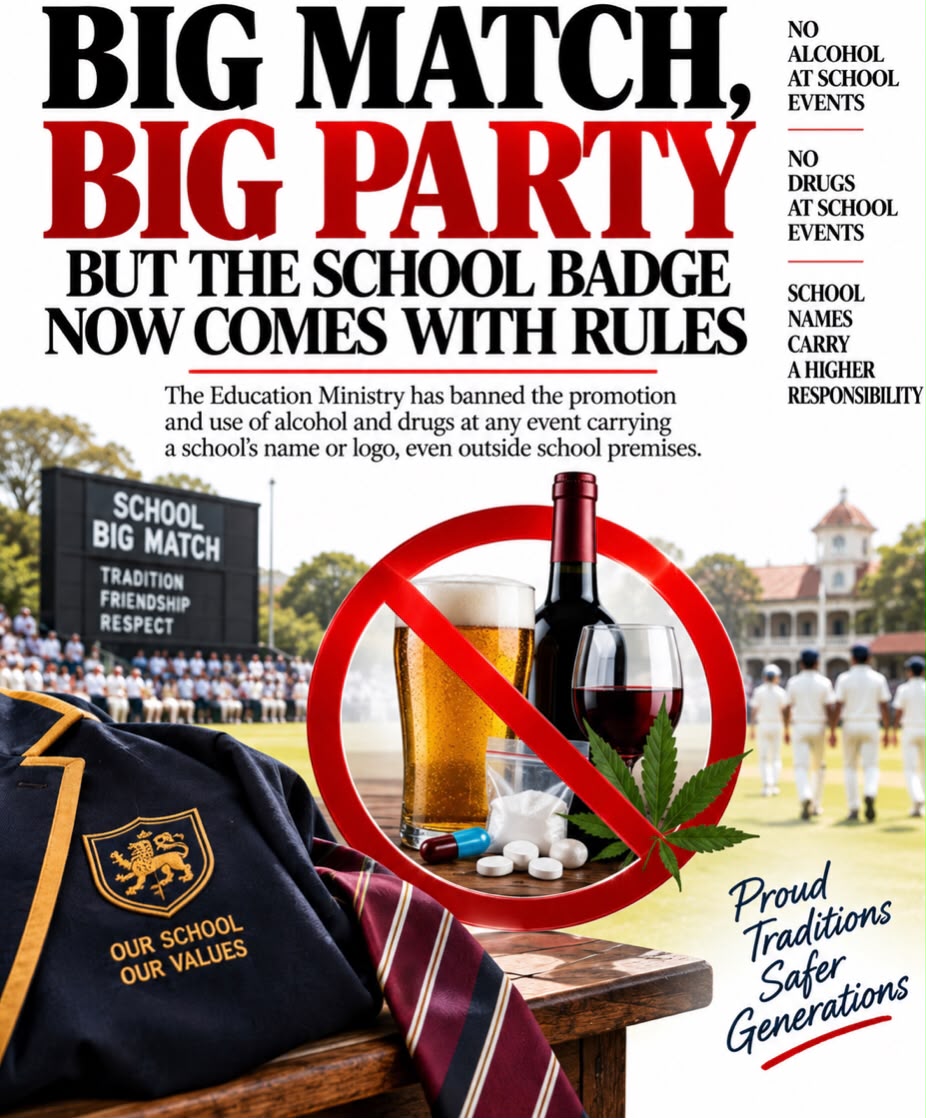
The Education Ministry has now drawn a much firmer line around what may accompany the school badge.
Under Education Ministry Circular No. 2026/10, the promotion and use of alcohol and drugs is prohibited at events conducted using a school’s name or logo. The Ministry’s position is that an event carrying the identity of a school is, for these purposes, a school event even when it takes place beyond the physical school premises.
The Secretary to the Ministry has also been empowered to prohibit an event immediately where the directive is breached.
The move follows repeated concerns from parents over the exposure of schoolchildren to intoxicants, particularly around major cricket encounters involving leading schools.
There is an obvious logic to the policy.
A school cannot reasonably insist upon one standard of behaviour inside its gates while allowing its name, crest and reputation to become the branding for an event at which an entirely different standard is tolerated.
Nor is the issue confined to whether a 50-year-old old boy has a drink while meeting friends.
The difficult question is what children see being normalised around them when alcohol or other intoxicants become an accepted part of an event presented under the identity of their school.
But writing a circular is the easy part.
Big Matches and the events surrounding them are complicated affairs. Schools, old boys’ associations, sports clubs, sponsors, venue operators and independent organisers can all become involved, while activities may occur inside grounds, in hospitality areas or at separate functions elsewhere.
The Ministry will therefore need to make absolutely clear where responsibility lies.
If an old boys’ association hires a private venue and uses the school crest, is that sufficient to bring the entire event within the prohibition? The Ministry’s present position suggests that it is.
What happens when organisers simply remove the official crest but continue marketing an event unmistakably around a particular Big Match? What sanctions follow if alcohol is discovered after thousands of people have entered, and who bears responsibility for enforcement?
There is also an important distinction between alcohol, which is a lawful product for adults subject to Sri Lanka’s regulatory restrictions, and illegal narcotics.
Both may legitimately be prohibited from a school-associated event, but the law surrounding possession, sale and consumption is not identical. Enforcement should therefore be precise rather than allowing the broad word “drugs” to become a substitute for identifying the actual conduct being prohibited.
The Government’s objective deserves support.
Schools have a responsibility extending beyond examination results and sporting trophies. Their names and symbols carry authority among young people, and there is nothing unreasonable about insisting that those identities are not used to promote environments which expose children to intoxicants.
But the test will arrive with the first major Big Match at which somebody decides the rules do not apply to his tent.
If the Ministry means what the circular says, enforcement must be even-handed. It cannot depend upon which school is playing, how influential its old boys are or who happens to occupy the hospitality enclosure.
A school badge should mean the same thing whether it belongs to the most powerful school in Colombo or the smallest school somewhere far beyond it.
That is when this circular will discover whether it is policy or merely paper.
Be that as it may.