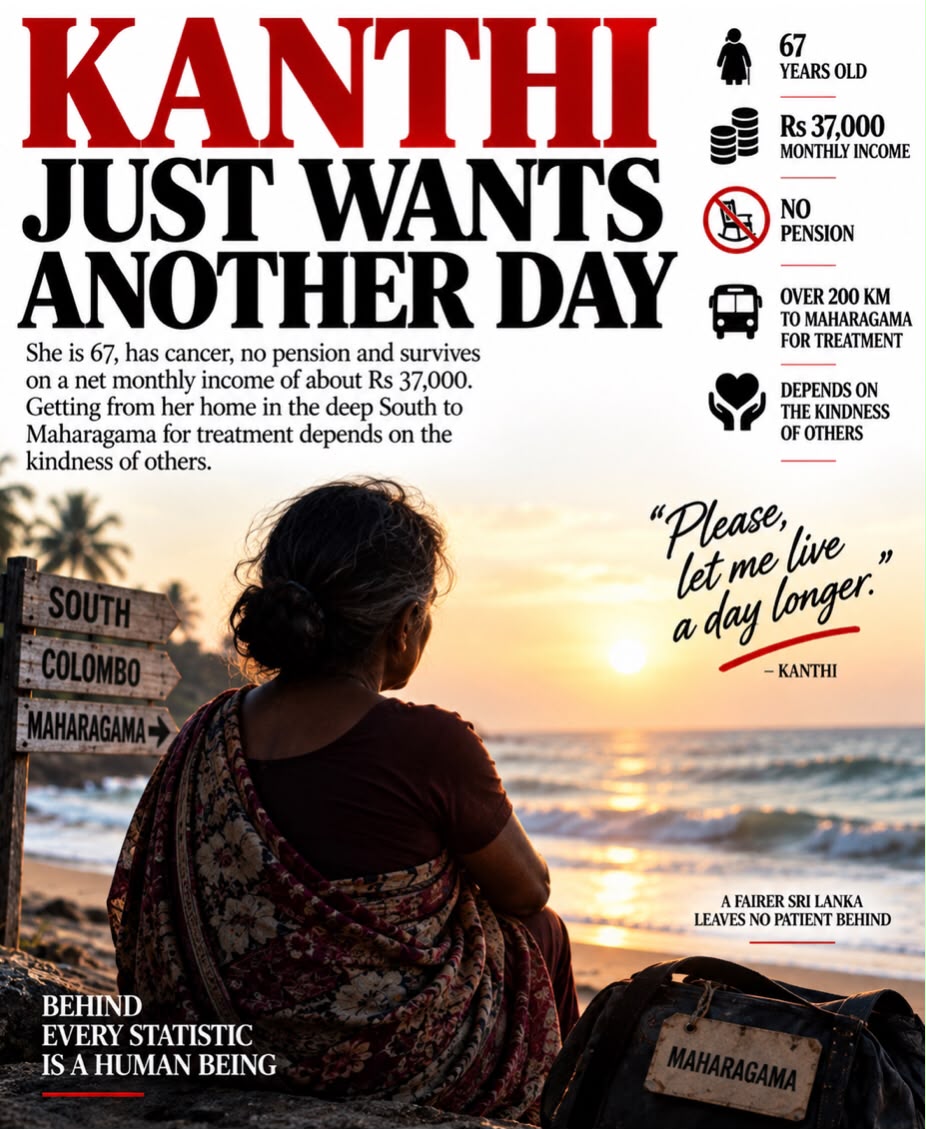
She is 67, has cancer, no pension and survives on a net monthly income of about Rs 37,000. Getting from her home in the deep South to Maharagama for treatment depends on the kindness of others. So sometimes does paying the electricity and water bills. Yet Kanthi’s ambition is remarkably modest: she simply wants to live another day.
Cancer has introduced “Kanthi” to a world measured differently from the one most of us know.
There are hospital appointments and journeys of more than 200 kilometres to Maharagama. There are days when she is well enough to manage and others when the illness and its treatment remind her just how fragile an ordinary life can become.

Then there are the bills.
Kanthi is 67. She has no pension and her net monthly income is approximately Rs 37,000. From that must come the ordinary costs of remaining alive: food, electricity, water and everything else that does not disappear simply because somebody has cancer.
Treatment at Apeksha Hospital in Maharagama means another expense before she even reaches the hospital. She has to get there.
For Kanthi, travelling more than 200 kilometres for treatment is not simply an inconvenience. She depends upon the charity and generosity of others to help make those journeys possible.
Sometimes that generosity has to stretch further. There are occasions when she needs help simply to pay her electricity or water bill.
There is something particularly cruel about serious illness when it meets poverty. Cancer does not suspend the electricity account, excuse the water bill or put food on the table, and the cost of reaching treatment can itself become part of the burden of being ill.
Kanthi’s circumstances are intensely personal, but the problem is not hers alone. Cancer-support organisations operating around Apeksha Hospital exist precisely because patients travel from distant parts of Sri Lanka and some cannot afford repeated journeys, accommodation, food or other costs surrounding their treatment.
Sri Lanka can rightly take pride in a public health system in which treatment at Apeksha Hospital is provided free of charge. But “free treatment” does not mean that being treated costs a poor patient nothing.
There is the bus fare or other transport. There may be food on the journey, somebody accompanying the patient and income lost because illness makes ordinary work impossible. Then the patient returns home and the household bills are waiting.
For someone living on Rs 37,000 a month without a pension, there is very little distance between managing and not managing at all.
Yet speak to Kanthi and what emerges is not a demand for comfort or luxury. She does not speak as though the world owes her something extraordinary.
Her wish is much, much smaller than that.
At 67, she knows what she is fighting and she knows that none of us is promised tomorrow. What she wants is the chance to keep fighting for it.
There are statistics for cancer. There are hospitals, treatment programmes, budgets and policies, and all of them matter.
But behind every statistic is somebody trying to get through an ordinary day.
For Kanthi, that means finding enough money to keep the lights on, enough help to make the long journey to Maharagama and enough strength to return when the hospital tells her she must come again.
She is not asking for a miracle.
She is asking for time.
“Please, let me live a day longer.”
For Kanthi, another day is not a figure in a medical chart. It is another sunrise at home, another conversation, another meal, another journey if necessary and another opportunity simply to remain among the living.
At Rs 37,000 a month, without a pension and dependent upon the kindness of others for some of life’s most basic expenses, even that modest hope comes at a price.(farazcolombo@gmail.com)
Be that as it may.