
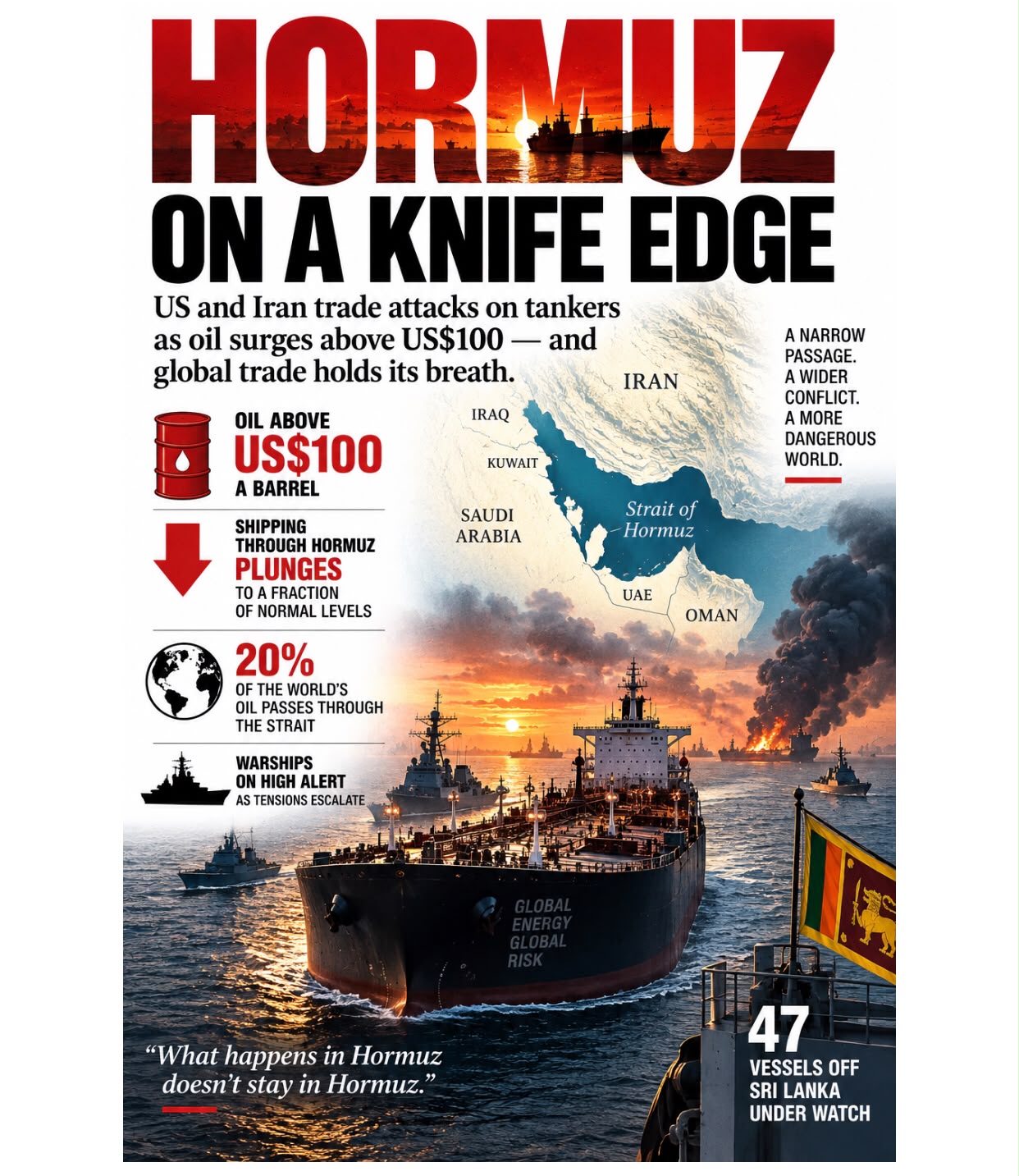
US and Iran trade attacks on tankers as traffic through the world’s most important energy chokepoint plunges – and 47 vessels off Sri Lanka suddenly take on greater significance
The Strait of Hormuz moved considerably closer to the edge yesterday as the United States and Iran traded attacks on shipping, oil surged back above US$100 a barrel and traffic through one of the world’s most important maritime chokepoints fell to a fraction of normal levels.
For Sri Lanka, thousands of kilometres away from the fighting but sitting astride the Indian Ocean’s great shipping routes, this is no longer a distant Middle Eastern confrontation.
Submit Your Press Release
Get your company news, announcements, launches, appointments and events in front of a wider audience.


Iran said it attacked 10 vessels near Hormuz after US forces struck five Iran-linked oil tankers. Washington said its action followed Iranian ballistic missile attacks against a US Navy vessel, while the US military disputed Iranian claims that American ships had been damaged.
The confrontation represents one of the most serious maritime escalations of the six-month conflict. At least one seafarer was reported killed and another missing as attacks spread across shipping routes already operating under extraordinary pressure.
The numbers from Hormuz tell their own story.
Only six commodity vessels were recorded passing through the Strait on Tuesday, according to preliminary Kpler data cited by Reuters. That was down from nine the previous day and a ten-day average of about 12.
Before the war began, the Strait typically handled around 125 large commercial vessels every day, carrying oil, liquefied natural gas and other cargo. Approximately 20 per cent of the world’s daily crude oil and LNG supply traditionally passed through this narrow stretch of water.
Some vessels may be crossing with their tracking transponders switched off, making precise measurement difficult. But even allowing for these so-called dark crossings, Reuters reports that roughly one-third of Gulf oil exports remain missing compared with normal flows.
Markets are beginning to price the danger accordingly.
Brent crude climbed above US$100 a barrel yesterday for the first time in six weeks, having risen roughly 25 per cent since early August. An estimated 10 million barrels a day of oil exports remain absent from the market as a consequence of the conflict, according to shipping-data estimates cited by Reuters.
That matters enormously to Sri Lanka.
A country dependent upon imported fuel does not need a tanker to be attacked in Colombo harbour to feel the consequences of Hormuz. Sustained oil above US$100 eventually works its way through fuel costs, electricity generation, transport, aviation, manufacturing, inflation and the country’s foreign-exchange requirement.
And now there is a specifically Sri Lankan dimension.
Foreign Minister Vijitha Herath has confirmed that approximately 47 vessels are being monitored in international waters near Sri Lanka, including several Iranian vessels. The United States Embassy in Colombo contacted the Foreign Ministry about the Iranian vessels and asked whether Sri Lankan authorities were aware of their presence and monitoring them.
Herath has been equally clear about what those 47 vessels are not.
They are not inside Sri Lankan territorial waters. None has sought permission or assistance from the Sri Lankan Government and Colombo says it has provided no logistical or operational support. The Navy is monitoring their movements.
That distinction is important and should not be blurred.
But so is the timing.
Iranian-linked shipping is under direct American military and economic pressure. Five Iran-linked tankers have just been rendered inoperable in attacks attributed to US forces, while Iran is retaliating against vessels it regards as violating restrictions around Hormuz.
Against that background, the presence of Iranian vessels among a much larger group of ships in international waters near Sri Lanka inevitably attracts attention from Washington.
Sri Lanka must therefore do something simultaneously simple and difficult: protect its sovereignty, comply with international law, maintain freedom of navigation and avoid becoming entangled in somebody else’s war.
The immediate danger remains centred on Hormuz. But every tanker diverted, every ship waiting for instructions, every vessel attempting to avoid a blockade and every cargo searching for an alternative route pushes the consequences further into the Indian Ocean.
That is why the 47 ships off Sri Lanka matter.
They do not mean Iran has entered Sri Lankan waters. They do not mean Colombo is assisting Tehran. And they certainly do not justify turning ordinary commercial shipping activity in international waters into something more sinister without evidence.
But Washington is watching.
Colombo is watching.
And after yesterday’s attacks on tankers around Hormuz, shipowners, insurers and energy markets are watching too.
Be that as it may, the Strait of Hormuz is no longer merely threatening the world’s energy lifeline.
The shooting has reached the ships carrying it.



