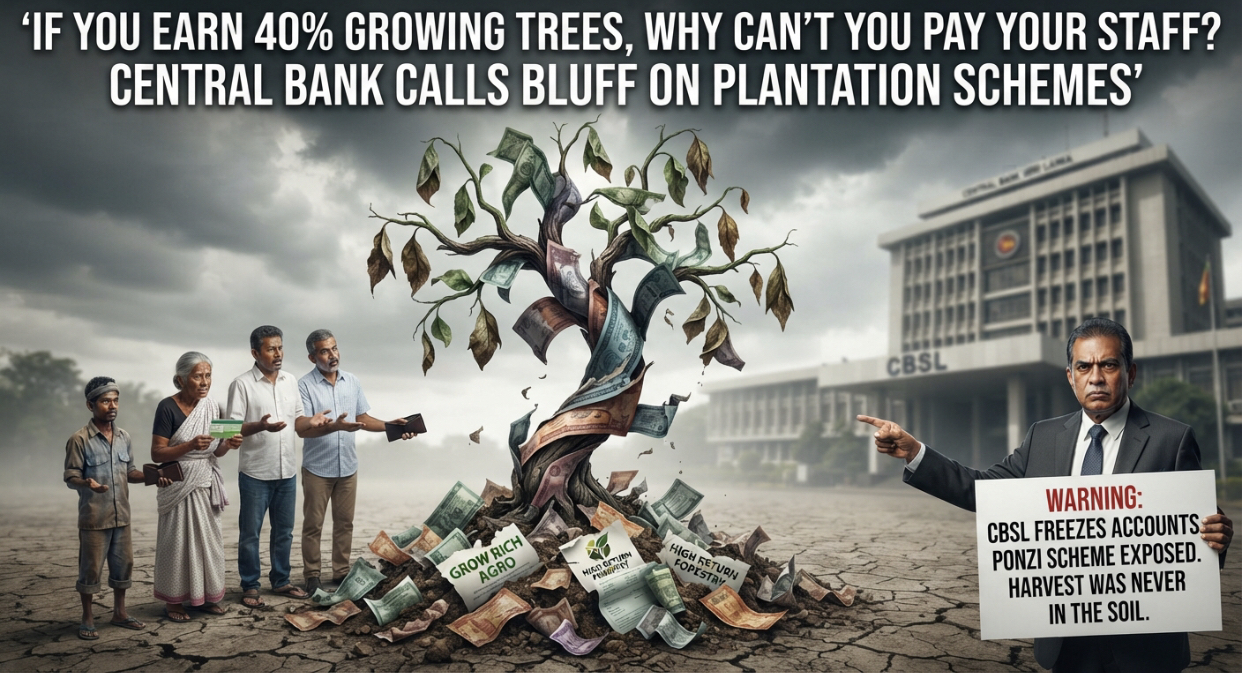
Anyone who has scrolled through Sri Lankan social media over the past year has seen the glossy pitch: hand over your savings to a booming plantation or agro-forestry company and watch your money grow by 30% or 40% a year. Now that regulators have started clamping down, several of those same outfits are telling panicked investors and employees that they cannot pay salaries or monthly returns because the Central Bank of Sri Lanka froze their bank accounts. Today, Governor Dr. Nandalal Weerasinghe called that excuse flatly false.
Speaking to reporters in Colombo, the CBLS Governor pointed out an obvious math problem that every depositor should pause and examine. First, the Central Bank froze only a very small fraction of the funds collected through illegal deposit-taking, while the vast bulk of the money had already been collected and moved by those companies. Second, not a single plantation, agricultural project, or legitimate commercial operation belonging to these firms has been banned.
If these businesses genuinely generate 40% returns from farming and timber cultivation as advertised, freezing a small slice of cash in a bank account would never prevent them from paying estate workers or honouring payouts to customers. “Saying that they cannot pay clearly demonstrates that these institutions can only be maintained if they collect money from the public again,” Weerasinghe said, describing the classic anatomy of a Ponzi-style operation where old investors are paid strictly with fresh cash from new recruits.
Submit Your Press Release
Get your company news, announcements, launches, appointments and events in front of a wider audience.


For Sri Lankan households watching interest rates on fixed deposits sit around single digits, a promised 40% return sounds tempting. Yet under the Banking Act and the Finance Business Act No. 42 of 2011, no company in Sri Lanka can legally accept public deposits or promise fixed financial returns unless it is licensed by the Central Bank. Earlier this year, the Central Bank launched probes into 18 institutions and individuals running suspected plantation investment schemes and secured High Court-backed freezing orders against 6 firms and their directors.
If you have already put money into one of these schemes, waiting around for reassuring social media videos from company promoters is the worst move you can make. Weerasinghe urged affected depositors to review their written agreements immediately and take swift legal action on their own behalf to recover their funds, even as existing court cases move forward and the Central Bank pursues parallel legal steps to halt public deception.
The Governor also drew a sharp line against paid smear campaigns online. He condemned one or two social media operators who allegedly accept money to publish false and vulgar personal attacks against senior Central Bank officials, particularly women carrying out regulatory enforcement. While policy criticism is fair game in any democracy, Weerasinghe warned that the Central Bank will initiate specific legal action to protect honest public officers from targeted defamation.
Before you sign over retirement savings or severance pay to any high-yield agriculture scheme, check the Central Bank’s official list of licensed banks and finance companies first. When a company claims it needs fresh deposits just to keep paying yesterday’s promises, the harvest was never in the soil.