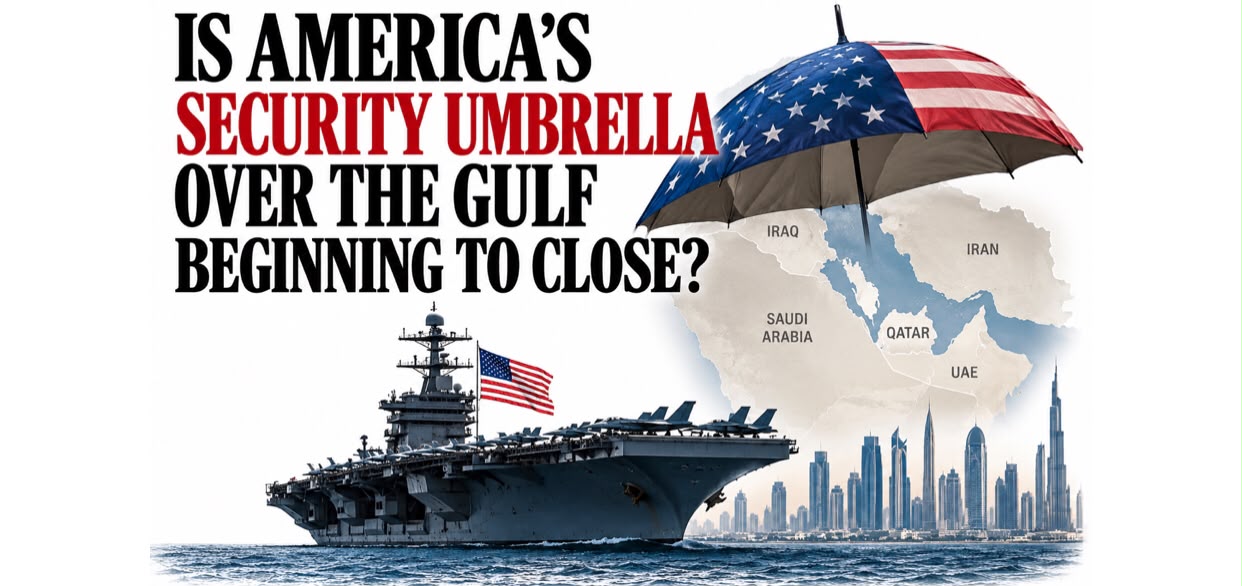
For decades the basic security calculation in the Gulf was remarkably simple. America provided the ultimate military guarantee and the Gulf states built their foreign policies around it. Seven months of war, Houthi attacks and America’s withdrawal from Iraq are forcing the region to ask whether that guarantee still means what it once did.
Something important is happening in the Gulf, and it has relatively little to do with the daily movement of oil tankers through the Strait of Hormuz. Saudi Arabia, Qatar, the United Arab Emirates and their neighbours are beginning to reconsider one of the assumptions upon which the modern Gulf security system was built.
That assumption was America.
Submit Your Press Release
Get your company news, announcements, launches, appointments and events in front of a wider audience.


For decades the United States maintained an extraordinary military presence across the region. American forces, aircraft and naval assets operated from bases throughout the Gulf, while Washington’s security relationships with Saudi Arabia, Qatar, Bahrain, Kuwait and the UAE provided an implicit understanding that serious external threats to those states would ultimately encounter American power.
That relationship has never been uncomplicated, but the fundamental bargain endured. The Gulf supplied an enormous proportion of the world’s energy and America helped guarantee the security architecture within which that energy could move.
The events of 2026 have begun testing whether the bargain still operates in quite the same way.
The United States and Israel entered a conflict with Iran despite opposition from Gulf states that understood rather better than most where Iranian retaliation might land. Saudi Arabia has subsequently faced repeated Houthi missile and drone attacks against cities and economically important infrastructure, while Gulf capitals have watched carefully to see how far Washington is prepared to become involved in their defence.
Now American forces have completed their withdrawal from Iraq.
None of this means America is abandoning the Middle East. The United States retains enormous military capabilities in and around the region and extensive security relationships with individual Gulf states. But governments do not construct national security policies around reassuring language. They construct them around what they believe another country will actually do when something goes wrong.
The Gulf appears increasingly unwilling to rely upon a single answer.
Qatar has proposed something that would have sounded extraordinary not very long ago: a regional security architecture that includes Iran itself. The argument is straightforward. If every security arrangement is constructed against Iran, Tehran will perpetually regard the arrangement as a threat and the region remains trapped in a cycle of deterrence, retaliation and escalation.
At the same time, Saudi Arabia has moved in another direction by establishing a mutual defence arrangement with Turkey and Pakistan. The so-called Mecca Accord provides that an attack upon one of the three countries is treated as an attack upon all three.
That is a significant development. Turkey possesses one of the largest and most experienced armed forces in the region, while Pakistan is a nuclear-armed state with longstanding military relationships with Saudi Arabia. Riyadh is therefore building additional layers of security that do not depend exclusively upon Washington.
The UAE and Saudi Arabia are also talking again after a prolonged period of serious disagreement. That rapprochement may have many explanations, but it is occurring at precisely the moment when both countries are being forced to reconsider the regional security environment around them.
None of these arrangements is yet a substitute for American military power. Qatar’s proposed architecture including Iran remains an idea rather than an established security system. The Saudi-Turkey-Pakistan agreement has yet to demonstrate what mutual defence means when confronted by a real crisis, while European and Chinese involvement cannot presently replicate the depth of America’s regional military capabilities.
But perhaps replacement is not what the Gulf is attempting.
Diversification may be.
Saudi Arabia does not need to choose between Washington and Islamabad. Qatar does not need to abandon its American relationship in order to speak to Tehran. The UAE can maintain Western defence relationships while rebuilding its relationship with Riyadh. Security, like investment, can be spread across several relationships rather than entrusted almost entirely to one.
That would represent a profound change.
The Gulf states spent much of the post-war period operating inside an American security order. What now appears to be emerging is something considerably more complicated in which Washington remains enormously important but is no longer assumed to be the only ultimate guarantor.
For the rest of the world this is not merely a diplomatic curiosity. These are the countries sitting upon some of the planet’s most important energy reserves and beside the shipping routes through which those resources reach international markets.
The Gulf’s security architecture therefore affects the price of fuel in Colombo just as surely as it affects the calculations being made in Riyadh, Doha and Abu Dhabi.
The question is no longer whether America is leaving the Gulf. It isn’t.
The more interesting question is whether the Gulf is learning how not to depend entirely upon America.