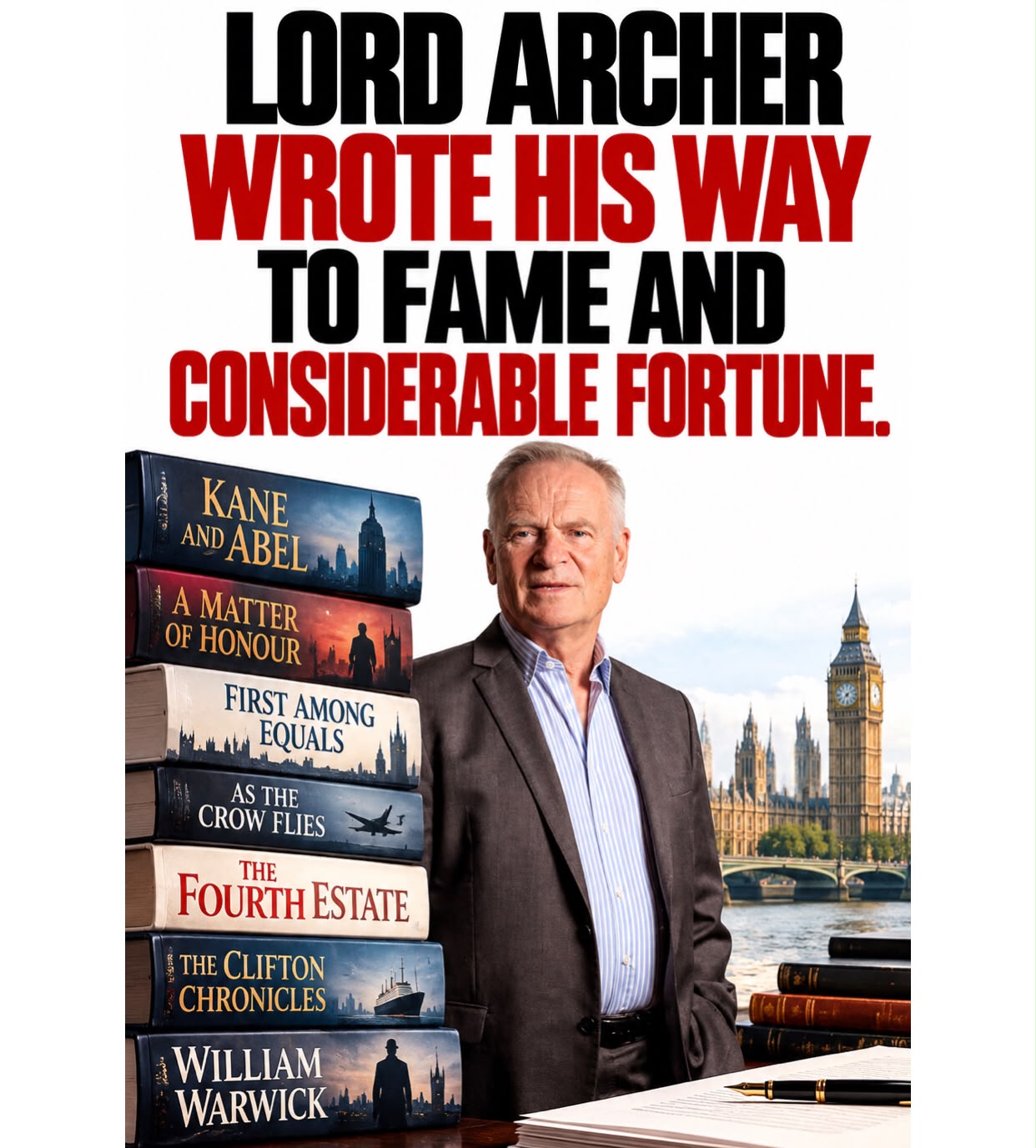
He wrote his way out of bankruptcy. He couldn’t write his way out of prison. Jeffrey Archer was a politician, millionaire, bankrupt, peer, prisoner and one of the most successful storytellers of his generation. He died aged 86, leaving behind a life so improbable that, had Archer himself submitted it as a manuscript, an editor might have told him to make it more believable.
There was something irresistible about Jeffrey Archer. You did not necessarily have to admire everything he did, approve of the choices he made or even particularly like his politics, but it was exceedingly difficult to find him boring. Perhaps that was because Archer lived as though every chapter required another plot twist.
He became an MP at 29, lost his fortune, resigned from Parliament, wrote himself back into wealth, returned to politics, entered the House of Lords, came within sight of becoming Mayor of London, was convicted of perjury, went to prison and then wrote about that too. Most people would have regarded one of those lives as quite enough.
Submit Your Press Release
Get your company news, announcements, launches, appointments and events in front of a wider audience.


Born in London in 1940 and raised in Somerset, Archer entered Parliament as Conservative MP for Louth in 1969 and appeared to have the political world ahead of him. A disastrous investment in the Canadian company Aquablast subsequently left him facing enormous debts, and he resigned from Parliament in 1974 before turning seriously to writing because, among other things, he needed the money.
Not a Penny More, Not a Penny Less appeared in 1976 and Kane and Abel followed in 1979. Archer ceased being merely a former politician who had written a novel and became an international bestselling author who had, quite literally, written his way out of bankruptcy.
Over the decades that followed, his books sold in their hundreds of millions. A Matter of Honour, First Among Equals, As the Crow Flies, The Fourth Estate, the Clifton Chronicles and his short stories found readers across the world, while literary critics who were not always enthusiastic about his prose were confronted by millions of readers who plainly were.
Archer understood something very simple about popular fiction. The reader had to want to know what happened next, and he knew how to end a chapter at precisely the point at which putting the book down became irritating.
Politics meanwhile kept calling him back. Margaret Thatcher appointed him deputy chairman of the Conservative Party in 1985 and in 1992 he became Baron Archer of Weston-super-Mare, a peerage he retained for the rest of his life.
Then came the extraordinary second collapse. Archer had successfully sued the Daily Star for libel in 1987 over allegations concerning a prostitute and received substantial damages, but years later evidence emerged that the case had been supported by false testimony and a fabricated alibi.
In 2001 he was convicted of perjury and perverting the course of justice and sentenced to four years in prison. The Conservative Party expelled him, but he was not stripped of his peerage, meaning the millionaire novelist, former MP and Baron Archer of Weston-super-Mare was now also prisoner FF8282.
Even prison became material. Archer watched the people around him, recorded the routines, absurdities, cruelties and friendships of prison life and eventually produced three volumes of prison diaries from an experience that would have caused many public figures simply to disappear.
One story from Purgatory, the second volume, perhaps captures Archer better than almost anything else. At HMP Wayland he befriended a Colombian prisoner named Sergio who had contacts back home, and through those contacts Archer set about obtaining an emerald for his wife Mary.
The transaction was wonderfully improbable. One of Britain’s wealthiest and best-known novelists was sitting in prison attempting to buy his wife a Colombian emerald through a fellow inmate whose brother could source the stone in Colombia. The emerald was reportedly obtained for around £10,000, substantially less than Archer believed an equivalent stone would have cost through a London jeweller, and he even explored whether the same Colombian connection could obtain a painting by Fernando Botero.
The painting never materialised, but the emerald story reveals something beyond Archer’s seemingly inexhaustible appetite for a deal. He was in prison, his political ambitions had collapsed and his reputation had suffered an extraordinary blow, yet he was still thinking about what he could give Mary for Christmas.
Dame Mary Archer had been beside him since their marriage in 1966. An accomplished scientist and academic in her own right, she remained through extraordinary wealth, political ambition, financial catastrophe, public humiliation, trial and imprisonment, and together they had two sons, William and James.
There is something rather human about the prisoner trying to find an emerald for the woman who had stayed through all of it. It would be easy to write Archer’s obituary entirely around his scandals, and a man who successfully sued a newspaper before subsequently being imprisoned for lying during that case cannot reasonably expect the episode to become a footnote, but neither should it swallow everything else.
Archer possessed an extraordinary capacity to recover. Bankruptcy did not finish him, political resignation did not finish him, public scandal did not finish him and prison did not finish him; sometimes the instrument of recovery was money, sometimes charm and sometimes sheer audacity, but most consistently it was writing.
Even into his eighties the books continued. The Clifton Chronicles gave way to the William Warwick novels and Archer remained fascinated by characters, plots and the mechanics of storytelling long after he had anything left to prove commercially.
There were always at least two Jeffrey Archers. One was ferociously ambitious, occasionally reckless and capable of decisions that inflicted astonishing damage upon himself, while the other could sit before a blank page and make millions of strangers care about people who did not exist.
Perhaps the two were inseparable. He understood ambition because he possessed enormous quantities of it, reversals because his life was full of them and people prepared to risk everything because he had repeatedly done precisely that, sometimes successfully and sometimes disastrously.
There will be arguments about Jeffrey Archer’s legacy and there should be. He was far too complicated a man to reduce conveniently to either hero or villain, and his failures were too serious to erase simply because his books sold spectacularly well.
Eventually, however, the politicians with whom he shared platforms will become names in old newspapers, the scandals will become archive material and the criminal case will belong to legal history. Somewhere, somebody who knows almost nothing about Jeffrey Archer will pick up Kane and Abel, read a chapter and then, because Archer knew exactly how to make them do it, read another.
Be that as it may, Jeffrey Archer spent much of his extraordinary life trying to control what happened next. In the end, the one place he could always do so was on the page, and for a storyteller that may be the more enduring obituary.
Thank you Lord Archer for the books. Thank you for the fantastic specimen of a Life. Well and truly lived.