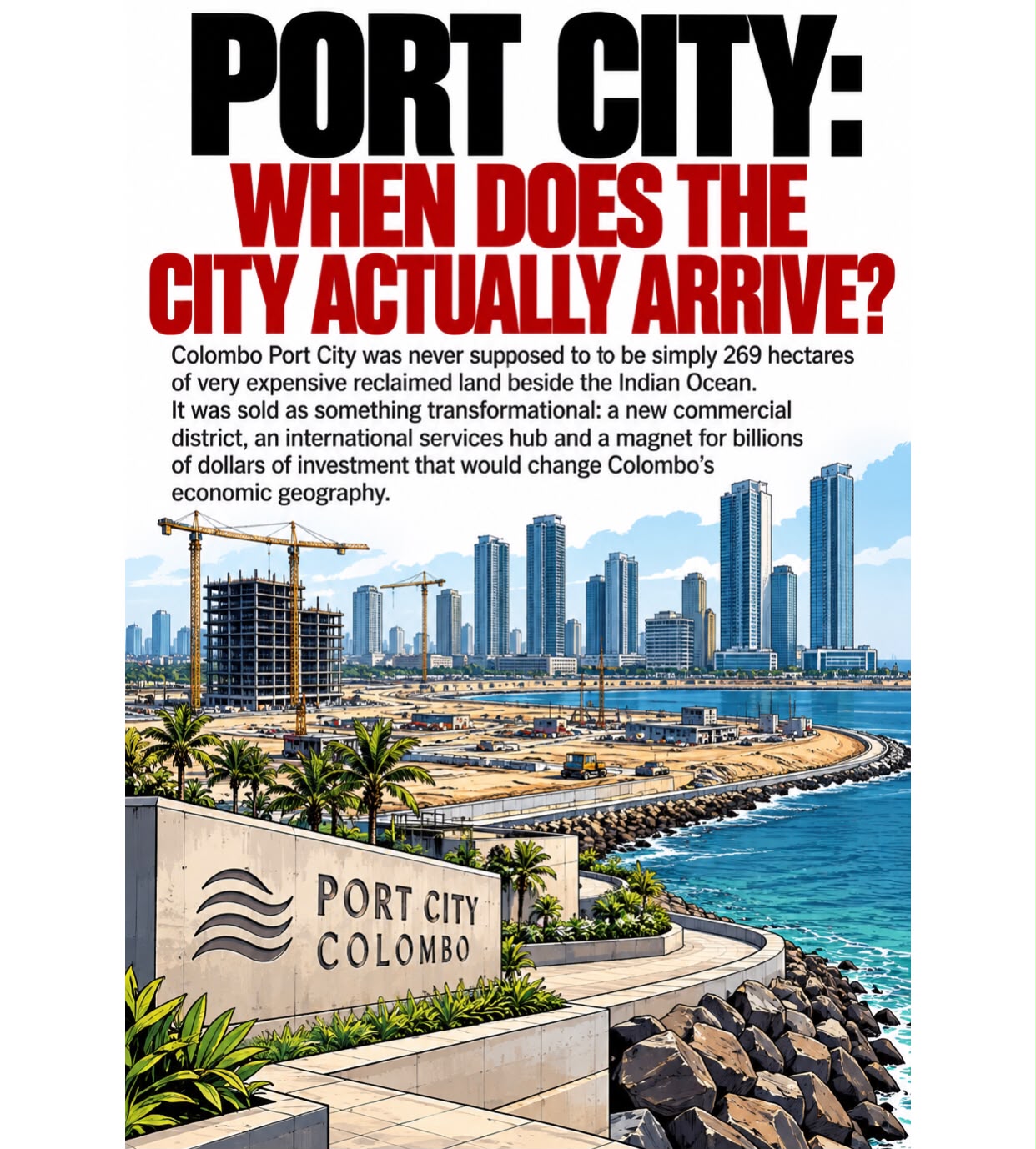
Colombo Port City was never supposed to be simply 269 hectares of very expensive reclaimed land beside the Indian Ocean. It was sold as something transformational: a new commercial district, an international services hub and a magnet for billions of dollars of investment that would change Colombo’s economic geography.
Years later, the question is becoming increasingly difficult to avoid. When does the city actually arrive?
There has been progress. Businesses have been approved, legislation amended, investors courted and projects announced. The Government said in July that Port City had attracted US$2.19 billion in investments, with 176 investments recorded and US$336.67 million described as finalised. New developments have been announced and three major projects have received strategic-investment status.
Submit Your Press Release
Get your company news, announcements, launches, appointments and events in front of a wider audience.


Those are not insignificant numbers.
But announcements are not buildings. Registrations are not operating businesses. Approved investments are not necessarily money already invested. Projected jobs are not people receiving salaries.
Port City itself says more than 150 companies are registered within the Special Economic Zone, associated with approximately 10,000 direct job opportunities. That sounds impressive, but it also makes transparency more important. How many of those companies are actually operating today? How many people are physically employed there? How much foreign exchange came into Sri Lanka from those businesses during the last twelve months? How much tax revenue was generated?
These are not hostile questions. They are the questions that should accompany a project of this scale.
Port City is estimated ultimately to require around US$15 billion in development. Its master developer says approximately US$1.4 billion has already gone into reclamation and enabling infrastructure. The country therefore has an enormous economic interest in making the next stage work.
That requires more than announcing another authorised business, another investment roadshow or another regulatory approval.
Sri Lanka needs cranes, foundations, offices, residents, companies, employees, transactions, exports of services and foreign exchange.
The Government has improved the regulatory framework and shortened approval processes. Port City says authorised-person registration can be completed within seven days and approved work visas within five business days. Good.
But facilitating thousands of potential employees, issuing authorisations or creating thousands of projected employment opportunities does not mean everything has been taken on board.
The ultimate measurement is considerably simpler.
What has actually been built? Who has actually arrived? What are they actually doing? And how much money is actually coming into Sri Lanka?
Be that as it may, Colombo Port City has had enough time to tell us what it intends to become.
It is time we were shown what it has become.