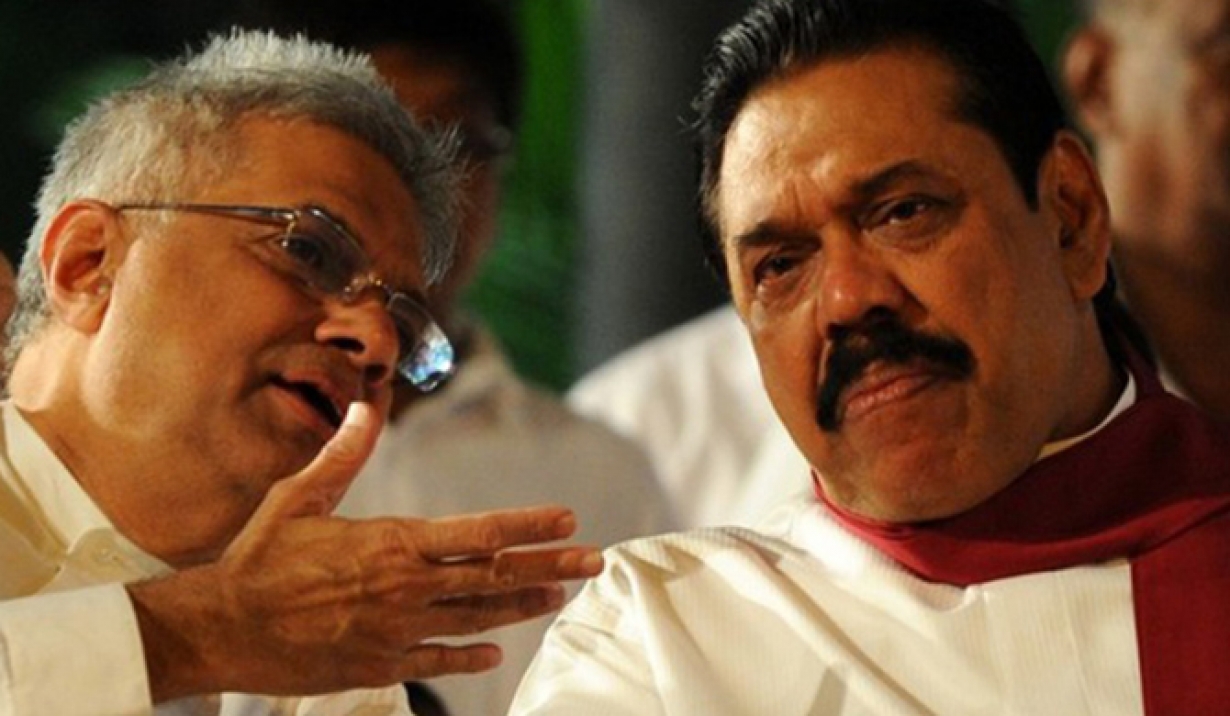
Sri Lanka’s political crisis did not show any signs of settling but analysts predict that finality on a balanced level is imminent early next week.
This week democracy in Sri Lanka once again heaped shame on the country, especially the international community who have for long been suspicious of the probity of the judiciary in Sri Lanka. Little wonder that they international community wants judges and investigators from outside of Lanka to look into allegations of war crimes and other deviations during the war years especially the closing stages.
The initial sacking of one Prime Minister and the appointment of the replacement caused consternation and was swiftly followed by proroguement of parliament. The Speaker asked for advice or an opinion from the Attorney General rather than the Supreme Court which also caused an outcry. On matters constitutional it is the Supreme Court that interprets matters. The Attorney General to his credit responded to the Speaker and said it would be inappropriate for him to proffer such opinion.
The Speaker was doing the unthinkable – he was interpreting the constitution which he patently should not have been doing. He was unwilling to follow through on the Presidential proclamation forgetting perhaps in his haste that Sri Lanka has a presidential democracy.
On the other hand the then premier was busying himself by calling on his western friends for ‘help’. In essence he was whining that his sacking was not in order and refused to budge from Temple Trees the official residence. He said it was a symbol of his right to continue to be the premier. He said he had the numbers. He cried foul that the President had sacked him and then prorogued parliament.
Wickremesinghe had forgotten that at the time of his appointment it was the very same Presidential opinion that saw him being appointed premier although at the time the numbers he had amounted to a paltry 41. The President’s opinion gave way to reality when there was no challenge in parliament later with the Sirisena election as presidency empowering a majority in the house to support him and his government.
The fault perhaps lies in the way we think about our governance. In Sri Lanka we elect a President but not a Prime Minister. We empower the President to appoint a Prime Minister who in terms of comparison to the Westminster system is not the first amongst equals. In Britain it is fair to say that the British Prime Minister is elected by the people. It is his or her government. In Sri Lanka it is the President’s government.
One can almost have total sympathy for the President. On the one hand he had a Prime Minister whom he had entrusted to manage governance alongside him but who post the appointment was acting as though he was the Chief Executive.
The President was to complain publicly that his premier and a coterie of the premiers’ close friends were responsible for a whole series of corrupt practices using ingenious methodologies to give an appearance of transparency and probity.
The President held nothing back: he blamed the Central Bank bond fiasco – the largest fraud perpetrated upon the people of this nation – on Wickremesinghe who was the Minister in charge, his friends including Mahendran and others on that.
He also blamed the premier for several other departures from due process that ultimately led to allegations of corruption and poor practice.
To say that the Presidential patience had run out was an understatement. He acted he was to say later, constitutionally and using the powers so vested in him without fear and in the interests of the people.
The President had also attempted to bring about change some months ago by approaching the Speaker to form a government because he felt unable to work with the premier who he called stubborn and was working not as being part of a national government.
The Supreme Court despite pleas from the Attorney General did grant interim relief but the 7th of December seemed way too far for Wickremesinghe to wait. Instead there was unfair unwarranted international interference with calls for the immediate reconvening of parliament where Wickremesinghe said and is now proven he had a comfortable majority.
Wickremesinghe failed to acknowledge that the President had continuously tried to rein in corruption and cronyism but failed to get Wickremesinghe to mend his ways. It appeared that Sirisena acted in desperation. Wickremesinghe won the narrative internationally of course but his international friends have been silent on other undemocratic and unconstitutional matters for example like the delayed provincial council elections which in the Eastern province is overdue by at least eighteen months.
President Sirisena has let it be known that he will willingly accommodate and recognize and appoint anyone other than Wickremesinghe as Premier obviously if they are able to show a majority in the House. He has apparently urged the Speaker and Sajith Premadasa but both had turned it down.
A meeting was held at Temple Trees on Friday morning just yesterday in which UNP and their partners had urged Wickremesinghe to step down and propose Premadasa as the Premier. He was assured of a full house of support. However Malik Samarawikrama and others were strongly opposed to the move who posed the obvious question as to why from an apparent position of strength they should be dictated to by the leader of another party. The meeting was inconclusive.
The Speaker wrote to the President once again on Friday claiming that there had indeed been a vote of no confidence in the Rajapaksa government. There were major concerns if this had been done within the spirit of the standing orders.
This came about because of the second day of chaos within parliament. Friday’s chaos was far more intense than Thursday and there was a wholesale attempt to subvert parliamentary democracy by members supporting Rajapaksa and inter alia the President. On Thursday a knife was brought in and on Friday it was basically anarchy. The Speaker’s chair was removed, another chair was broken and used as a weapon to attack the Police cordon that accompanied the Speaker. A bag of chili powder was throw at the Security Cordon and the Speakers entry was frustrated by the UPFA members.
In between the chaos the Speaker not seated at his usual seat, conducted a vote of no confidence and a voice recording noted that he declared it carried for the Ayes.
Predictably the UPFA cried foul.
Sections of the senior clergy have become alarmed at what they view as a descent into anarchy. They are considering their options and may well make a plea to the Supreme Court to hear this case expeditiously and before the 7th of December citing a grave national requirement.
In the meantime there are growing calls for the UNP to ask Wickremesinghe to step aside just as there are strong calls for him to hold on. It’s difficult to imagine Wickremesinghe to give up especially as he is a well-known political power survivor in spite of his dismal record as a leader with over 24 losses to his account.
The worrying question was why the UNP are shying away from having elections – a call that the senior clergy in this country are thought to be backing to end the impasse now prevalent in Sri Lanka.
For diehard United National Party faithful, Sajith Premadasa has emerged as a natural savior and his stirring speech on Thursday’s rally only added further resolve.
The multi-billion dollar question remains: will Ranil Wickremesinghe give up in the face of this very significant and grave national interest?