
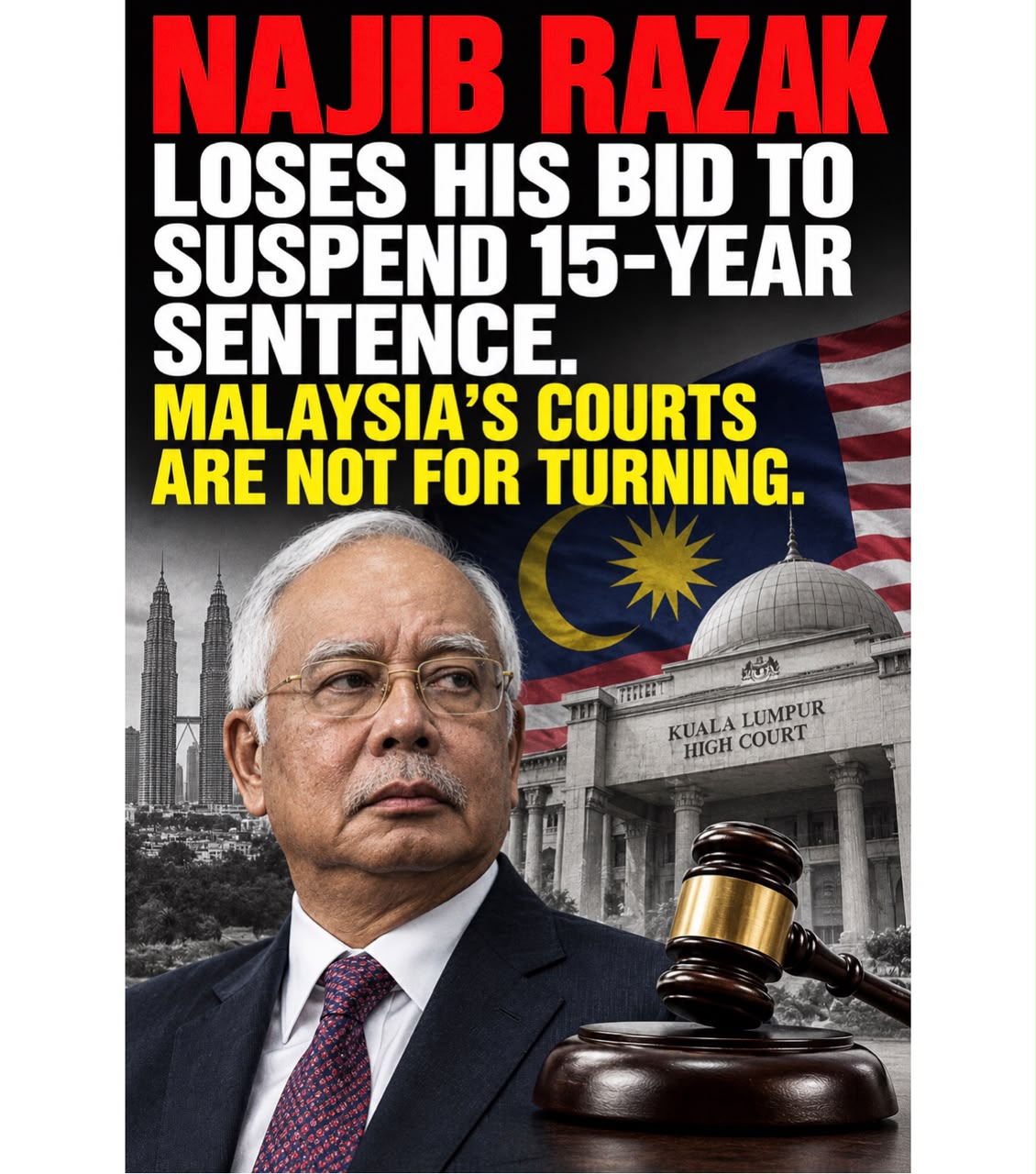
Malaysia’s former Prime Minister Najib Razak suffered another judicial setback on Wednesday when the Kuala Lumpur High Court refused to suspend his 15-year prison sentence and RM11.38 billion fine arising from the 1MDB corruption scandal. The ruling leaves the former leader confronting a second substantial prison term even as legal arguments continue over the possibility of serving the remainder of his existing sentence under house arrest.
Malaysia’s former Prime Minister Najib Razak has failed in his attempt to suspend a 15-year prison sentence and an accompanying fine of RM11.38 billion arising from his conviction in the 1Malaysia Development Berhad corruption scandal. The Kuala Lumpur High Court rejected his application on Wednesday, October 14, finding that he had not established the special circumstances necessary to justify suspending the punishment pending appeal. The ruling represents another significant setback for a former national leader whose political influence remains considerable despite his imprisonment. It also reinforces the distinction between the constitutional power of pardon and the authority of the courts to determine criminal liability.
Najib’s lawyers had argued that his medical circumstances, the magnitude of the financial penalty and the legal issues arising from his conviction justified a stay of execution. High Court Judge Noor Ruwena Md Nurdin was not persuaded that those considerations satisfied the applicable legal requirements. The court took account of the seriousness of the offences and the wider public interest in the enforcement of criminal judgments. Najib’s legal team has indicated that it intends to pursue further proceedings before the Court of Appeal.
Submit Your Press Release
Get your company news, announcements, launches, appointments and events in front of a wider audience.


The former Prime Minister has been imprisoned since August 2022 following his conviction in the separate SRC International corruption case. That conviction originally carried a 12-year prison sentence, subsequently reduced to six years through a royal pardon granted in 2024. The pardon also reduced the financial penalty imposed in that case, while separate proceedings concerning a purported royal direction have raised the possibility of Najib serving part of his remaining sentence under house arrest. Those developments have generated substantial political and constitutional controversy in Malaysia, particularly concerning the relationship between the monarchy, the executive and the judiciary.
The difficulty for Najib is that the SRC conviction is not the only criminal judgment confronting him. In December 2025, he was convicted of four counts of abuse of power and 21 counts of money laundering arising from the wider 1MDB scandal. The effective prison sentence imposed was 15 years, with the terms ordered to run concurrently, and the financial penalty amounted to approximately RM11.38 billion. That sentence is expected to commence after the completion of his existing custodial term, making the consequences of Wednesday’s ruling particularly significant.
The 1MDB scandal exposed an extraordinary series of financial transactions involving a Malaysian state investment fund established during Najib’s administration. Investigations conducted across several jurisdictions examined the movement of enormous sums through international financial institutions and the acquisition of luxury assets. Najib has maintained that he was misled by others and has consistently denied criminal wrongdoing. Nevertheless, his convictions remain subject to the legal consequences determined by the courts unless overturned through the appellate process.
The political implications are substantial because Najib’s United Malays National Organisation remains an important component of Prime Minister Anwar Ibrahim’s governing coalition. Anwar’s administration has promoted institutional reform and the strengthening of public accountability, yet it depends upon political arrangements involving individuals and parties with differing views about Najib’s treatment. That tension is not unique to Malaysia, where coalition politics frequently requires uncomfortable compromises. The more important question is whether those compromises are permitted to influence the administration of justice.
For Sri Lanka, the Malaysian experience provides a useful comparison at a time when former political leaders and their associates are increasingly facing investigations and criminal proceedings. Political popularity cannot provide immunity from prosecution, but neither should public hostility towards a former leader justify denying the protections available to every accused person. The right to appeal, the presumption of innocence where applicable and the requirement of fair judicial proceedings remain fundamental. Those principles do not become less important merely because the accused once exercised considerable political power.
The distinction between clemency and judicial determination is equally important. A royal pardon may alter the consequences of a particular conviction, but it does not automatically extinguish liability arising from separate criminal proceedings. Malaysia’s courts must determine the issues before them according to law, irrespective of the political implications for the governing coalition. Be that as it may, Najib’s continuing influence has not persuaded the High Court to suspend his latest sentence, and his legal battle must now continue through the appellate process.



