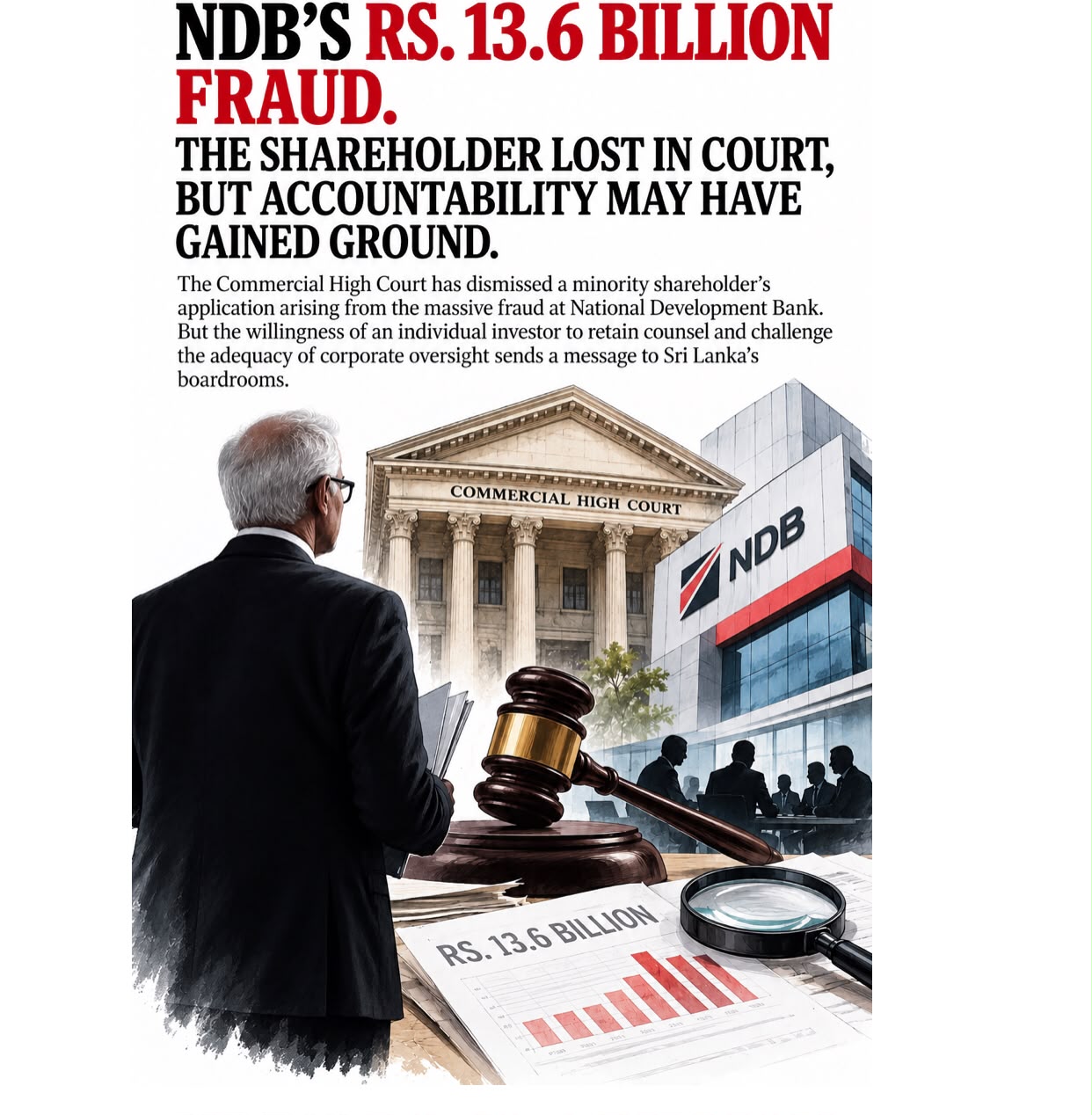
The Commercial High Court has dismissed a minority shareholder’s application arising from the massive fraud at National Development Bank. But the willingness of an individual investor to retain counsel and challenge the adequacy of corporate oversight sends a message to Sri Lanka’s boardrooms. Shareholders, however modest their holdings, are beginning to ask difficult questions. And they are entitled to answers.
The dismissal of a shareholder’s application by the Commercial High Court in the National Development Bank fraud matter deserves to be examined beyond the immediate outcome of the litigation. The petitioner lost his application and was ordered to pay costs. The Court found that the legal requirements for allowing him to pursue proceedings independently of the bank’s directors had not been satisfied. That is the judicial determination, and it must be respected.
But there is another aspect of this case that deserves attention. A minority shareholder, M. Thiyagaraja, considered the circumstances surrounding one of Sri Lanka’s largest reported internal banking frauds sufficiently serious to retain legal counsel and seek judicial intervention. He questioned whether those entrusted with safeguarding the institution had exercised adequate vigilance.
Submit Your Press Release
Get your company news, announcements, launches, appointments and events in front of a wider audience.


That willingness to challenge corporate conduct is significant in a market where minority shareholders have often appeared content to leave governance to controlling interests, institutional investors and boards of directors.
The size of a shareholding does not determine the legitimacy of a shareholder’s concerns. A person holding a relatively small investment has a financial interest in the company and a legitimate expectation that its affairs will be conducted responsibly. The law places conditions on the remedies available to shareholders, but it does not require them to abandon their interest in accountability merely because their holdings are modest.
The arguments advanced in the NDB proceedings concerned corporate governance, internal controls and the responsibilities of directors and auditors. These were substantial issues arising from a fraud whose financial impact, according to the final forensic findings, reached approximately Rs. 13.64 billion.
On October 9, Commercial High Court Judge Viraj Ranatunge dismissed the application, finding insufficient grounds to permit the petitioner to proceed independently of the bank’s directors. The Court took account of the bank’s response, including its complaint to the Criminal Investigation Department and the commissioning of a forensic audit.
Those actions were relevant to the legal question before the Court. They demonstrated that the institution had taken steps to address the matter following its discovery.
But there is an important distinction between responding to a fraud after its discovery and maintaining effective controls capable of preventing or detecting it in the first place.
The Court’s decision on the shareholder’s entitlement to proceed should not be confused with a comprehensive judicial determination that every aspect of the bank’s previous governance, supervision and internal controls was satisfactory.
Indeed, the subsequent forensic findings make continued examination particularly important.
The final forensic review, conducted by Deloitte Touche Tohmatsu India LLP, identified a financial impact of approximately Rs. 13.6 billion and weaknesses across several areas of the bank’s operations. These included transaction processing, management of user credentials, access controls, transaction monitoring, reconciliation, internal audit and operational risk management.
These findings are not, by themselves, proof that individual directors, executives or auditors breached their legal duties. Such conclusions require examination of their respective responsibilities, the information available to them and the applicable standards of care.
Nevertheless, the weaknesses identified are substantial enough to justify continued scrutiny.
There is also an important regulatory dimension.
The forensic audit was commissioned by NDB in consultation with the Central Bank, following recommendations from the regulator’s Director of Bank Supervision. The Central Bank had also directed the bank to strengthen its internal controls and governance processes.
That regulatory involvement is important. But it raises a further question: how effectively did the existing supervisory arrangements operate during the period in which the fraudulent transactions were taking place?
The matter came under sharp scrutiny at Parliament’s Committee on Public Finance, chaired by Dr. Harsha de Silva. Opposition MP Ravi Karunanayake was among those who questioned the effectiveness of the Central Bank’s banking supervision function and its failure to identify the irregularities earlier.
The Central Bank Governor, Dr. Nandalal Weerasinghe, offered an explanation that also deserves consideration. He described an organised concealment of fraudulent activity in which those responsible for answering questions about suspicious transactions were themselves allegedly involved in the wrongdoing.
The Governor explained that banking supervision relies substantially on the assurances provided by bank management, boards and auditors, rather than independently examining every underlying transaction.
That distinction is central to understanding the regulatory problem.
A supervisor cannot reasonably be expected to identify every dishonest transaction occurring within a licensed bank. Equally, the effectiveness of a supervisory system must be assessed by examining whether it was sufficiently alert to warning signs, unusual balances, control deficiencies and inconsistencies in the information supplied by supervised institutions.
If a sophisticated fraud can defeat internal audit, external audit, management oversight, board supervision and regulatory scrutiny over an extended period, the appropriate response is not simply to identify the individuals who allegedly committed it. It is also to examine how the safeguards intended to protect the institution were circumvented.
This is not an argument for finding everyone guilty. It is an argument for establishing what happened, identifying any failures of responsibility and ensuring that the lessons are not confined to a confidential report.
The Committee on Public Finance has also highlighted the public interest involved. Significant NDB shareholdings are held by institutions representing public and State funds. Consequently, the financial and governance implications extend beyond the bank’s immediate private shareholders.
It is equally important to recognise that the forensic review found no customer accounts had been affected by the fraud. The Central Bank has maintained that NDB continues to satisfy its regulatory capital and liquidity requirements.
Those assurances matter. Public confidence in a bank should not be undermined through speculation or unsupported allegations.
But confidence cannot depend upon reassurance alone. It must also rest upon credible governance, effective supervision and demonstrable corrective action.
The minority shareholder’s unsuccessful application therefore deserves to be understood in its proper context.
He did not obtain the Court’s permission to pursue the proposed proceedings. That outcome cannot be presented as a legal victory, nor can it be used to imply that the Court accepted his allegations.
What the proceedings do demonstrate is a willingness by an individual investor to use the legal mechanisms available to question corporate conduct. That is a development worth recognising, irrespective of whether this particular application satisfied the statutory requirements.
Sri Lanka’s corporate governance culture would benefit from more shareholders examining annual reports, questioning audit committees, attending general meetings and demanding clear explanations when serious financial irregularities emerge.
The right to ask questions does not guarantee the right to litigate on behalf of a company. Nor does an unsuccessful application establish that the questions themselves were unreasonable.
Be that as it may, there is a certain irony in a shareholder having to approach the courts to test the adequacy of corporate vigilance after Rs. 13.6 billion has already disappeared from the accounts.
The bank has taken steps since the fraud was discovered. The Central Bank has intervened. A forensic investigation has identified weaknesses. Parliament has examined the matter. These are important developments, and the respective institutions should be assessed fairly on the actions they have taken.
The remaining task is to establish whether the corrective measures are sufficient, whether further regulatory or professional action is warranted and whether the weaknesses identified have implications for supervision elsewhere in the banking system.
The Commercial High Court has determined the application before it. It has not been asked to write the final chapter on banking governance in Sri Lanka.
For the country’s directors, auditors, regulators and institutional investors, the message from this litigation should be clear. Shareholders are entitled to take an active interest in how their companies are managed, and even those with relatively small investments can demand explanations through the appropriate channels.
A shareholder may lose a case without losing the right to ask questions.
And a board may successfully resist litigation without being relieved of its continuing responsibility to account for the stewardship of the institution.
That is how corporate accountability ought to work.
The parliamentary account confirms the forensic findings and the governance deficiencies. The Central Bank’s statement confirms its involvement in commissioning the forensic review, while reporting of the COPF proceedings records the exchanges involving Ravi Karunanayake, Harsha de Silva and the Governor.